

This guide helps technical procurement teams buy Cortagen for research while keeping the page strictly focused on research-use-only documentation. Cortagen is indexed as H-Ala-Glu-Asp-Pro-OH, a short peptide entity with the molecular formula C17H26N4O9 and a computed molecular weight of 430.4 g/mol [1]. The purpose of this product-page guide is to connect Cortagen peptide identity, literature context, COA review, analytical testing, and lot-level documentation without implying consumer or applied biological outcomes.
Researchers evaluating where to buy Cortagen for research should start with batch-specific COA documentation, peptide identity, purity testing, lot traceability, RUO labeling, and supplier documentation consistency. Products discussed in this article are intended for laboratory research use only and are not intended for human or animal consumption. Scientific literature may inform research context, but product selection should stay grounded in documentation review.
The phrase buy Cortagen for research carries commercial intent, but the safe product-page interpretation is technical procurement. The page should help qualified laboratory buyers review research materials, not make claims about product performance.
That framing changes the SEO task. The article can address procurement questions, COA documentation, analytical testing, and Cortagen research literature while avoiding applied-use claims or consumer-oriented promises.
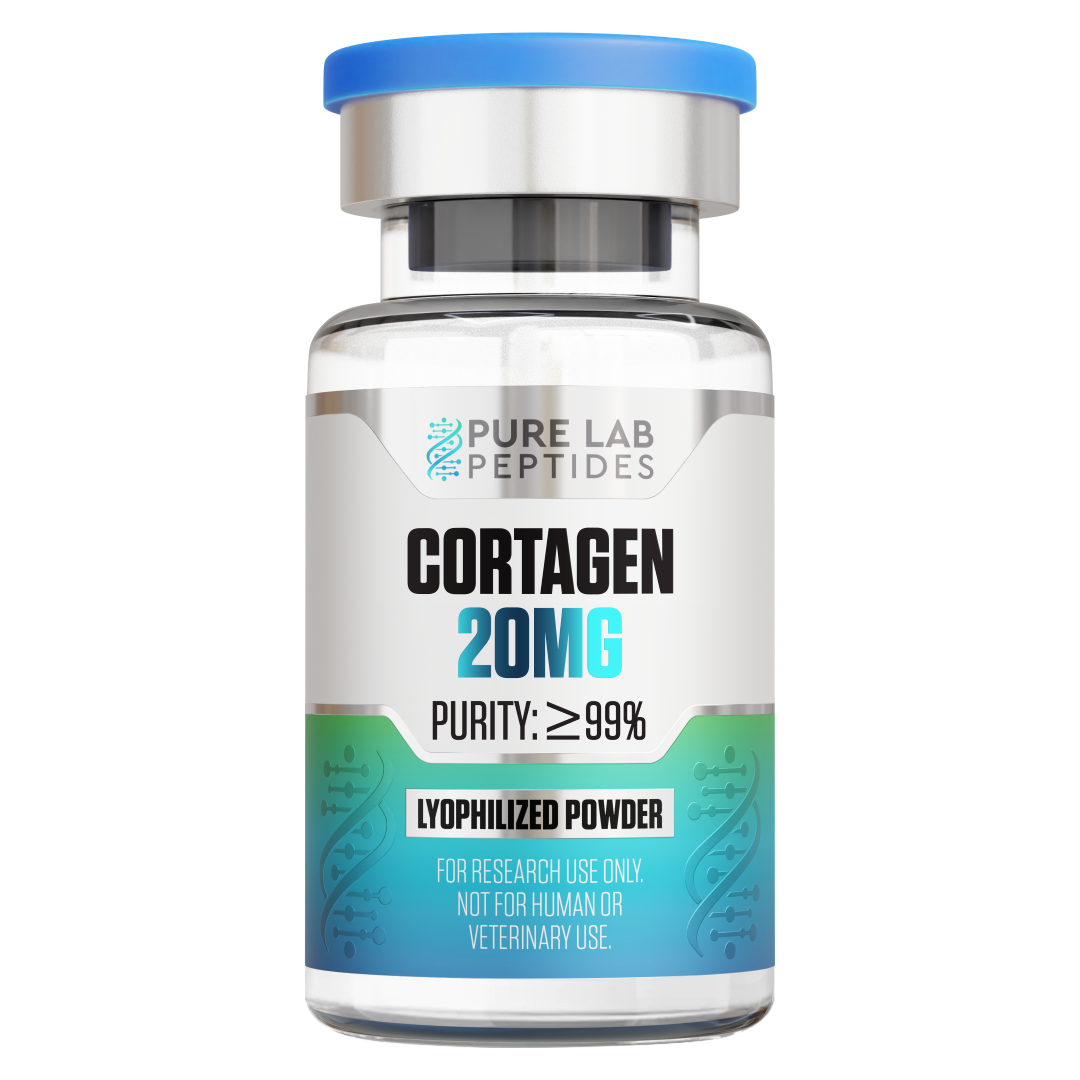
The first documents to review are the product label, batch-specific COA, lot identifier, purity method, identity method, and supplier documentation. For research compounds, the practical question is whether every document identifies the same Cortagen peptide material.
A useful documentation stack includes the compound name, amino acid sequence, molecular formula, molecular weight, COA date, and method notes. PubChem lists H-Ala-Glu-Asp-Pro-OH as C17H26N4O9 with computed molecular weight of 430.4 g/mol, which gives researchers a reference point for identity checks [1].
RUO labeling sets the page’s intended context before any scientific discussion begins. FDA guidance for in vitro diagnostic products describes RUO labeling as connected to laboratory research-phase materials that are not represented for diagnostic purposes, which is useful as a general example of why research-only labeling must remain clear [6].
For Pure Lab Peptides product content, RUO language should reinforce that the material is intended solely for laboratory research. It should not convert published literature into applied claims.
Cortagen appears in the literature as a synthetic tetrapeptide, with the sequence Ala-Glu-Asp-Pro. A PubMed-indexed microarray paper described the synthetic tetrapeptide Cortagen as obtained by directed synthesis based on amino acid analysis of a brain cortex peptide preparation [2].
This makes Cortagen a research peptide with a compact sequence profile. The article should therefore emphasize compound characterization, peptide structure, and documentation rather than broad product claims.

Cortagen peptide identity starts with sequence. The amino acid sequence Ala-Glu-Asp-Pro corresponds to the one-letter abbreviation AEDP, and each amino acid is represented as a residue within the peptide chain.
IUPAC defines peptides as amides derived from two or more amino carboxylic acid molecules joined by covalent bonds with formal loss of water [7]. IUPAC also describes an amino-acid residue as what remains of each amino acid after peptide formation [8].
A tetrapeptide contains four amino acid residues. Cortagen is a synthetic tetrapeptide because the cited Cortagen literature describes it as Ala-Glu-Asp-Pro and as obtained by directed synthesis [2].
That classification matters for SEO and documentation. It helps separate Cortagen research from unrelated peptide categories and keeps the product page focused on a specific canonical entity.
Cortagen research use should be framed around laboratory investigation, published literature, and technical documentation. It should not be framed as a consumer buying guide.
For Pure Lab Peptides, the product-page value is clarity. Researchers need enough information to evaluate identity, COA consistency, and research-lane relevance without crossing into applied-use language.
Research use means the page presents the material as a laboratory research compound. It can discuss compound identity, literature context, analytical testing, and documentation review.
It should not become a personal decision guide. A research-use page is strongest when it answers documentation questions: what is the compound, how is identity supported, and what should a lab retain in its records?
Documentation-focused copy reduces ambiguity. It keeps the commercial page aligned with peptide COA review, lot traceability, and research procurement rather than unsupported claims.
This is especially important for lab peptides with literature in neurobiology, cellular models, or gene expression research. Published findings can guide source review, but they should not become product positioning.
Cortagen fits the short peptide and peptide bioregulator research lane. Published short regulatory peptides are often discussed in relation to gene expression, peptide-DNA interaction hypotheses, and cellular signal models [3].
The safer product-page angle is not to state what Cortagen does in a system. The safer angle is to explain how researchers can document what Cortagen is.
Molecular weight supports identity review by giving procurement teams a value to compare across documentation. PubChem lists H-Ala-Glu-Asp-Pro-OH with computed molecular weight of 430.4 g/mol [1].
This does not prove identity by itself. It becomes more useful when paired with amino acid sequence, molecular formula, LC-MS documentation, and the batch-specific certificate of analysis.
AEDP is the one-letter sequence abbreviation for Ala-Glu-Asp-Pro. In Cortagen documentation, AEDP should match the full sequence, the compound name, and the expected molecular identifiers.
A mismatch across product page, COA, label, or batch documentation should trigger a documentation review. For research buyers, sequence consistency is a practical safeguard.
Khavinson peptide research has discussed short peptides as small signaling-related molecules in gene expression and protein synthesis literature [3]. Cortagen appears in that broader literature as a synthetic tetrapeptide investigated through gene-expression methods [2].
The key research boundary is simple. Literature about short peptide models can support topical context, but it should not be written as a claim about a supplied RUO material.
A systematic review of peptide regulation of gene expression describes short peptides as 2–7 amino acid residues in one discussed classification and reviews DNA, histone, and gene-expression topics [3]. That review also discusses peptide regulation across multiple experimental systems.
For Cortagen, this helps build semantic context around short peptide research. It does not establish product-specific claims for a research material.
Bioregulatory peptide context can clarify why gene expression, signal pathway, and tissue-specific terminology appears in Cortagen research discussions. It helps explain the research lane.
It should not be used to infer outcomes. A product page should treat bioregulatory peptide language as literature context, then return to identity, COA, analytical testing, and RUO boundaries.
The Cortagen microarray study examined gene expression in a preclinical tissue model and reported changes across a limited group of transcripts [2]. Broader short peptide literature also reviews peptide interactions with DNA, histones, and transcription-related mechanisms [3].
For product-page writing, signal pathway research should be model-specific. It should avoid transforming a pathway association into a product claim.
Tissue-specific gene expression refers to gene activity measured in a defined biological context. The Cortagen microarray paper examined expression patterns in a specific tissue model rather than making a general product-page claim [2].
That distinction matters. A research model can generate observations, but product-page copy should not generalize those observations beyond the study context.
Pathway research can identify a molecular or cellular context, but it does not automatically support claims for research materials. In broader short peptide literature, terms such as cellular stress, apoptosis, gene expression, and oxidative stress may appear as model-level research concepts [3].
A safe RUO interpretation keeps those terms inside literature discussion. It should not state or imply that Cortagen peptide materials create the same findings in every laboratory setting.
Cortagen research belongs in a literature lane that includes in vitro laboratory research, preclinical research, and molecular documentation. Broader short-peptide studies have used cell culture models to evaluate differentiation markers and gene-expression-related endpoints [9].
This does not create a product-use claim. It only shows that same-lane short-chain peptide literature often uses experimental model systems.
In vitro models can clarify how researchers design controlled observations around cellular markers, peptide signaling concepts, or gene expression endpoints. A cell model can support mechanistic questions while keeping interpretation narrow.
For Cortagen research, in vitro language should stay tied to study design. It should not imply broad claims about a product listing.
A research model is a context, not a guarantee. Different methods, materials, endpoints, and analytical controls can produce different findings.
That is why this page treats published literature as a source-quality layer. Procurement teams should separate literature review from COA review, because each answers a different question.
Researchers should interpret Cortagen literature by asking what model was used, which endpoint was measured, and how directly the finding relates to compound identity. The Cortagen microarray study used cDNA microarray analysis to examine transcript patterns, making it useful for literature context but not a substitute for batch documentation [2].
A safer reading keeps the evidence level visible. The page should avoid turning study findings into sales claims.
Useful study design signals include model type, assay method, controls, endpoint definition, sample context, and limitations. In gene-expression literature, microarray or PCR-style approaches should be interpreted as measurement methods rather than product validation methods.
Analytical product documentation is different. HPLC, LC-MS, and COA records help review the supplied research material, while literature studies examine experimental questions.
An evidence ladder helps keep interpretation organized.
| Research Area | What Literature Examines | Evidence Type | RUO Interpretation |
|---|---|---|---|
| Cortagen identity | Sequence and synthetic tetrapeptide description [2] | Compound description | Supports canonical entity review, not applied claims |
| Short peptide gene expression | DNA, histone, and gene-expression concepts in short peptide literature [3] | Review literature | Provides same-lane context |
| Cell model research | Short peptides in controlled cellular differentiation models [9] | In vitro research | Supports model-specific interpretation |
| Analytical documentation | Fit-for-purpose validation principles for identity and purity methods [10] | Analytical guidance | Supports COA and method review |
| Peptide testing | HPLC and LC-MS use in peptide separation and characterization [4], [5] | Analytical chemistry | Supports purity and identity evaluation |
The table does not rank suppliers or make product claims. It shows which question each evidence type can answer.

Published literature and product claims are not the same thing. Literature may examine gene expression, cellular signaling, or peptide structure, while product-page copy should focus on the research material’s documentation.
Some phrases related to peptide effects or product performance can become claims if separated from model-specific literature context. RUO pages should keep those phrases controlled and return to COA review, analytical testing, identity confirmation, and lot traceability.
Claim-boundary control means every scientific statement should remain tied to its source and evidence level. A microarray finding, for example, should be described as a study observation within a defined research model [2].
For product pages, the safer language is “published literature has examined” or “researchers have investigated.” It is not safe to present the product listing as delivering the same study findings.
Product-page copy should emphasize Cortagen peptide identity, certificate of analysis review, lab documentation, research-use labeling, and batch records. These elements match commercial research intent without implying applied outcomes.
A useful product page also explains uncertainty. Literature can guide research context, while analytical documentation supports evaluation of the material supplied.
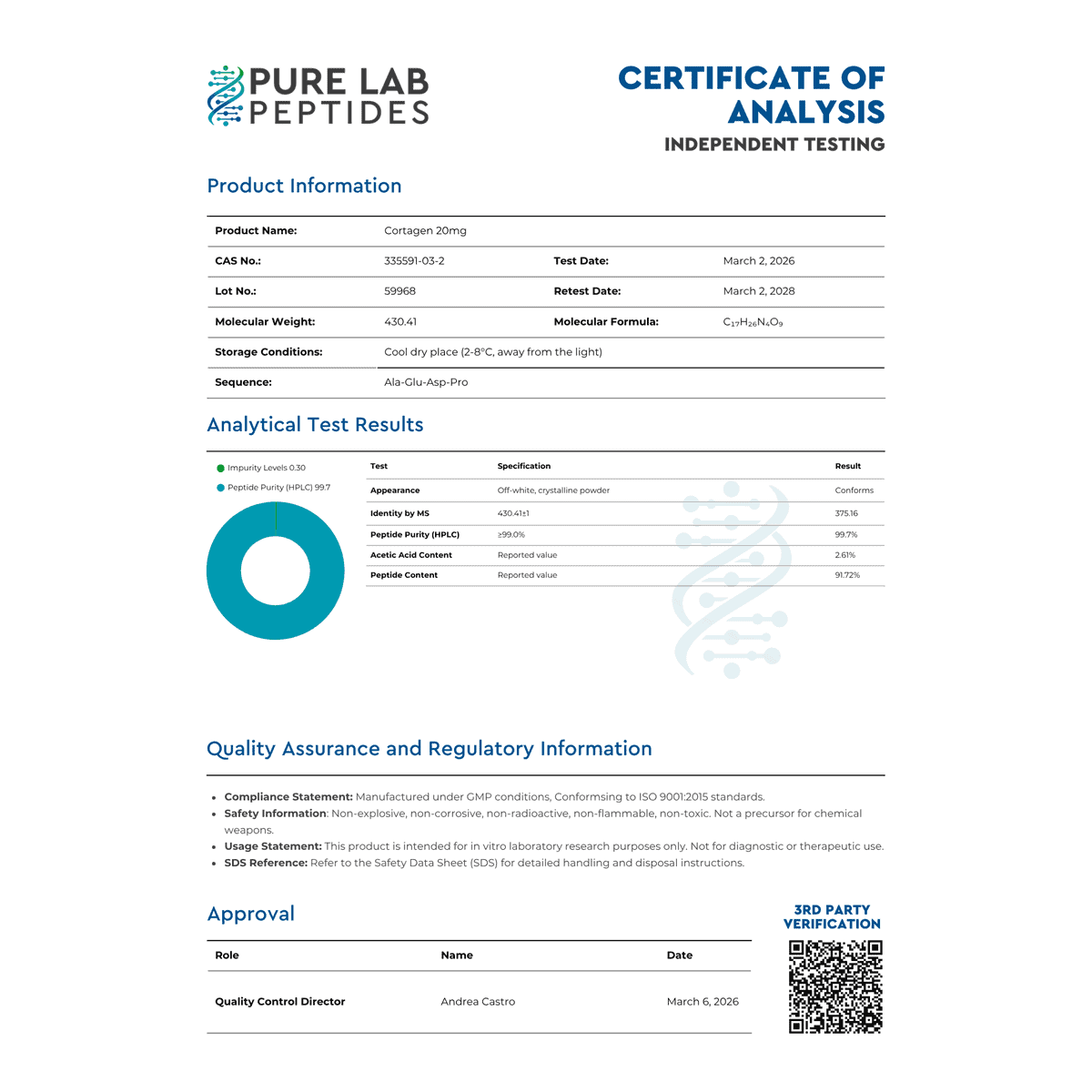
COA documentation matters because it links the Cortagen research material to a specific batch. A certificate of analysis should help reviewers connect lot number, compound name, purity method, identity method, and date.
Analytical guidance from ICH Q2(R2) frames validation around whether an analytical procedure is fit for its intended purpose and identifies common analytical purposes such as purity, impurities, identity, and quantitative or qualitative measurement [10]. That principle supports careful review of COA methodology.

A certificate of analysis should confirm the compound name, batch or lot identifier, purity value, method type, testing date, and identity support. FDA analytical-method guidance discusses documentation of identity, quality, purity, and related analytical data in regulated contexts, which helps explain why documentation quality matters in laboratory review [11].
For Cortagen research procurement, the key is consistency. The COA should match the product label and product-page research material listing.
COA review should not stop at a single percentage value. The reviewer should check whether the method is named, whether the lot is specific, and whether identity testing is represented clearly.
Peptide reference-standard literature also highlights the role of RP-HPLC in assessing homogeneity, stability, identity, content, and purity for peptide reference standards [12]. That reinforces why method context matters.
Batch-specific documentation helps lab teams connect the material received to the record being reviewed. Without that connection, a COA may not answer the procurement question.
For lab peptides, the lot number is the bridge. It should appear consistently across COA, label, and supplier documentation.

Purity and identity are related, but they are not identical. Purity review asks about the proportion of the main detected component under a method, while identity review asks whether the material matches the expected Cortagen peptide entity.
ICH Q2(R2) lists purity and identity as common purposes for analytical procedures [10]. For a Cortagen peptide page, that distinction should be clear.
HPLC can support peptide purity review by separating components and producing chromatographic data. A peer-reviewed methods chapter describes major modes of HPLC used for peptides, including size-exclusion, ion-exchange, reversed-phase, and mixed-mode approaches [4].
In product documentation, HPLC is most useful when the COA gives method context. A purity value without method context is less informative than a purity value tied to a batch and chromatographic record.
LC-MS supports identity review by pairing liquid chromatography with mass spectrometry. A 2021 review proposed LC-MS workflows for characterizing synthetic peptide impurities, and related LC-HRMS literature describes peptide identification, characterization, separation, and quantification of peptide-related impurities [5], [13].
For Cortagen research, LC-MS documentation can help compare observed mass information with expected molecular data. It should be read with the COA, not in isolation.
Analytical testing can support identity, purity, impurity profiling, and batch documentation when the method is appropriate. It cannot by itself replace all supplier documentation.
A numbered lab-test verification workflow can stay documentation-focused:
Lot traceability helps research buyers connect a specific research material to its supporting documentation. It also helps prevent confusion between a general product description and a batch-specific record.
Analytical-method guidance emphasizes that reference materials or suitably characterized materials with documented identity and purity may be part of validation work [10]. In supplier review, that principle supports attention to documented identity and batch traceability.
Research buyers should compare the product name, lot number, sequence, molecular formula, molecular weight, COA date, analytical methods, and storage documentation. Any mismatch deserves clarification before procurement decisions are finalized.
For Cortagen, the expected sequence is Ala-Glu-Asp-Pro, and the PubChem-indexed formula for H-Ala-Glu-Asp-Pro-OH is C17H26N4O9 [1]. Those identity anchors should align with product documentation.
Labeling consistency matters because it reduces ambiguity. If the product page says Cortagen, the COA says Cortagen peptide, and the label identifies the same lot, the documentation tells a clearer story.
If the naming or lot details diverge, the research buyer should pause. Documentation consistency is a procurement quality signal.
Storage documentation helps preserve a record of how the research material should be managed in a laboratory inventory system. Many peptide materials are supplied as lyophilized peptide materials, and documentation should state storage conditions clearly.
Peptide stability literature describes physical stability as influenced by intrinsic sequence factors and external conditions [14]. Lyophilization literature also discusses freeze-drying as a common approach for stabilizing protein and peptide-related materials in pharmaceutical development contexts [15].
Lyophilized peptide documentation should include product name, lot number, storage conditions, label status, COA availability, and any handling notes suitable for laboratory inventory records. It should not drift into applied-use guidance.
For Cortagen research materials, storage documentation is part of traceability. It helps the laboratory maintain a consistent record from receipt to archive.
Stability notes should be treated as documentation, not as an outcome claim. They help laboratories plan inventory control and recordkeeping.
Because peptide stability can depend on sequence and external conditions, the product page should avoid broad guarantees [14]. Batch documentation and supplier storage notes are more useful than generic statements.
A research procurement checklist keeps commercial intent safe and useful. It turns “buy” intent into a documentation-first workflow.
Before researchers buy Cortagen for research, they should evaluate whether the product page, COA, analytical testing, and label language stay aligned with RUO positioning.
Use this quality and documentation checklist:
Procurement confidence comes from matching records, not from hype. A clear Cortagen research material listing should give qualified researchers enough documentation to review identity, purity, lot traceability, and research-use status.
For peptide research materials, HPLC and LC-MS references can support analytical interpretation when the method and batch are clearly connected [4], [5]. The COA should make that connection visible.
Catalog amounts should stay separate from SEO targeting because they are listing specifications. A Cortagen 20mg catalog descriptor should not become a separate content strategy or research instruction.
Common misunderstandings to avoid include: published literature is not product-use guidance; preclinical findings are not product-page claims; a purity value does not prove complete identity; a COA should be batch-specific; RUO labeling does not support personal-use positioning; pathway relevance is not a product claim.
The next step is to review documentation before selecting any RUO peptide. A strong review compares product page, label, COA, lot details, analytical testing, and storage notes.
Pure Lab Peptides supplies compounds for laboratory research use only. Products are not intended for human or animal consumption, diagnostic use, therapeutic use, clinical use, veterinary use, or as food, drugs, cosmetics, dietary supplements, or household products. Researchers are responsible for ensuring lawful, appropriate handling and use in accordance with applicable regulations and institutional guidelines.
Teams should review Cortagen peptide research materials as a documentation package. The package should include identity anchors, COA details, analytical testing references, lot traceability, and storage documentation.
A useful final check is whether every document supports the same canonical entity. Cortagen should remain the canonical target, not a collection of variant pages.
Lab teams should save the product listing, COA, lot information, storage notes, and any analytical documentation available for the batch. They should also save internal review notes showing that RUO boundaries were checked.
Review the product-page documentation, COA details, and RUO labeling before evaluating this compound for laboratory research.
Cortagen is a research peptide described as a synthetic peptide with the sequence Ala-Glu-Asp-Pro, also represented as AEDP [2]. In sequence terms, alanine, glutamic acid, aspartic acid, and proline define the compound’s identity markers. Product-page discussion should focus on compound characterization, research documentation, and batch records.
Research use only means Cortagen is intended for controlled laboratory research contexts, not applied consumer or clinical settings. For research purposes, the page should emphasize RUO labeling, supplier documentation, batch-specific documentation, and analytical review. This framing helps keep the product page focused on documentation rather than claims beyond the research setting.
Researchers should consider documentation first before they buy Cortagen for research. The key review areas are COA availability, lot traceability, peptide identity, analytical testing, storage documentation, and consistency across the product listing and batch records. A strong procurement review should confirm that the material is presented as a research compound with clear RUO positioning.
A COA matters for Cortagen research materials because it connects a specific batch to identity, purity, testing method, lot number, and documentation date. It helps technical procurement teams compare the product label with batch-specific documentation. A COA should support research documentation review, but it should not be treated as a substitute for literature interpretation.
Published literature about Cortagen should be interpreted as research context, not product-positioning language. A cited Cortagen study examined gene-expression patterns in a defined research model [2], while broader short peptide literature discusses gene-expression regulation across experimental systems [3]. Those findings should remain tied to research models and should not be converted into product claims.
Analytical methods support Cortagen documentation review by helping evaluate peptide identity and purity. HPLC can support peptide purity review through chromatographic separation, while LC-MS can support identity review through mass-based characterization when paired with suitable batch records [4], [5]. These methods are most useful when linked to the COA and supplier documentation.
The following authors are recognized for published research that helped shape the scientific context discussed in this article.
Author profile: RUDN Journal of Medicine Profile
Vladimir Khatskelevich Khavinson is recognized for published work in short peptide and bioregulator peptide research that helps frame Cortagen within a sequence-based research lane. His publications are relevant to Cortagen because they include a PubMed-indexed Cortagen study and broader short-peptide literature on peptide synthesis, molecular interaction models, and gene expression. For this article, that work helps support research documentation, peptide identity, sequence review, and literature interpretation. It also provides background for separating model-specific findings from product-page claims while keeping the page focused on RUO documentation. The emphasis here is scientific context, not product validation.
Selected publications:
Author profile: CU Anschutz Profile
Robert S. Hodges is recognized for published analytical-method work relevant to peptide HPLC, peptide synthesis, amino acid analysis, mass spectrometry, and characterization of peptides and proteins. His publications help frame the analytical side of the Cortagen page, especially the difference between peptide purity, peptide identity, method context, and batch documentation. This work is useful for explaining why COA review should consider the named analytical method, not just a single purity value. It also supports the documentation-focused discussion of HPLC and related separation workflows in research peptide evaluation. The section remains focused on laboratory records and analytical characterization.
Selected publications:
This research disclaimer clarifies how this page handles published literature and search language around Cortagen. In bioregulator peptide research content, terms such as nootropic, cognitive enhancement, mental clarity, brain health, nasal spray, peptide therapy, and neuroprotective effects can drift into consumer-facing, administration-focused language, wellness language, therapeutic language, or product-claim language when framed incorrectly. Similar care applies to phrases such as effects of Cortagen, efficacy of Cortagen, absorption, bioavailability, and clinical outcomes, which should remain tied to model-specific research interpretation rather than product positioning.
Here, those phrases are handled only as research-language examples, not product claims, outcomes, instructions, or recommendations. The focus remains on Cortagen identity, COA review, analytical testing, peptide purity, lot traceability, RUO labeling, product documentation, and published literature boundaries. Any discussion of central nervous system, receptor signaling, or neurotransmitter-related literature should be read as research context for evaluating documentation and study language, not as a statement about a research material’s purpose beyond laboratory review.
Discount Applied Successfully!
Your savings have been added to the cart.




There are no reviews yet.