


$284.99
Research Studies:


FREE Shipping on
orders over $200
ALL ARTICLES AND PRODUCT INFORMATION PROVIDED ON THIS WEBSITE ARE FOR INFORMATIONAL AND EDUCATIONAL PURPOSES ONLY. The products offered on this website are intended solely for research and laboratory use. These products are not intended for human or animal consumption. They are not medicines or drugs and have not been evaluated or approved by the FDA to diagnose, treat, cure, or prevent any disease or medical condition. Any form of bodily introduction is strictly prohibited by law.
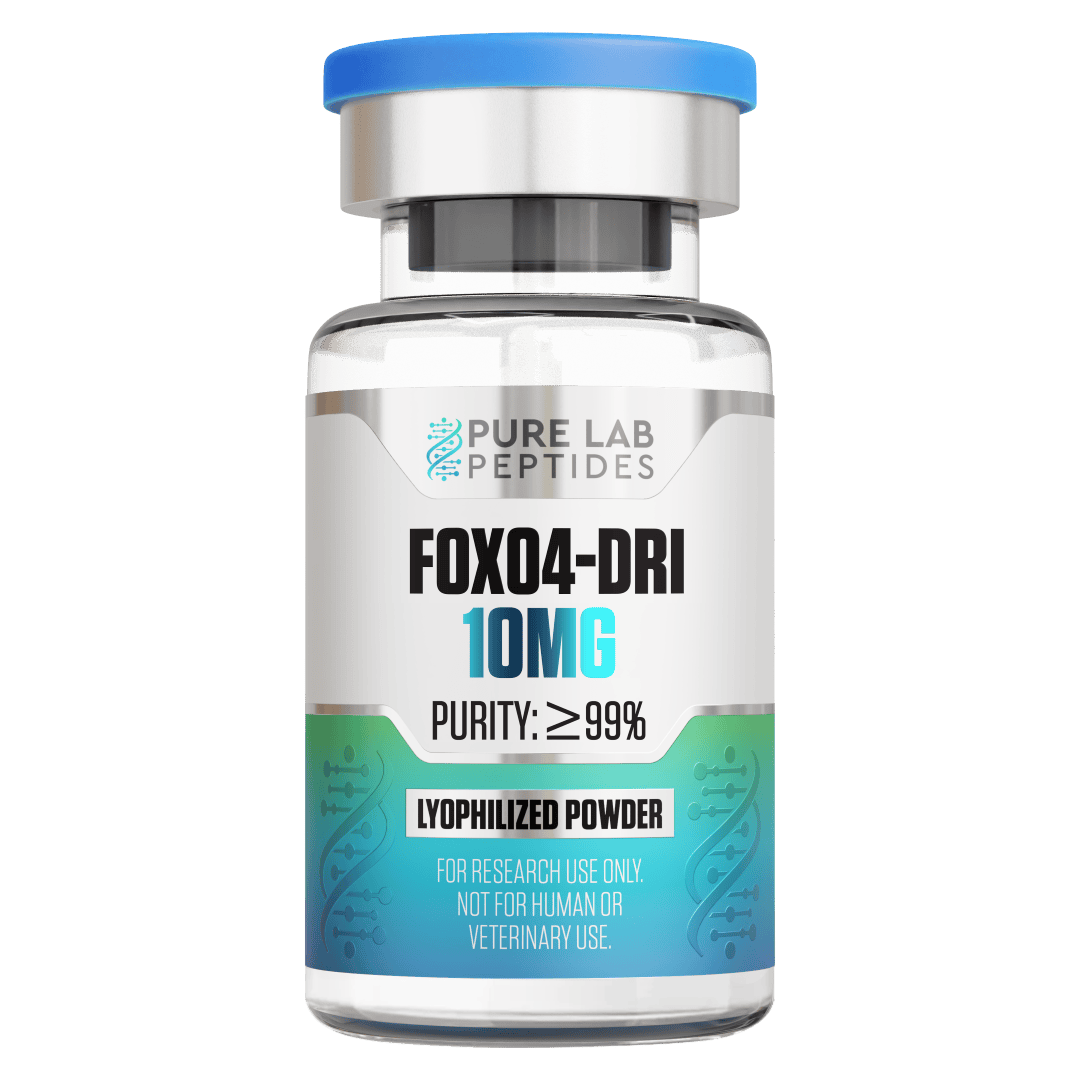
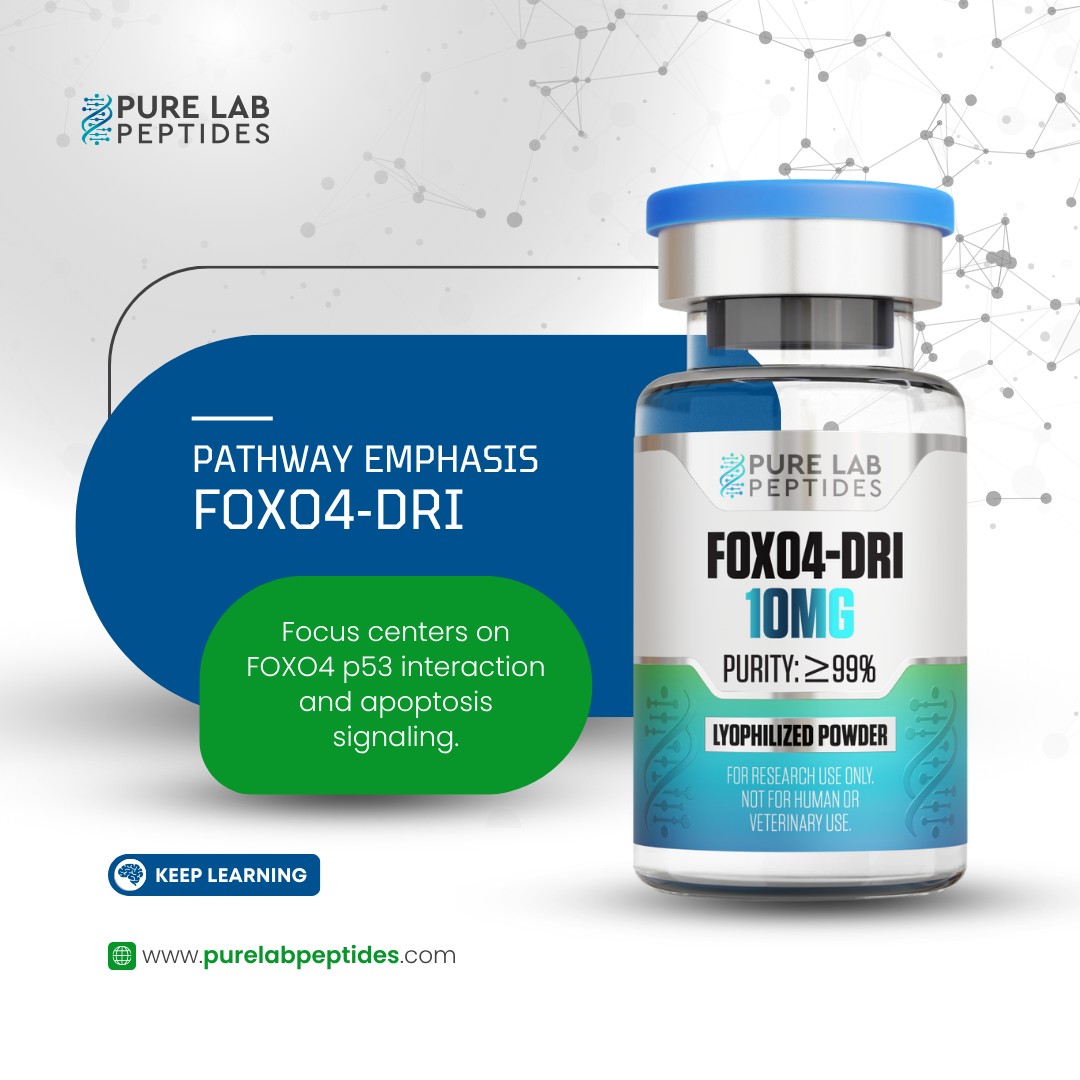
FOXO4-DRI 10mg (Proxofim) is a research-use-only laboratory material supplied for controlled research workflows, compound characterization, and analytical documentation review. It is manufactured under rigorous quality standards to support consistency, traceability, and batch-specific verification for qualified laboratory settings.
FOXO4-DRI 10mg (Proxofim) is intended strictly for laboratory research use only. This product is not intended for human or animal consumption, therapeutic use, diagnostic use, clinical use, veterinary use, or as a food, drug, cosmetic, dietary supplement, or household product.
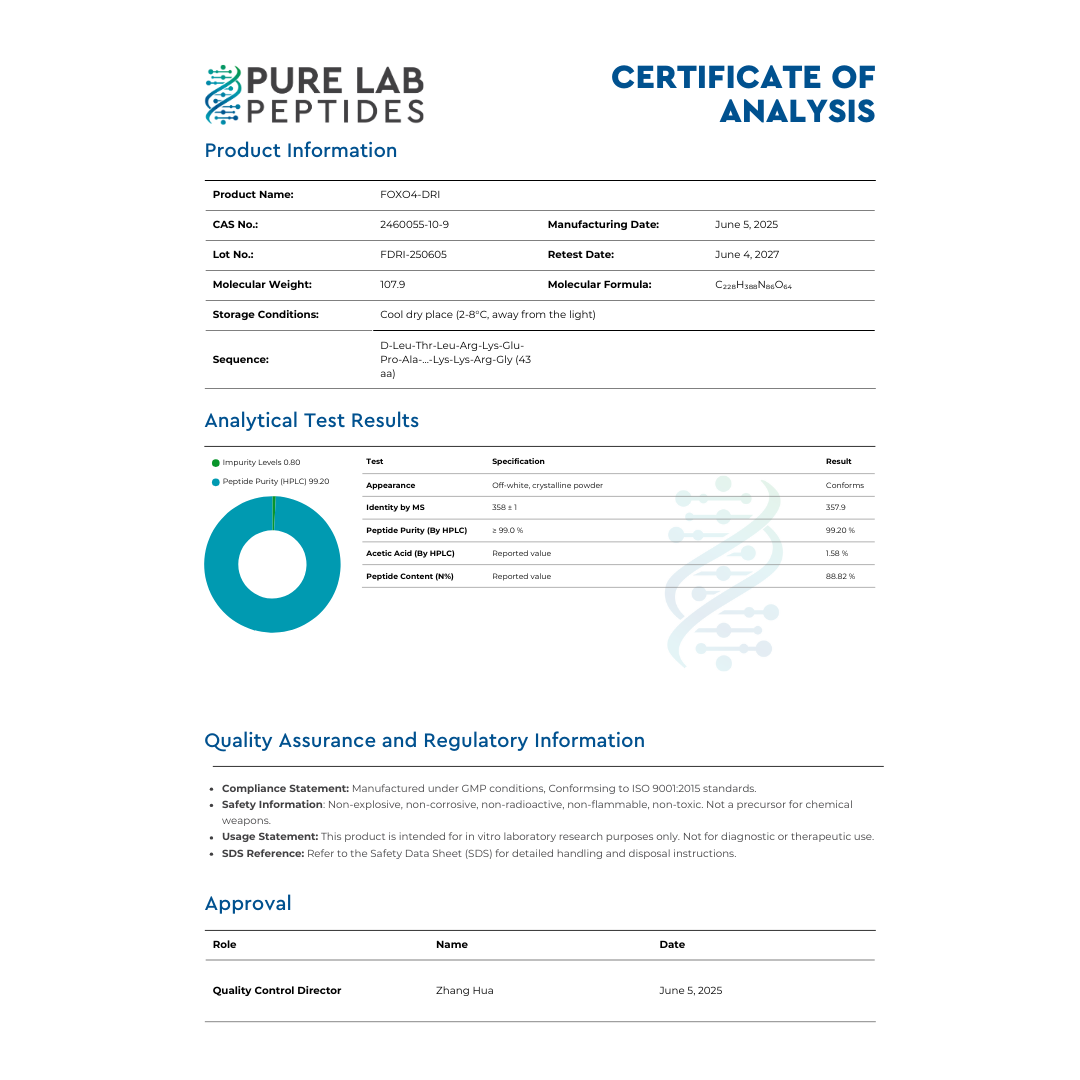
| CAS No. | 2460055-10-9 |
|---|---|
| Purity | ≥99% |
| Sequence | D-(Leu-Thr-Leu-Arg-Lys-Glu-Pro-Ala-Ser-Glu-Ile-Ala-Gln-Ser-Ile-Leu-Glu-Ala-Tyr-Ser-Gln-Asn-Gly-Trp-Ala-Asn-Arg-Arg-Ser-Gly-Gly-Lys-Arg-Pro-Pro-Pro-Arg-Arg-Arg-Gln-Arg-Arg-Lys-Lys-Arg-Gly) |
| Molecular Formula | C₂₂₈H₃₈₈N₈₆O₆₄ |
| Molecular Weight | 358.06 g/mol |
| Applications | Senescence research, anti-aging studies, degenerative disease models |
| Synthesis | Solid-phase synthesis |
| Solubility | Soluble in water or 1% acetic acid |
| Stability & Storage | Stable for up to 24 months at -20°C. After reconstitution, may be stored at 4°C for up to 4 weeks or at -20°C for up to 6 months. |
| Appearance | White lyophilized powder |
| Shipping Conditions | Shipped at ambient temperature; once received, store at -20°C |
| Regulatory/Compliance | Manufactured in a facility that adheres to cGMP guidelines |
| Safety Information | Refer to provided MSDS |
Consider these supplementary peptides for a comprehensive research approach.
Pure Lab Peptides created this guide for research teams evaluating where to buy FOXO4-DRI Peptide for research while keeping the review limited to RUO documentation, compound identity, and analytical records. FOXO4-DRI appears in cellular senescence literature as a D-retro-inverso peptide studied around FOXO4-p53 interaction models, not as a consumer-facing product claim [3], [4], [5]. This article explains how to interpret the literature, review a certificate of analysis, and compare lot-level records without shifting into personal, therapeutic, or clinical-use framing.
Researchers looking to buy FOXO4-DRI Peptide for research should first verify RUO labeling, batch-specific COA data, peptide identity records, and analytical testing support. Products discussed in this article are intended for laboratory research use only and are not intended for human or animal consumption. The safest commercial research review starts with documentation, not claims.
A shortened commercial query like buy FOXO4 only becomes appropriate for this page when it is reframed as research procurement intent. The safer search target is buy FOXO4-DRI Peptide for research because it keeps the page tied to compound documentation, RUO labeling, certificate of analysis review, and laboratory research context.
That distinction matters. FOXO4-DRI is discussed in published senescence research as a synthetic peptide connected to FOXO4-p53 interaction models, but that literature does not define a consumer purpose for an RUO research material [3], [4].
Start with the product name, lot number, label language, and batch-specific COA. A certificate of analysis should identify what was tested, which analytical method was used, when the test was performed, and whether the lot record matches the product listing.
For a research peptide, the strongest documentation set usually combines identity information, purity information, lot traceability, and storage records. Analytical validation guidance treats identity, purity, assay, and impurity testing as distinct analytical purposes, so a single number should not be read as the whole documentation story [12].
RUO labeling keeps procurement review aligned with research purposes. It tells laboratory buyers that the material belongs in controlled research settings and that the product page should stay focused on documentation, analytical testing, and literature context.
A useful rule is simple: if a phrase sounds like a product effect or product performance statement, it needs to be separated from the research-use-only product listing. RUO product pages should answer documentation questions before commercial questions.
FOXO4-DRI Peptide belongs in a research-use-only framework. In this context, the product-page article can discuss peptide identity, pathway literature, analytical testing, and research documentation, but it should not position the compound for personal, therapeutic, diagnostic, clinical, veterinary, wellness, cosmetic, or fitness purposes.
Official RUO labeling rules in the IVD context show why research-only wording must stay tied to intended research settings and separate from diagnostic claims [18]. That regulatory example is not a product classification for this peptide; it is a useful documentation principle.
RUO positioning means the article discusses FOXO4-DRI as a laboratory material. It can explain what researchers should review before procurement, how published literature frames senescence models, and what records support compound identity.
It does not turn literature into product-use guidance. It also does not imply that a Pure Lab Peptides research material is approved, cleared, or intended for any non-research context.
Laboratory research framing keeps the page anchored to what can be checked. Researchers can check a COA, purity method, LC-MS identity support, lot number, storage documentation, and RUO label consistency.
They should not treat the product page as a claim summary. Even when a paper discusses apoptosis in senescent cells, that phrase belongs to the model-specific literature and must not become a product claim for research-use-only materials [3], [17].
FOXO4-DRI is discussed in cellular senescence research as a D-retro-inverso peptide related to FOXO4 and p53 interaction models. The original research literature examined FOXO4 as part of senescent cell viability models and evaluated a FOXO4-derived D-retro-inverso peptide in that research setting [3].
Cellular senescence itself is a complex cell state, and expert consensus literature emphasizes that senescence requires careful marker selection and model-specific interpretation [6]. That is why product-page content should not oversimplify the research lane.
FOXO4 is a forkhead box protein listed in UniProt as a human transcription factor, and the reviewed UniProt entry for FOXO4 identifies the protein as 505 amino acids in length [1]. p53, encoded by TP53, is also listed in UniProt as a transcription factor involved in cell-cycle and apoptosis-related contexts [2].
FOXO4-DRI peptide research connects these entities through molecular binding context. The key product-page point is not to restate every experimental detail; it is to confirm that the material’s name, documentation, and analytical records align with the compound being evaluated.
A D-retro-inverso peptide uses D-amino acid stereochemistry with sequence reversal to mimic side-chain orientation while changing the peptide backbone arrangement [5]. Reviews of retro-inverso peptides describe this design as a peptide chemistry strategy often studied for stability and molecular recognition questions [5].
For FOXO4-DRI documentation, that means buyers should look for clear identity records. Peptide stability language should stay technical and documentation-focused, not claim-focused.
FOXO4 and p53 appear together in FOXO4-DRI research because published studies have examined the FOXO4-p53 interaction in senescent cell models [3], [4]. Structural work published in 2025 reported solution NMR models involving the p53 transactivation domain, FOXO4, and FOXO4-DRI, which adds molecular binding context to earlier literature [4].
That does not make the product page a mechanism claim page. It makes FOXO4 and p53 important same-lane entities for interpreting research literature and product documentation.
Product documentation should make the compound easy to verify across records. The product listing, COA, label, lot number, and analytical test record should all point to the same FOXO4-DRI Peptide identity.
Documentation review is especially important for synthetic peptide materials because peptide quality discussions often involve identity, purity, impurities, analytical method, reference standards, and stability records [15]. A clean product-page review keeps each of those categories separate.
Molecular weight is one identity-related attribute used in peptide documentation. LC-MS or other mass spectrometry records can support identity review by connecting the observed mass data to the expected peptide identity when the method and batch record are clear [12], [15].
Molecular weight alone is not the same as complete documentation. It should be evaluated alongside peptide name, sequence documentation when available, lot number, COA, and analytical method.
Amino acid sequence review can add another identity layer when sequence information is verified from a trusted source or supplier record. For synthetic peptide documentation, sequence-level information is most useful when it connects directly to a batch-specific COA and identity testing record.
The article does not list a FOXO4-DRI sequence because product-page sequence claims should be verified against controlled supplier documentation or authoritative literature before publication. That approach keeps peptide research copy more accurate and less speculative.
Published literature frames FOXO4-DRI Peptide primarily through cellular senescence, FOXO4-p53 interaction, and apoptosis research models [3], [4]. The strongest editorial approach is to describe what the literature examines, then explain what the product page can and cannot claim.
Some papers use stronger mechanism wording than an RUO product page should use. The article should translate those findings into neutral phrases such as “researchers investigated,” “models examined,” and “findings were model-specific.”
In vitro models can clarify how a compound behaves in defined cell systems. For FOXO4-DRI, literature has examined senescent fibroblast, Leydig-cell, chondrocyte, and endothelial-cell model contexts [3], [10], [11], [19].
That evidence remains model-specific. It supports research context, not product positioning outside RUO documentation.
Senescent cell models are often characterized using multiple markers rather than a single feature. Consensus literature describes cellular senescence as a state with growth arrest, stress-response features, and diverse molecular markers that vary by context [6].
FOXO4-DRI literature often discusses senescent cell models together with p53, p21, p16, SASP markers, and SA-β-Galactosidase assays [3], [6], [8], [9]. Those markers help interpret research models, but no marker alone makes a broad product claim.
Preclinical literature can identify research hypotheses, model-specific observations, and pathway questions. It cannot be treated as product-use guidance for RUO materials.
| Research Area | What Literature Examines | Evidence Type | RUO Interpretation |
|---|---|---|---|
| FOXO4-p53 interaction | FOXO4 and p53 binding context in senescence models [3], [4] | Mechanistic and structural literature | Useful for pathway context, not a product claim |
| Cellular senescence markers | p16, p21, SA-β-Galactosidase, and SASP patterns [6], [7], [8], [9] | Review, assay, and cell-model literature | Useful for research interpretation; marker choice is model-specific |
| Chondrocyte model literature | Senescence-related markers in expanded chondrocyte models [10] | In vitro research | Relevant as a model example, not an intended-use statement |
| Endothelial-cell model literature | P53 signaling pathway context in FOXO4-DRI senescence research [19] | Recent cell-model literature | Relevant as evolving literature context, not product positioning |
| Analytical verification | Identity, purity, and method records for peptide materials [12], [15] | Analytical and standards literature | Relevant for COA review and procurement documentation |
FOXO4, p53, and apoptosis appear together because the literature has examined how FOXO4-p53 interaction models relate to senescent cell viability and programmed cell death research [3], [4], [17]. Apoptosis is generally defined as a programmed cell death process with characteristic biochemical and morphological features [17].
On a product page, pathway context should stay narrow. It should explain the literature lane without implying that the listed research material produces outcomes outside controlled research models.
FOXO4 is discussed as a forkhead box transcription factor. UniProt describes FOXO4 as involved in insulin signaling pathway regulation and transcriptional activation at insulin-response elements [1].
That database-level identity helps define the research entity. It does not replace batch-specific FOXO4-DRI Peptide documentation.
Molecular binding context helps explain why FOXO4 and p53 appear together in the literature. The 2025 structural study reported p53 transactivation-domain complexes involving FOXO4 and FOXO4-DRI, which supports a more detailed research map of this interaction [4].
For procurement review, this is background context. The actionable review items remain COA, identity testing, lot traceability, and RUO labeling.
The senescence-associated secretory phenotype, often shortened to SASP, is part of cellular senescence literature. Coppé and colleagues described SASP patterns involving secreted factors in senescence models, and later reviews continue to treat SASP as a core but context-sensitive feature of senescence research [7], [6].
SASP language must remain research-specific. It should not become a product-claim shortcut.
SASP markers help researchers organize literature around secretory profiles, inflammatory signaling context, and cell-model differences [7]. These markers can clarify what a paper measured and how the model was interpreted.
They do not prove that a product listing has any specific biological outcome. For an RUO page, they belong in literature interpretation and not in commercial claims.
SA-β-Galactosidase is a widely used senescence-associated assay marker first described as detectable at pH 6 in senescent cells in culture [8]. Later senescence literature continues to discuss SA-β-Galactosidase as a useful but context-dependent marker [6].
This is a good example of why marker interpretation requires caution. A marker can support model characterization, but it does not define every senescent cell state by itself.
Fibroblast and chondrocyte models should be interpreted separately because cell type, culture conditions, marker selection, and endpoint design can change what the literature shows. FOXO4-DRI has been examined in fibroblast-related senescence research and in expanded chondrocyte model literature [3], [10].
Research pages should avoid merging those contexts into a single claim. A safer approach is to state which model type a study examined and what documentation relevance the finding has.
The key research boundary is simple: literature context is not product positioning. A paper may study FOXO4-DRI in a cellular model, but a product page should focus on RUO labeling, compound identity, COA review, analytical testing, and supplier documentation.
This boundary also protects scientific accuracy. Model-specific findings can be useful, but they should not be turned into clinical outcomes or product effects language.
Study findings have methods, limitations, controls, and model conditions. Product pages have listing records, labels, COAs, and procurement documentation.
When those categories are mixed, the article can drift from research education into claim language. For FOXO4-DRI, the safer phrasing is that published literature has examined FOXO4-p53 and apoptosis-related models, while the product page verifies research documentation [3], [4], [17].
Claim boundaries help researchers separate three categories: what the literature examines, what the product documentation confirms, and what the product page should not imply. Terms such as product effects or clinical outcomes require careful framing because they can become claims when separated from model-specific literature.
The RUO answer is to keep the page grounded in documentation. COA records, analytical testing, lot traceability, and research-use-only labeling are the commercial research signals that matter.
A certificate of analysis matters because it gives laboratory buyers a batch-level record to compare against the product listing. For FOXO4-DRI Peptide, COA review should focus on whether the compound name, lot number, purity method, identity method, test date, and supplier record align.
Analytical validation sources treat identity and purity as separate analytical purposes, so a COA should not be reduced to a single purity percentage [12], [14]. Strong documentation shows how the result was generated.
A COA should confirm the tested material, lot identifier, analytical method, test result, testing date, and reporting source. For peptide materials, reference-standard and analytical literature also emphasizes the importance of characterization, stability studies, and analytical testing for quality-related records [15].
A COA should be batch-specific whenever possible. If the COA cannot be matched to the product lot, it is less useful for technical procurement review.
Batch-specific documentation lets research teams connect a product listing to a specific tested lot. That matters because peptide identity and purity are analytical questions, not general brand statements.
Batch records also support reproducibility in laboratory documentation. A lab record that includes lot number, COA date, storage record, and supplier documentation is easier to audit than a general product page snapshot.
COA review should come before catalog selection is finalized. Teams evaluating where to buy FOXO4-DRI Peptide for research should compare the product listing, COA, label, and lot record before treating the material as procurement-ready.
This is a documentation workflow, not a claim review. The goal is to confirm that the research material is clearly identified and appropriately documented.
Analytical testing helps support peptide identity and purity review. HPLC, LC-MS, mass spectrometry, reference standards, and validated analytical procedures each answer different documentation questions [12], [13], [15].
A practical lab-test verification workflow can include:
HPLC supports peptide purity review by separating detected components and reporting chromatographic data. Analytical guidance treats purity and impurity testing as common analytical procedure purposes, which is why the method and result should both appear in documentation [12].
For peptide research materials, HPLC purity should be read as one part of the record. It does not, by itself, prove complete identity.
LC-MS combines chromatographic separation with mass spectrometry data. For peptide documentation, mass spectrometry can support identity review by comparing observed mass-related data with expected peptide characteristics when the method is suitable and the record is batch-specific [12], [15].
This is why HPLC and LC-MS work best as complementary documentation signals. One helps with purity review; the other can help with identity confirmation.
Lot traceability connects the product listing to the actual tested batch. That connection matters because research procurement depends on records that can be matched, saved, and reviewed later.
Supplier documentation should be internally consistent. The lot number on the label should match the COA, and the COA should match the product listing used by the laboratory buyer.
Lot numbers matter because they make documentation specific. Without lot-level matching, a COA may describe a similar material without confirming the exact research material under review.
Lot records also support reproducibility. If a lab team later revisits a study record, the lot number helps connect the material to the correct COA and storage record.
Research buyers should compare compound name, lot number, purity result, identity method, COA date, label language, storage information, and supplier documentation. Analytical procedure guidance emphasizes that method documentation supports quality-related records, including identity and purity data [14].
The review should be practical. If the records do not align, the documentation should be clarified before procurement.
Labeling and storage records help keep research materials traceable after procurement. For FOXO4-DRI Peptide, the label should clearly indicate research-use-only status and match the lot documentation.
Storage documentation is also relevant when a peptide is listed as lyophilized. Stability guidance describes how quality can vary with environmental factors such as temperature, humidity, and light, which is why storage records belong in laboratory documentation [16].
RUO labeling should be clear, visible, and consistent across the product page, label, and supporting records. The same research-only framing should appear in product documentation and procurement notes.
A clear label does not replace analytical testing. It supports the intended research boundary while the COA and testing records support identity and purity review.
Storage documentation clarifies the recorded conditions associated with the research material. It can include temperature range, light sensitivity notes, desiccation considerations, and internal lab record entries, depending on the supplier record and institutional procedures.
The purpose is traceability. Storage documentation helps research teams preserve a clear record of how the material was received and maintained in a laboratory setting.
FOXO4-DRI research pages can attract mixed search intent. Some readers may arrive from literature searches, while others may arrive from commercial queries.
A compliant product-page article should answer the research procurement question without turning into a claim page. The following misunderstandings are the most important to correct.
A literature mention means a study examined a research question. It does not mean a product page can claim the same finding for a listed RUO material.
For example, a paper may discuss FOXO4-p53 interaction models, senescent cell markers, or apoptosis research [3], [4], [17]. The product page should translate that into literature context and documentation review, not product positioning.
Search intent can drift when commercial queries are paired with outcome-focused wording. That is why this page uses buy FOXO4-DRI Peptide for research instead of a standalone commercial phrase.
The safer structure is commercial research intent plus documentation review. That structure supports ranking for research buyers while keeping the content inside RUO boundaries.
Researchers should treat pathway descriptions, model-specific findings, and senescence-marker discussions as context only. FOXO4, p53, SASP, SA-β-Galactosidase, p16, p21, and apoptosis are useful scientific terms, but they do not replace product documentation [1], [2], [6], [7], [8], [9], [17].
A second common misunderstanding is that a purity value proves everything. It does not. Identity support, lot matching, method details, and COA source all matter [12], [15].
Research procurement should be documentation-first. A clear checklist helps laboratory buyers evaluate FOXO4-DRI Peptide without drifting into consumer-style claims.
Use this checklist before final catalog selection:
Researchers should review the product page, COA, lot number, analytical testing records, label language, and storage documentation. For FOXO4-DRI Peptide, literature context can guide what the compound is, but documentation confirms what the supplier record supports.
A strong procurement record should answer four questions: What is the compound? Which lot is documented? How were purity and identity assessed? Does the page remain RUO-safe?
Documentation is what makes buy FOXO4-DRI Peptide for research a safe commercial research phrase. The phrase is not about personal selection; it is about evaluating a research material for laboratory procurement.
Pure Lab Peptides product-page content should therefore keep the emphasis on COA availability, analytical testing, batch-level traceability, RUO labeling, and research peptide documentation. Those are the signals that align with qualified research intent.
Lab teams should save the product listing, COA, label record, lot number, storage information, and any available analytical testing documentation. If the record includes HPLC or LC-MS data, that information should be saved with the batch file.
Pure Lab Peptides supplies compounds for laboratory research use only. Products are not intended for human or animal consumption, diagnostic use, therapeutic use, clinical use, veterinary use, or as food, drugs, cosmetics, dietary supplements, or household products. Researchers are responsible for ensuring lawful, appropriate handling and use in accordance with applicable regulations and institutional guidelines.
Review the product-page documentation, COA details, analytical testing support, and RUO labeling before evaluating FOXO4-DRI Peptide for laboratory research procurement.
FOXO4-DRI Peptide is a research peptide discussed in cellular senescence literature as a FOXO4 D-retro-inverso peptide. Published research connects it to FOXO4 protein, p53 protein, FOXO4 binding, and model-specific pathway research [3], [4]. On an RUO product page, that literature should be read as compound context, not as product-use guidance.
FOXO4-DRI research is discussed in model-specific literature involving senescent cell systems, including fibroblast and chondrocyte research contexts [3], [10]. These models help researchers study cellular senescence markers, gene expression patterns, and pathway questions. Findings should remain tied to the experimental model and should not be converted into broad product claims.
Senescent cells are studied because cellular senescence is a research state involving growth arrest, stress-response features, and marker patterns that vary by model [6]. FOXO4-DRI appears in literature connected to regulation of cellular senescence and accumulation of senescent cells. Researchers should interpret those topics through published literature, model design, and RUO documentation.
FOXO4-DRI pathway context centers on FOXO4, p53, molecular binding, apoptosis research, and cell signaling models [3], [4]. FOXO4 is a transcription factor, while p53 is often discussed in cell-cycle and programmed cell death literature [1], [2]. Product-page content should keep this pathway research separate from product claims.
Researchers should consider compound characterization, COA availability, analytical testing records, lot traceability, and RUO labeling before they buy FOXO4-DRI Peptide for research. Documentation should connect the product listing, batch record, peptide identity, and purity review. If records do not align, the documentation should be clarified before procurement review.
Freeze drying may appear in peptide documentation as part of how a laboratory material is listed or stored. For FOXO4-DRI Peptide records, researchers should focus on label consistency, storage documentation, COA details, and batch-specific files. Storage language should support traceability, not claims about performance, outcomes, or broader research conclusions.
The following authors are recognized for published research that helped shape the scientific context discussed in this article.
Author profile: University Medical Center Utrecht Profile
Peter L. J. de Keizer is a research author whose publications are closely connected to the FOXO4-DRI Peptide literature discussed in this article. His work is relevant to cellular senescence research, FOXO4-p53 pathway context, and the distinction between model-specific findings and research-use-only product documentation. Publications involving de Keizer helped shape the article’s discussion of FOXO4, p53, peptide research models, and the need to keep published literature separate from commercial product claims. His related work also supports the broader research context used to explain compound identity, pathway interpretation, and documentation-focused review for laboratory research materials.
Selected publications:
Author profile: Medical University of Graz Profile
Tobias Madl is a research author whose publications are relevant to the molecular biology and biochemistry context behind FOXO4-p53 literature. His work helps inform the article’s discussion of disordered protein interactions, pathway-focused research, and structural interpretation around FOXO4-DRI. Publications involving Madl are useful for understanding why research pages should describe pathway models carefully while keeping product documentation, analytical review, and RUO positioning separate from product claims. His related studies provide context for interpreting FOXO4, p53, and cellular senescence literature as research background rather than product-use guidance.
Selected publications:
This research disclaimer clarifies how this page handles published literature and search language around FOXO4-DRI Peptide. In cellular senescence research content, terms such as senolytic peptide, cell-permeable peptide, peptide antagonist, selectively removes senescent cells, and induces apoptosis in senescent cells can drift into product-claim language when separated from model-specific research context. Even catalog terms such as 10mg should be treated as listing information, not research guidance or outcome language.
Here, boundary-sensitive phrases such as absorption, bioavailability, tissue homeostasis, therapeutic language, administration-focused language, wellness language, and consumer outcomes are handled only as research-language examples. The focus remains on FOXO4-DRI Peptide identity, COA review, analytical testing, peptide purity, lot traceability, RUO labeling, product documentation, and published literature boundaries. This keeps the page aligned with research procurement and documentation review rather than product positioning.
Our team is ready to assist you with any inquiries regarding our catalogue of peptides and their applications.
Discount Applied Successfully!
Your savings have been added to the cart.
Pure Lab Peptides
You must be at least 21 years of age to enter this site. By entering, you confirm that you are of legal age and agree to our terms.
For research use only.




There are no reviews yet.