

$249.99
Research Studies:


FREE Shipping on
orders over $200
ALL ARTICLES AND PRODUCT INFORMATION PROVIDED ON THIS WEBSITE ARE FOR INFORMATIONAL AND EDUCATIONAL PURPOSES ONLY. The products offered on this website are intended solely for research and laboratory use. These products are not intended for human or animal consumption. They are not medicines or drugs and have not been evaluated or approved by the FDA to diagnose, treat, cure, or prevent any disease or medical condition. Any form of bodily introduction is strictly prohibited by law.
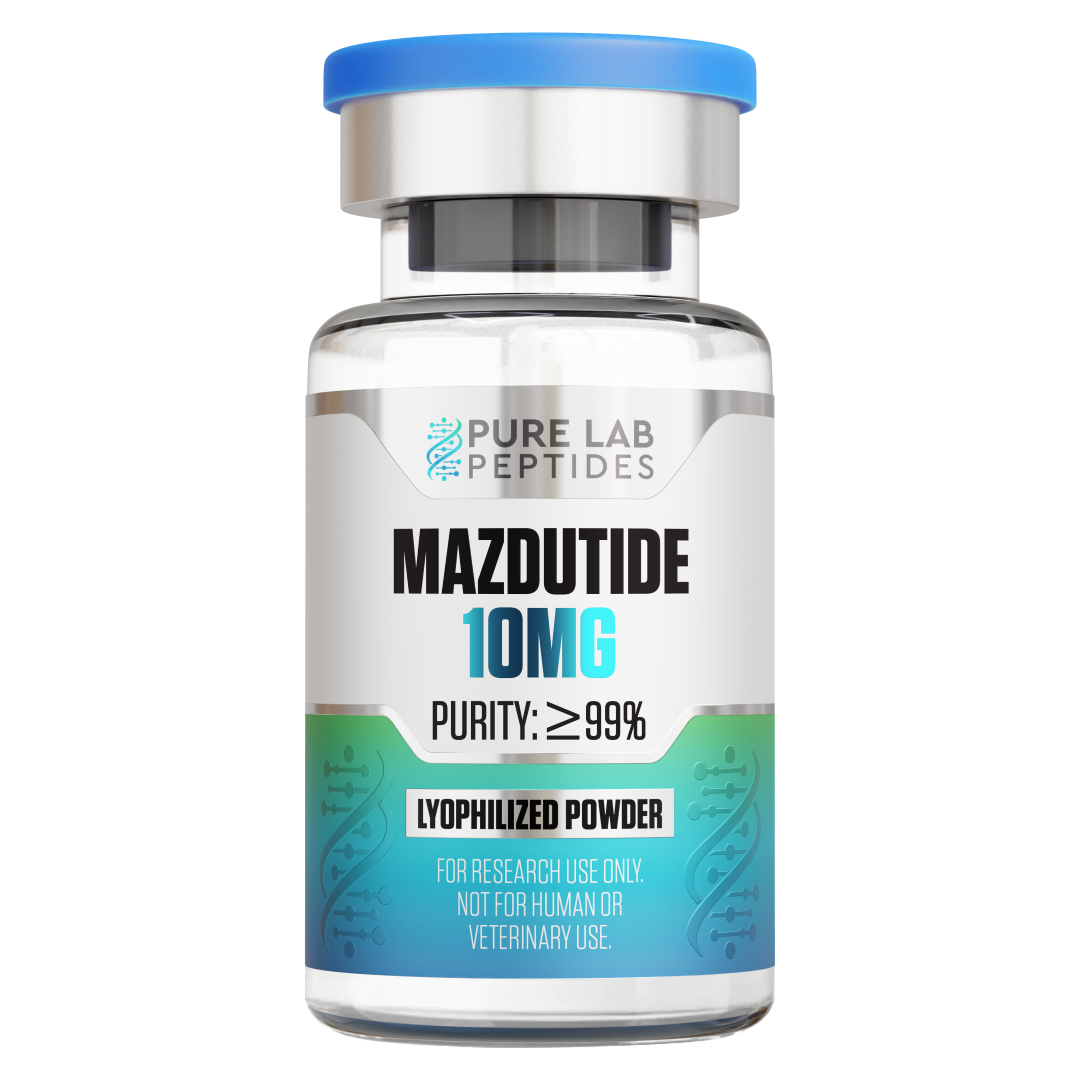
Mazdutide 10mg is a research-use-only laboratory material supplied for controlled research workflows, compound characterization, and analytical documentation review. It is manufactured under rigorous quality standards to support consistency, traceability, and batch-specific verification for qualified laboratory settings.
Mazdutide 10mg is intended strictly for laboratory research use only. This product is not intended for human or animal consumption, therapeutic use, diagnostic use, clinical use, veterinary use, or as a food, drug, cosmetic, dietary supplement, or household product.
| CAS No. | 2259884-03-0 |
|---|---|
| Sequence | H-Aib-Glu-Gly-Thr-Phe-Thr-Ser-Asp-Val-Ser-Ser-Tyr-Leu-Glu-Gly-Gln-Ala-Ala-Lys-Glu-Phe-Ile-Ala-Trp-Leu-Val-Arg-Gly-Arg-Gly |
| Molecular Formula | C210H322N46O67 |
| Purity | ≥99% |
| Molecular Weight | 4563.06 g/mol |
| Applications | Metabolic disorder research, obesity and weight management studies, type 2 diabetes investigations |
| Synthesis | Solid-phase synthesis |
| Solubility | Soluble in water or 1% acetic acid |
| Stability & Storage | Stable for up to 24 months at -20°C. After reconstitution, may be stored at 4°C for up to 4 weeks or at -20°C for up to 6 months. |
| Appearance | White lyophilized powder |
| Shipping Conditions | Shipped at ambient temperature; once received, store at -20°C |
| Regulatory/Compliance | Manufactured in a facility that adheres to cGMP guidelines |
| Safety Information | Refer to provided MSDS |
Consider these supplementary peptides for a comprehensive research approach.
Researchers evaluating where to buy Mazdutide for research should begin with compound identity, RUO labeling, batch-specific documentation, and analytical records rather than consumer-facing claims. Mazdutide is cataloged as a peptide research compound in chemical and pharmacology databases, with synonym records that include IBI-362 and LY-3305677 [1], [3]. This guide explains how Pure Lab Peptides product-page readers can assess Mazdutide documentation while keeping the discussion strictly limited to laboratory research use.
Researchers looking to buy Mazdutide for research should check RUO labeling, compound identity, synonym consistency, COA availability, analytical testing records, lot traceability, and supplier documentation before procurement. Products discussed in this article are intended for laboratory research use only and are not intended for human or animal consumption. Scientific literature should remain separate from product positioning and interpreted only as research context.
Start with the documents that define the material. The product listing, label, COA, and any batch-specific analytical file should all use the same compound name, lot number, and research-use-only framing.
For Mazdutide, synonym consistency matters because published and database records may reference IBI-362, IBI362, LY-3305677, or LY3305677 [3]. A research buyer should treat those names as identity-mapping checkpoints, not as separate product targets.
RUO labeling defines the product-page boundary. It tells laboratory buyers that the material is being presented for research purposes, documentation review, and controlled laboratory workflows rather than consumer or clinical positioning.
A strong RUO product page should avoid converting receptor literature into applied product promises. The practical procurement question is simple: do the label, COA, batch record, and analytical documents tell the same technical story?
The phrase buy Mazdutide becomes safer and more precise when reframed as buy Mazdutide for research. That wording keeps commercial intent connected to laboratory procurement, not personal-use intent.
For Pure Lab Peptides, the commercial research intent should point readers toward documentation. The page should help qualified research buyers review identity, purity, testing methods, lot-level traceability, and claim boundaries.
Research use means the page is about a laboratory material and its documentation. It is not a medical, wellness, body-composition, or product-performance page.
The article can discuss Mazdutide as a research peptide, explain database records, summarize receptor-pathway literature, and clarify analytical testing concepts. It should not translate study findings into purchasing promises.
A product-page research guide serves buyers who already have technical procurement intent. They need to know whether the listing is clear, whether documentation is available, and whether the material is presented within RUO boundaries.
That makes the safe primary keyword useful when it is attached to verification language. The safest version is not simply commercial; it is documentation-led: buy Mazdutide for research after reviewing COA, identity, purity, and lot records.
Technical buyers should look for a clear compound name, research-use-only labeling, batch-specific COA, purity method, identity method, storage notes, and lot number alignment. These items are documentation markers, not performance markers.
When a listing includes a catalog amount, the amount should be treated as a catalog specification only. It should not become a study-design recommendation or a separate SEO target.
Mazdutide is listed by PubChem under CID 167312357, and FDA GSRS provides a substance record under UNII MB76Z4IBZ5 [1], [2]. IUPHAR describes Mazdutide as a peptide and identifies it as an acylated long-acting synthetic single-chain peptide analogue of oxyntomodulin, with activity described in relation to GLP-1 and glucagon receptor research [3].
That identity framing is enough for a product-page guide. A research page does not need to make claims beyond what documentation and literature can support.
Peptide identity review should compare the compound name, synonym set, molecular record, and supplier documentation. Official database records are useful because they help reduce ambiguity before the laboratory buyer evaluates lot-specific files [1], [2].
Classification should remain technical. For this page, Mazdutide belongs in an incretin and glucagon receptor research lane, not a consumer category.
IUPHAR lists IBI-362, IBI362, LY-3305677, and LY3305677 as Mazdutide synonyms [3]. Those names can appear across research papers, compound databases, and supplier documentation.
A supplier file should not leave the buyer guessing whether a synonym refers to the same research material. The synonym map should support identity review, not keyword stuffing.
Amino acid and molecular-weight fields help research teams cross-check peptide identity. They are not sufficient by themselves, but they can support review when paired with COA records, analytical method details, and lot-level documents.
For a peptide such as Mazdutide, molecular records and pharmacology database entries help set expectations for identity documentation [1], [3]. The lot-specific COA still matters because it connects the listed material to a batch record.
Mazdutide is described in pharmacology resources as long-acting and oxyntomodulin-inspired [3]. Oxyntomodulin literature is relevant because oxyntomodulin is a proglucagon-derived peptide discussed in relation to GLP-1 and glucagon receptor systems [17].
A product page should use that background carefully. Scientific context explains why researchers may study the compound class, but it does not create product-use guidance.
Oxyntomodulin has been studied as a peptide that interacts with GLP-1 and glucagon receptor systems [9], [17]. Mazdutide appears in the same broad receptor-research lane because it is described as a dual agonist related to glucagon-like peptide-1 and glucagon receptors [3].
This is pathway context only. It should not become a product claim.
Biochemical characterization supports entity clarity by connecting the compound name to structural, receptor, and analytical records. Databases such as PubChem and IUPHAR help identify names, synonyms, and receptor-lane context [1], [3].
Product-page clarity improves when those records are paired with batch-specific documentation. A database record can support identity context, while a COA supports lot-level review.
GLP-1R and GCGR are class B G-protein-coupled receptor targets in the glucagon receptor family [4], [5]. NCBI describes GLP1R as encoding a receptor for glucagon-like peptide-1 and GCGR as encoding the glucagon receptor [4], [5].
Mazdutide is relevant to this research lane because IUPHAR describes it as a dual glucagon-like peptide-1 and glucagon receptor agonist [3]. That description should remain a receptor classification, not a product-positioning statement.
GLP-1 receptor literature describes class B GPCR structure, ligand interaction, and signaling concepts [6], [7]. Glucagon receptor research is relevant because GCGR is a protein-coding receptor gene linked to glucagon signaling biology [5].
A Mazdutide product page can mention GLP-1R and GCGR to explain research category. It should not use those receptor names to imply product performance.
A receptor agonist is a ligand discussed in relation to receptor activation in assay or pathway contexts. A dual agonist is described in the literature when a compound is evaluated against two receptor systems, such as GLP-1R and GCGR [10], [11].
Structural literature has examined dual agonism at GLP-1R and GCGR, which helps researchers understand receptor selectivity and ligand behavior at a mechanistic level [8]. Product-page copy should keep that language tied to literature and assay context.
Pathway relevance is not a product claim. It only tells the reader which research lane, receptor family, or assay category is relevant.
This distinction is critical for an RUO page. A receptor pathway can explain why literature exists, but it cannot define what a research material is intended to do.
Research applications for Mazdutide belong in laboratory research, receptor signaling, model interpretation, and documentation review. Some published literature outside the scope of RUO product use has examined this compound class in human study settings. That literature should not be interpreted as a use claim for research-use-only materials.
A safe research page can describe evidence categories. It should not give product-use guidance or consumer-facing outcomes.
Research applications are study categories. Product positioning is how a supplier presents a material.
For Mazdutide, research applications may include receptor assay interpretation, GLP-1R and GCGR pathway discussion, biological activity records, and COA review. Terms such as type 2 diabetes, obesity, and clinical outcomes may appear in published study contexts, but an RUO product page should treat them as boundary-sensitive literature descriptors rather than product claims [12], [15].
In vitro assays can be used to study receptor signaling, concentration-response behavior, and ligand-receptor interactions under controlled research conditions. EC50 is commonly used in agonist concentration-response analysis as a midpoint value summarizing assay response behavior [18].
Those values are model-specific. They should be interpreted as assay data, not product-use instructions.
The safest way to read Mazdutide literature is to separate model type, evidence level, and RUO meaning. Human study settings, preclinical literature, and in vitro assays answer different scientific questions and carry different interpretation limits.
| Research Area | What Literature Examines | Evidence Type | RUO Interpretation |
|---|---|---|---|
| Compound identity | Names, synonyms, database identifiers, and receptor-lane classification [1], [3] | Database and pharmacology records | Supports identity context; does not replace batch-specific COA review |
| Receptor pathway research | GLP-1R, GCGR, and dual agonist mechanisms [8], [10] | Mechanistic and review literature | Supports pathway framing; does not create product claims |
| Mazdutide study literature | Model-specific and study-setting evaluations of IBI362 or Mazdutide [12], [13] | Published research | Provides literature context; not product-use guidance |
| Analytical documentation | Identity, purity, method validation, and laboratory records [19], [20] | Official guidance and technical records | Supports documentation review before procurement |
Published findings can describe what researchers examined, the model used, and the methods reported. They cannot establish that an RUO product is intended for any clinical, veterinary, personal, or consumer setting.
This matters for Mazdutide because the broader literature includes multiple evidence types, including receptor studies, preclinical literature, and human study settings [12], [13], [14]. An RUO page should keep those categories clearly separated.
Study design shapes what a finding can mean. In vitro receptor work can describe assay behavior, preclinical literature can describe model-specific observations, and human study settings remain outside RUO product positioning.
Review articles on incretin and glucagon co-agonism show how this field has developed across mechanistic, preclinical, and clinical-literature categories [11], [16]. The page should explain the category, not overextend it.
Caution is needed whenever a study finding might be turned into product performance language. A phrase may be acceptable in a paper but unsuitable on an RUO product page if it sounds like a promise about a research material.
For procurement teams, the safer question is not “what does the literature claim?” The safer question is “what does the documentation verify?”
Biological activity documentation should be framed around assay context, receptor model, and reported analytical terms. In pharmacology, concentration-response analysis can summarize agonist behavior using values such as EC50 [18].
For an RUO product page, biological activity language should not become an applied claim. It should remain linked to literature, assay design, and documentation review.
In an RUO setting, biological activity means a literature or assay descriptor. It does not define a product promise.
A useful documentation file may state what method was used, what reference material or comparison condition was involved, and what record connects the result to a lot. Analytical guidance from ICH and FDA emphasizes that identity, purity, and related measurements depend on validated or scientifically justified procedures [19], [20].
EC50 and potency should be interpreted as assay-context terms. They are not procurement promises and should not be separated from the model, method, and conditions used to generate them [18].
Molecular binding language needs the same discipline. Ligand-receptor interaction can help explain GLP-1R and GCGR literature, but it should not become product-effect language.
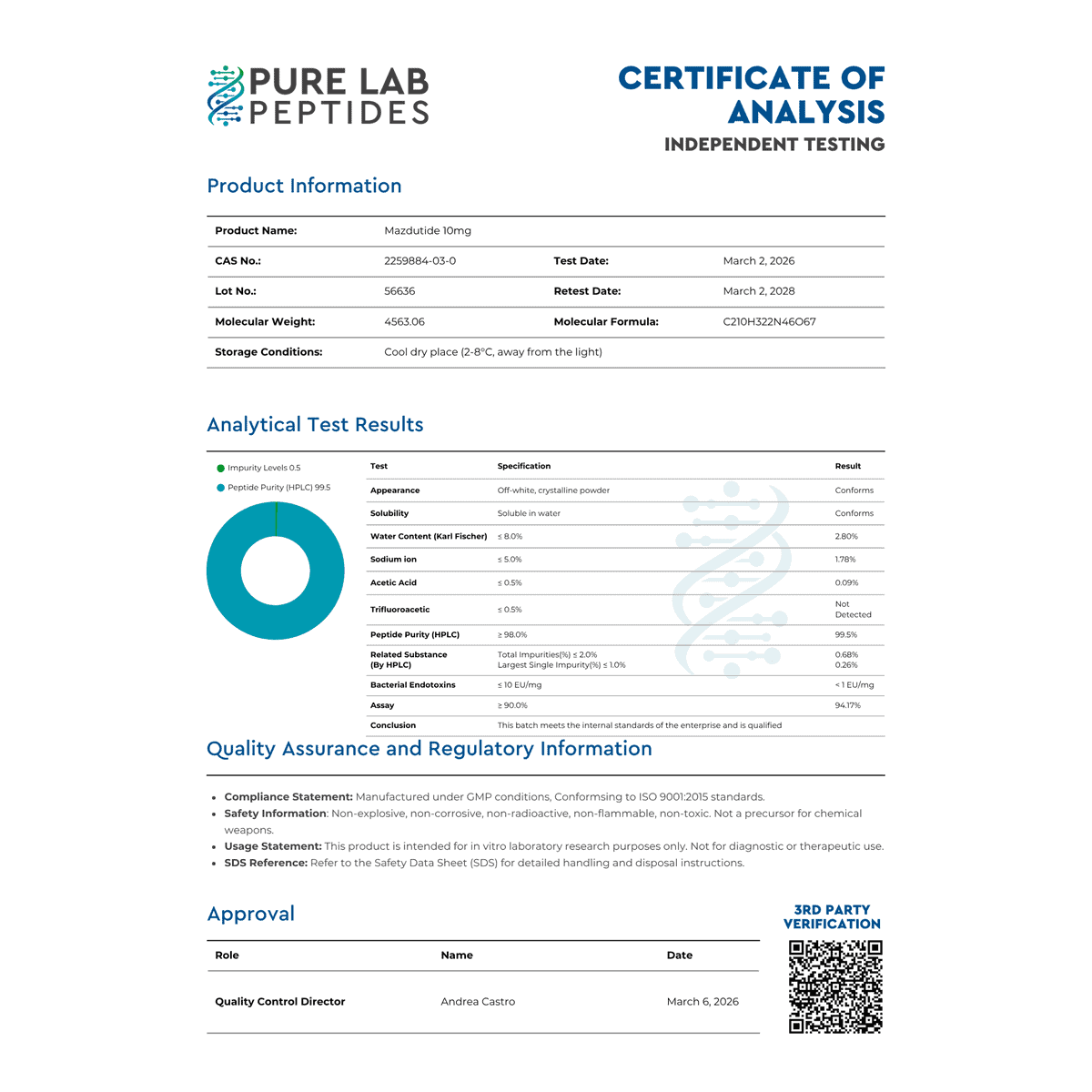
A certificate of analysis should be batch-specific and should identify the tested material, lot number, analytical method, date, and result fields. FDA analytical-method guidance describes documentation supporting identity, quality, purity, and potency measurements in regulated analytical contexts [20].
For RUO procurement, a COA is a review document. It should be used to check consistency, not to infer outcomes.
A strong COA should show the compound name, lot number, testing date, purity result, identity result, method reference, and laboratory source. USP notes that peptide standards may include documentary standards, validated test methods, acceptance criteria, and characterized reference materials [21].
A COA should also be specific to the batch being reviewed. Generic testing statements are weaker than lot-level records.
COA dates and lot numbers connect a document to a material batch. That connection helps research buyers compare product labels, supplier files, and analytical records.
Traceability concepts matter because measurement records need an unbroken and documented chain of information. NIST describes metrological traceability as a property of measurement results linked through documented reference systems [26].
Third-party laboratory testing documentation can strengthen review when it clearly identifies the test, the sample, the method, and the reporting laboratory. ISO/IEC 17025 is designed to help testing and calibration laboratories demonstrate competence and generate valid results [25].
A documentation-focused verification process can look like this:
Analytical testing should combine identity and purity review rather than relying on a single number. ICH Q2(R2) describes analytical validation concepts for common measurements such as identity, assay, purity, and impurity testing [19].
For peptides, HPLC and LC-MS can provide complementary information. HPLC can support chromatographic purity review, while LC-MS can support molecular identity review [22], [24].
High-performance liquid chromatography separates components in a sample and can provide chromatographic purity information when the method is appropriate. FDA analytical guidance references chromatographic methods as part of analytical-method validation and documentation review [20].
For a Mazdutide peptide COA, HPLC data should be read as one piece of documentation. It does not, by itself, prove complete identity.
LC-MS connects liquid chromatography with mass spectrometry, allowing researchers to evaluate mass-related information alongside chromatographic separation. LC-MS literature describes its role in peptide and protein identification, characterization, and quantification workflows [22], [23].
For a research-grade peptide, LC-MS support is strongest when the record can be matched to the same lot shown on the COA. That is why batch-specific documentation matters.
A chromatogram can show retention-time and peak-area information, while mass spectrometry can support molecular mass review. LC-HRMS literature also describes the use of high-resolution mass spectrometry for peptide characterization and related impurity review [24].
Research buyers should look for consistency across data, not isolated claims. The chromatogram, mass data, COA, and lot label should align.
Stock solution preparation belongs in laboratory documentation, not product-use instruction. The page can state what records matter without telling readers how to prepare a material.
Solubility, solvent, and concentration details should be recorded as part of laboratory planning and traceability. Peptide stability literature notes that peptide behavior can be affected by formulation, concentration, pH, and external conditions [28], [29].
Documentation may include solvent identity, concentration target, calculation record, analyst initials, date, storage condition, and internal project identifier. These are recordkeeping fields.
The article does not provide product-use procedures. It keeps stock solution preparation as a documentation category for qualified laboratory teams.
Solubility and solvent notes should be treated as research records that affect reproducibility. Peptide stability reviews describe degradation and aggregation pathways that can depend on solution environment and handling conditions [28], [29].
A research buyer should not expect a product page to replace internal laboratory controls. The supplier page should provide documentation, not experimental design.
Handling and storage documentation should be practical, lot-specific, and research-focused. It should identify how the material is labeled, how the supplier describes storage conditions, and how the laboratory records those conditions after receipt.
Peptide stability literature emphasizes that external factors can influence peptide integrity, and moisture can affect freeze-dried protein materials [28], [30]. Those concepts support careful recordkeeping.
Lyophilized material review should include label condition, lot number, COA match, storage statement, and package integrity. Lyophilization and residual moisture are discussed in protein and peptide stability literature as factors relevant to material quality over time [30].
This section remains about documentation. It does not provide handling instructions for personal or applied settings.
Moisture, temperature, and labeling consistency should be recorded in the laboratory file. Stability reviews describe peptide aggregation and degradation as influenced by intrinsic and external factors, which supports careful documentation of storage conditions [28].
For procurement review, consistency is the key. The label, COA, and supplier documentation should not conflict.
Handling and storage notes stay research-focused when they describe records, conditions, and documentation fields. They drift when they start sounding like consumer guidance.
A safe product page does not tell readers what to do with a material outside laboratory research. It helps laboratory buyers know which records to review.
RUO claim boundaries keep scientific literature separate from product claims. The page may discuss Mazdutide as a research peptide, cite receptor and analytical literature, and explain documentation review.
It should not say or imply that the product produces clinical outcomes or product performance. Those phrases belong, at most, in a claim-boundary discussion explaining what RUO pages should avoid.
Search intent can drift when commercial phrases are combined with outcome language. A phrase that begins as procurement intent can become unsafe if it suggests personal application, therapeutic positioning, or consumer outcomes.
For this reason, the page uses buy Mazdutide for research instead of a standalone commercial phrase. The focus remains on COA review, identity documentation, analytical testing, and lot traceability.
Literature context describes what researchers have examined. Product positioning describes what a supplier is presenting.
Those two functions should not merge. The safest RUO product page treats published research as background and treats the COA, label, lot record, and analytical file as the procurement evidence.
Before researchers buy Mazdutide for research, supplier documentation should be reviewed as a package. The product page, label, COA, analytical method record, lot number, and storage statement should align.
Data integrity guidance from FDA emphasizes complete laboratory records, including notebooks, worksheets, graphs, charts, spectra, and other data types used for review [27]. That principle supports documentation-first procurement.
Lot traceability links the listed material to a batch-specific record. Without that link, the buyer cannot confidently connect a COA result to the exact research material being evaluated.
Traceability also supports internal laboratory records. NIST’s traceability guidance explains that measurement results depend on documented chains tied to recognized reference systems [26].
Batch records, COA alignment, and product labels should form one coherent file. The compound name, synonym set, lot number, test date, and method fields should not conflict.
Use this quality and documentation checklist before procurement:
Common misunderstandings also deserve attention. Published literature does not equal product-use guidance. Preclinical findings should not be converted into human claims. A purity percentage does not prove complete compound identity. A COA should be batch-specific. RUO labeling does not support personal or consumer positioning.
Pure Lab Peptides supplies compounds for laboratory research use only. Products are not intended for human or animal consumption, diagnostic use, therapeutic use, clinical use, veterinary use, or as food, drugs, cosmetics, dietary supplements, or household products. Researchers are responsible for ensuring lawful, appropriate handling and use in accordance with applicable regulations and institutional guidelines.
Review the product-page documentation, COA details, analytical testing support, and RUO labeling before evaluating this compound for laboratory research.
Researchers should consider whether the Mazdutide listing supports research documentation, compound characterization, COA review, analytical testing, and lot traceability. The safest procurement review focuses on RUO labeling, batch-specific records, and consistency between the product page and supplier documentation. Buy Mazdutide for research only in the context of qualified laboratory procurement and documentation review.
Research-use-only means Mazdutide is presented solely as a laboratory research material. In this context, the page should focus on research documentation, peptide identity, compound characterization, and analytical testing. It should not frame Mazdutide as a consumer product or convert published literature into product-positioning language.
Metabolic research applies to Mazdutide product pages as a research-category framework, not as an outcome claim. A product page may discuss metabolic regulation, receptor-pathway context, cell signaling, and research models when those topics are clearly tied to literature interpretation and documentation. The page should keep those concepts separate from product claims.
Glucose and insulin terms may appear in Mazdutide literature as part of metabolic research context. On an RUO product page, those terms should be treated as pathway or model descriptors, not as product claims. Research buyers should prioritize COA review, peptide identity, analytical testing, and lot-level documentation.
In vitro research matters for Mazdutide documentation because it can help frame receptor signaling and assay-context discussion. Product-page content should not overextend in vitro research into broad claims. Instead, it should connect research models, assay interpretation, compound characterization, and analytical documentation in a clear RUO context.
Mazdutide product pages should stay research-use-only by focusing on compound identity, research documentation, COA review, analytical testing, and lot traceability. Boundary-sensitive literature language should remain separate from product positioning. A compliant page explains what researchers can review without presenting Mazdutide as intended for non-laboratory contexts.
The following authors are recognized for published research that helped shape the scientific context discussed in this article.
Author profile: ORCID
Linong Ji’s published Mazdutide work is relevant to the literature context reviewed for this research-use-only product page. His publications help frame how Mazdutide, IBI362, and LY3305677 appear across peer-reviewed records connected to incretin and glucagon receptor research. This work is useful for understanding compound naming, research-lane classification, and how published study settings should be interpreted separately from product positioning. His authorship also supports the broader academic background behind Mazdutide literature review, GLP-1R and GCGR context, and documentation-focused interpretation for laboratory research pages.
Selected publications:
Author profile: ORCID
Hongwei Jiang’s published work is relevant to Mazdutide literature because it includes research connected to IBI362, GLP-1R, and GCGR pathway discussion. His authorship helps support the article’s focus on receptor pathway context, compound characterization, and careful interpretation of published research records. For a research-use-only page, this literature is most useful as scientific background: it helps explain why Mazdutide is discussed in incretin and glucagon receptor research while keeping product documentation, COA review, and analytical testing separate from research findings.
Selected publications:
This research disclaimer clarifies how this page handles published literature and search language around Mazdutide. In incretin and glucagon receptor research content, phrases such as energy expenditure, obesity and type 2 diabetes, glucose control, insulin sensitivity, reduces body weight, T2D, and diet-induced obesity model can drift into consumer-facing, clinical-use, wellness, or product-claim language when framed incorrectly. Terms such as research protocols, peptides online, online at wholesale prices, and 10mg can also shift the page away from documentation-led research procurement if they are treated as product positioning rather than controlled search-language examples.
Here, those phrases are handled only as research-language examples, not product uses, outcomes, instructions, or recommendations. The focus remains on Mazdutide compound identity, COA review, analytical testing, peptide purity, lot traceability, RUO labeling, product documentation, and published literature boundaries. Model-specific terms should stay connected to literature interpretation, while procurement-focused terms should stay connected to research-use-only labeling and batch-level documentation review.
Our team is ready to assist you with any inquiries regarding our catalogue of peptides and their applications.
Discount Applied Successfully!
Your savings have been added to the cart.
Pure Lab Peptides
You must be at least 21 years of age to enter this site. By entering, you confirm that you are of legal age and agree to our terms.
For research use only.



There are no reviews yet.