


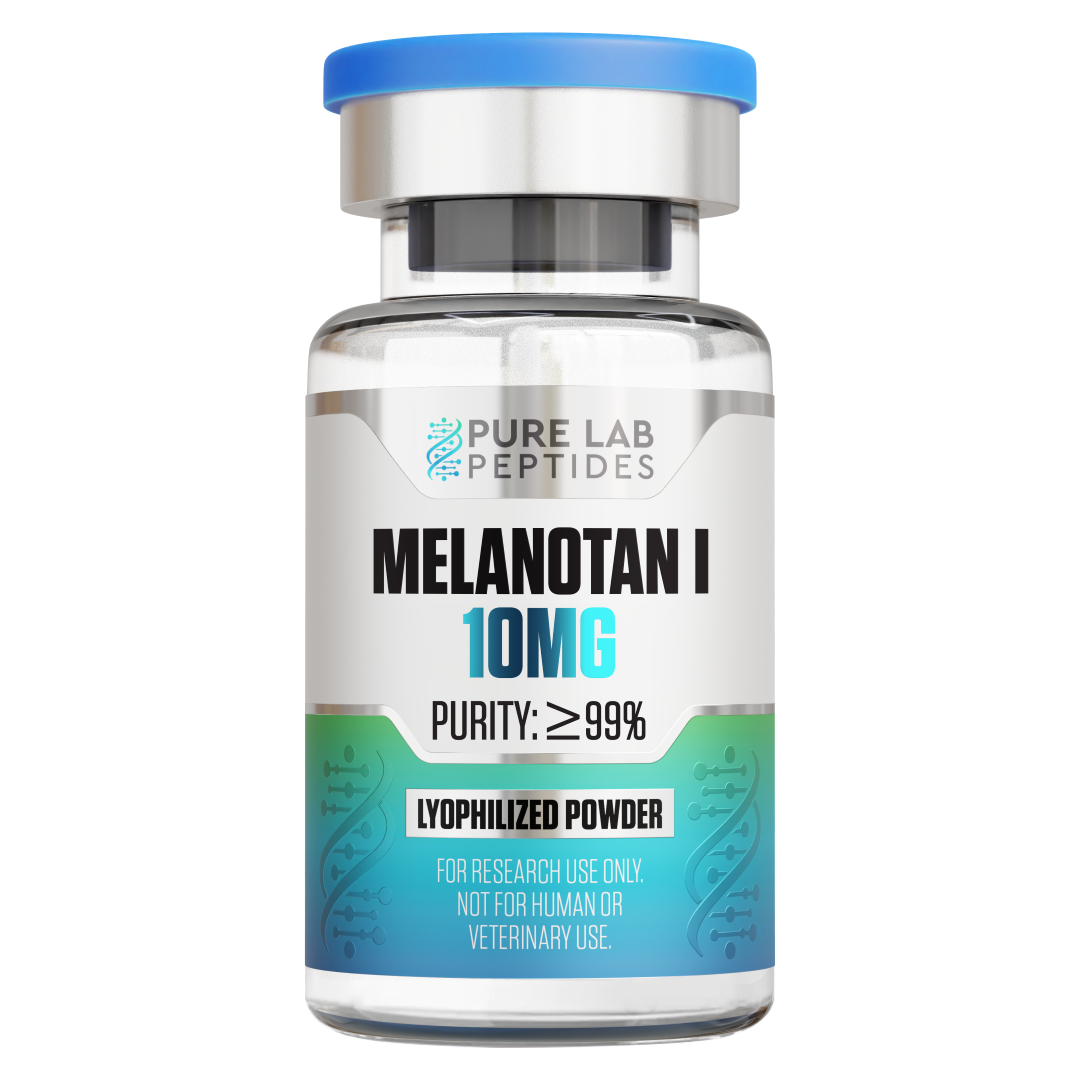
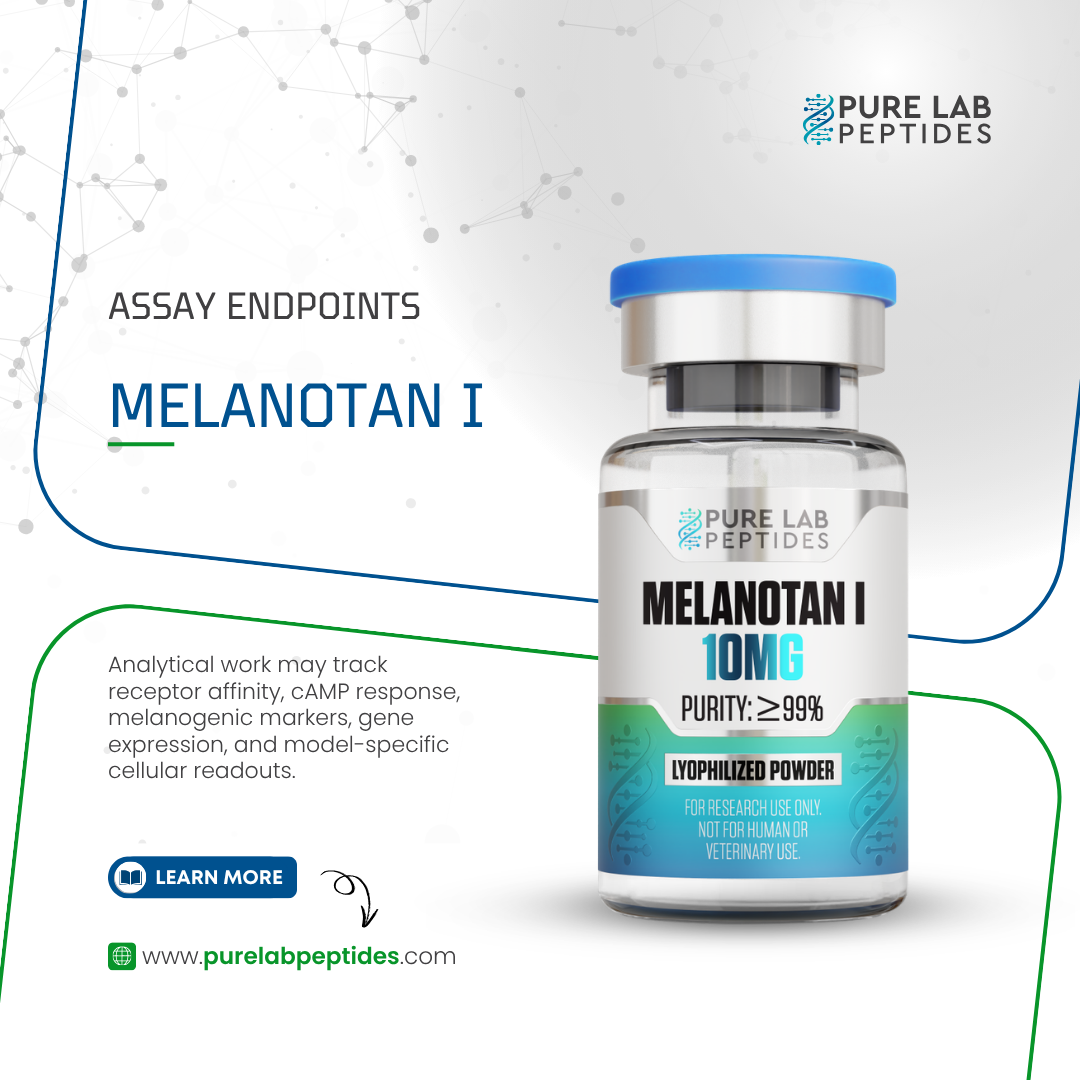
Researchers who want to buy Melanotan 1 for research should evaluate it as an RUO melanocortin receptor research peptide, not as a consumer product. Melanotan 1 is commonly mapped to Melanotan-I, MT-I, and afamelanotide/NDP-MSH naming in chemical and pharmacology databases, with identity records listing the formula C78H111N21O19 and a molecular weight near 1646.8 g/mol [1], [2], [3]. This page explains how Pure Lab Peptides frames product-page research intent through compound identity, published literature context, COA review, analytical testing, lot traceability, and research-use-only documentation.

Researchers looking to buy Melanotan 1 for research should first review RUO labeling, a batch-specific COA, identity data, purity testing, and lot-level documentation before evaluating supplier fit. Products discussed in this article are intended for laboratory research use only and are not intended for human or animal consumption. The compound should be interpreted through melanocortin receptor literature and analytical documentation, not product-use claims.
Start with documents that make the listing auditable: compound name, lot number, batch-specific COA, purity method, identity method, storage notes, and research-use-only label language. FDA and ICH analytical guidance both emphasize that identity, purity, specificity, precision, and method suitability are core quality-documentation concepts for analytical review [21], [22], [23].
Commercial search intent should be translated into technical procurement intent. In practice, a safer research framing asks whether the Melanotan 1 product page provides enough documentation for lab teams to verify compound identity, receptor-literature context, and batch-level analytical records.
RUO labeling defines the boundary of the product page before any scientific discussion begins. It keeps the commercial task focused on research procurement, supplier documentation, and laboratory recordkeeping rather than personal, clinical, cosmetic, or therapeutic positioning.
Melanotan 1 is a melanotropic peptide analog associated with alpha-melanocyte stimulating hormone literature and melanocortin receptor research. PubChem lists Melanotan-I as C78H111N21O19, and IUPHAR describes afamelanotide as a peptide and synthetic analogue of α-MSH with non-selective melanocortin receptor agonist characterization in pharmacology records [1], [3].
Research documentation should keep Melanotan-1, Melanotan-I, MT-1, MT-I, NDP-MSH, and afamelanotide naming consistent across product listings, COAs, and literature notes. ChEMBL and GSRS also index afamelanotide records, which helps reviewers compare synonyms, molecular formula, and molecular weight across independent databases [4], [5].
Alpha-MSH is an endogenous peptide hormone in melanocortin biology, while Melanotan 1 is discussed as an analog of alpha-melanocyte stimulating hormone. Structure-activity literature on NDP-MSH describes the Nle4 and D-Phe7 substitutions as key features in melanocortin ligand research [13], [14].
Afamelanotide is the literature and database name most often used when Melanotan 1 is discussed in formal pharmacology contexts. Review literature and official pharmacology databases connect afamelanotide with NDP-MSH and [Nle4,D-Phe7]-α-MSH naming, which is why researchers should check naming consistency before comparing sources [3], [19], [20].
A product-page research guide should describe Melanotan 1 as a research peptide within melanocortin receptor research. That keeps the page aligned with compound characterization, receptor literature, COA review, and RUO procurement rather than product performance claims.
Catalog clarity depends on separating the canonical compound name from listing details. The canonical target is Melanotan 1; catalog amounts, when shown elsewhere on a listing, should remain neutral product specifications and should not shape SEO targeting or imply research-model parameters.
Molecular weight, molecular formula, and sequence records help lab teams compare identity data across the product page, COA, and reference databases. PubChem, ChEMBL, and GSRS list afamelanotide or Melanotan-I identity data near the same formula and molecular-weight range, which supports cross-document consistency checks [1], [4], [5].

Melanocortin receptor context gives Melanotan 1 a safe scientific lane. The melanocortin receptor family is commonly described as a set of G protein-coupled receptors that includes MC1R, MC2R, MC3R, MC4R, and MC5R [10].
MC1R is a melanocortin receptor that binds melanocyte-stimulating hormones and ACTH-related ligands in receptor biology records [6]. MC1R reviews describe it as a G protein-coupled receptor with major roles in melanocyte signaling models, pigment biology, and related molecular pathways [8], [9].
MC3R and MC4R belong in the same receptor-family map, but they should be discussed as literature context rather than product positioning. Melanocortin ligand reviews commonly compare ligand activity across MC1R, MC3R, MC4R, and MC5R to explain receptor selectivity and structure-activity interpretation [10], [13].
Receptor selectivity is a literature and assay concept. It should be discussed with source context, receptor model context, and assay limitations because ligand activity can differ by receptor subtype, species system, assay design, and signal readout [13], [15], [16].
The mechanism of action should be described as research-model context. Melanocortin receptor signaling literature commonly discusses ligand binding, receptor activation, cyclic adenosine monophosphate, and downstream transcription factor pathways in melanocyte and cell signaling models [11], [12].
Alpha-MSH analog activity is usually interpreted through receptor assays, ligand comparisons, and signal transduction models. NDP-MSH literature has examined how structural substitutions affect melanocortin receptor activity, which is useful for literature interpretation but not a claim about an RUO product [14], [15].
MC1R signaling is often linked to cAMP, MITF, tyrosinase-related expression, and melanin synthesis in mechanistic literature [11], [17], [18]. In a product-page setting, those details should remain pathway context, not consumer-facing claims.
Published literature may discuss Melanotan 1, afamelanotide, NDP-MSH, or related melanocortin ligands across in vitro and in vivo research categories. Evidence remains model-specific, and RUO product pages should separate academic interpretation from procurement claims.
| Research Area | What Literature Examines | Evidence Type | RUO Interpretation |
|---|---|---|---|
| Compound identity | Melanotan-I and afamelanotide naming, formula, molecular-weight records [1], [4] | Database | Useful for cross-checking product-page and COA identity fields |
| Receptor family | MC1R, MC3R, MC4R, and related melanocortin receptor context [10], [13] | Review | Supports same-lane receptor mapping, not product claims |
| Receptor signaling | cAMP, MITF, tyrosinase, melanogenesis, and cellular signaling pathways [11], [12] | Mechanistic literature | Helps explain pathway models without implying RUO material outcomes |
| Literature models | In vitro and in vivo research reports involving melanocortin ligands [13], [14] | Preclinical literature | Findings remain tied to model design and source context |
| Analytical verification | HPLC, LC-MS, impurity characterization, and identity review [24], [25], [26] | Analytical literature | Supports documentation review and lot-level verification |
| Storage records | Peptide stability variables, lyophilized materials, moisture, and temperature [28], [29], [30] | Stability literature | Supports storage documentation, not broad product guarantees |
Published literature can describe receptor binding, signaling pathway models, analytical characterization, and experimental observations. It cannot, by itself, establish a claim for an RUO material sold for research purposes.
Preclinical findings should be read through model type, assay conditions, species system, and measurement endpoint. The melanocortin literature includes receptor-family complexity and differential activity across targets, which is why procurement copy should avoid simplifying study findings into product claims [10], [13], [14].
Study design affects how evidence should be interpreted. For receptor research, the source of the receptor, ligand comparator, assay readout, concentration range, and analytical method can influence how findings are reported [12], [15], [16].

The key research boundary is simple: literature context is not product positioning. Some published literature outside the scope of RUO product use has examined this compound class in human study settings. That literature should not be interpreted as a use claim for research-use-only materials [19], [20].
A pathway relationship does not make a product claim. For example, literature that discusses MC1R signaling, melanocortin signaling, melanin synthesis, or transcription factor activity should be treated as model-specific research context [11], [18].
RUO copy should make documentation the center of the page. That means compound identity, COA data, HPLC, LC-MS, lot traceability, and handling records matter more than language about product effects or product performance.
Product-page language should keep clinical-use language separate from RUO procurement content. A safer page structure explains what the literature examines, then returns to documentation review, source quality, analytical testing, and research-only labeling.
COA documentation gives research buyers a batch-level record to compare against the product page. It should not be a generic quality statement; it should identify the lot, compound name, purity method, identity method, date, and documentation source.
A certificate of analysis should show the compound name, lot identifier, analytical method, reported purity, identity-supporting data, and date of analysis. ICH Q2(R2) lists identity, purity, impurity, assay, and qualitative or quantitative measurements as common analytical procedure uses [21].
Lot-specific records help technical procurement teams confirm that the COA belongs to the material being reviewed. FDA analytical-method guidance emphasizes documentation for identity, quality, purity, and analytical methodology, which makes document matching central to procurement review [23].
COA dates help lab teams assess whether a record belongs to the current lot and whether the listing, label, and batch file tell the same story. A COA date is not a substitute for identity testing, but it is a useful traceability checkpoint.

Analytical testing supports research-material review by separating purity evidence from identity evidence. HPLC is widely used for peptide analysis and purification, while LC-MS can add mass-based identity information and impurity characterization [24], [25].
Lab-test verification workflow for research records:
This workflow is documentation-focused and should not be converted into product-use guidance.
HPLC can separate peptide components so a lab record can report a chromatographic purity profile. Peptide HPLC literature describes reversed-phase, ion-exchange, and size-exclusion approaches as major modes used in peptide analysis and purification [24].
LC-MS can support identity review by pairing chromatographic separation with mass-spectrometry data. LC-HRMS literature describes peptide-drug and related-impurity characterization through qualitative and quantitative mass-based workflows [25], [26].
Chromatograms and mass-spectrometry records are strongest when they are connected to a lot number and COA. Analytical literature also notes that peptide impurities can include structurally related species, which is why purity and identity should not be treated as the same checkpoint [26], [27].
Stock solution preparation records and dilution documentation should be treated as internal laboratory record categories. A product page can discuss what records may need to exist, but it should not provide procedural steps for creating a working solution.
A stock solution preparation record may document compound name, source lot, solvent identity, concentration notation, label text, storage location, and date. Solubility and solvation details are chemistry variables that should be handled within qualified laboratory systems and recorded without turning a product page into procedural guidance.
A research dilution calculator can support consistent record units and reduce transcription mistakes in internal lab documentation. On an RUO product page, calculator language should remain a documentation concept rather than a public instruction set.
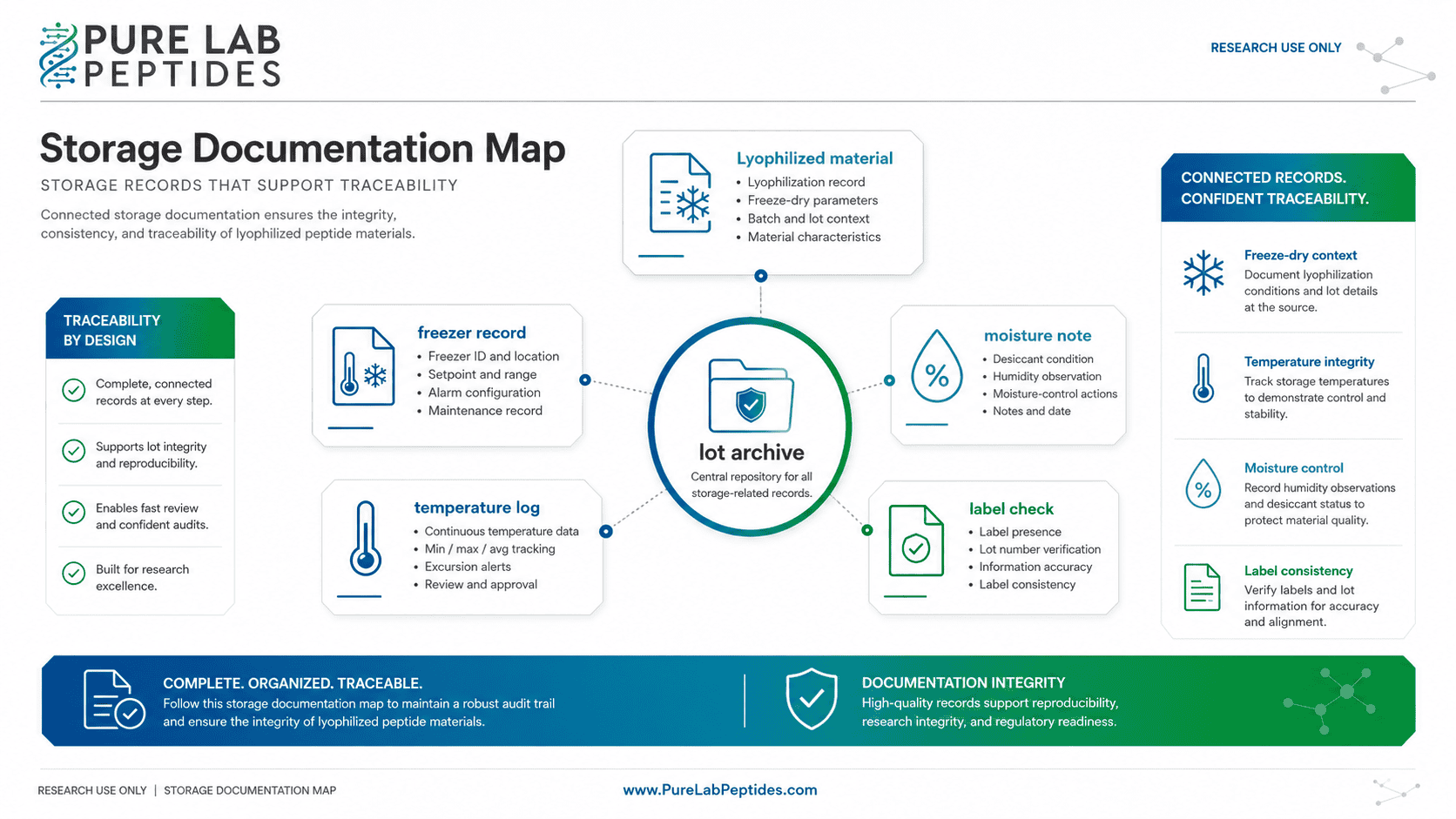
Handling and storage documentation should describe how records are reviewed, not how a material is applied in a research model. For peptide materials, stability literature highlights that peptide chemistry, moisture, temperature, and matrix conditions can affect degradation risk [28], [29].
Lyophilized and freeze-dry context belongs in storage records because dry peptide materials are often reviewed differently from solution-phase materials. Peptide stability literature notes that lyophilized peptide materials can be more stable than solution-phase materials when kept under appropriate dry and cold conditions, but stability remains compound- and condition-specific [28], [30].
Temperature and moisture logs help lab teams preserve a clear chain of storage documentation. If documentation references conditions such as freezer storage, −20 °C, −80 °C, room temperature, or away from moisture, those entries should be copied into laboratory records as supplier-specific or lab-specific record fields, not treated as universal guarantees [28], [29], [30].
Research buyers comparing where to buy Melanotan 1 for research should compare documentation quality before price, packaging, or catalog presentation. The strongest product-page evaluation asks whether the listing, COA, label, lot number, and testing records are consistent.
Use a supplier documentation matrix during technical procurement review:
Important listing signals include canonical compound name, synonym consistency, RUO label clarity, available COA, lot traceability, analytical testing information, and handling notes. The listing should support research procurement, not convert melanocortin receptor literature into a claim about the product.
Melanocortin research pages can drift when they treat search demand as product positioning. A better structure keeps research overview, receptor context, COA review, testing, and procurement documentation in separate lanes.
Search demand may include appearance-focused, consumer-facing, or clinical phrasing, but those phrases should not drive the claim strategy of an RUO page. A research product page should answer commercial research intent through documentation, not through outcome language.
Research pages should emphasize five points:
Before procurement, technical teams should confirm that the product page supports a clean documentation trail. That trail should connect compound identity, COA records, analytical testing, lot traceability, label consistency, and storage documentation.
A final procurement checklist should include:
Lab teams should archive COA files, chromatogram images, mass-spectrometry records, supplier documentation, label copies, and storage notes under the same lot identifier. This creates a traceable record for Melanotan 1 research procurement without turning the product page into research-model guidance.
Review the product-page documentation, COA details, analytical testing records, lot traceability, and RUO labeling before evaluating this compound for laboratory research. For research teams comparing peptide suppliers, prioritize transparent documentation and batch-level records before procurement.
Research use only means Melanotan 1 is intended solely for laboratory research contexts. It is not intended for human or animal consumption. Researchers should interpret all findings as model-specific and focus on compound identity, analytical testing, COA review, and lot traceability when documenting and evaluating materials.
Published literature for Melanotan 1 should be interpreted strictly as research context. Findings from in vitro, in vivo, or preclinical studies describe receptor pathways, signaling mechanisms, or molecular interactions, and should not be translated into product-use guidance. All literature should be cross-referenced with COA and analytical documentation for RUO verification.
Analytical methods commonly used to evaluate Melanotan 1 purity include HPLC and LC-MS. These techniques support confirmation of peptide identity and molecular weight, and allow researchers to verify compound characterization against batch-specific documentation and certificate of analysis records.
Lot traceability is critical because it ensures that each batch of Melanotan 1 corresponds with a specific certificate of analysis and analytical testing record. Tracking lot numbers allows researchers to confirm consistency, review batch-specific purity and identity, and maintain proper documentation within laboratory research environments.
Researchers should review the certificate of analysis, batch-specific documentation, purity and identity testing results, and analytical method descriptions for Melanotan 1. Proper review ensures that laboratory records align with COA data, confirms peptide identity, and maintains compliance with RUO labeling and research-use-only standards.
Melanotan 1 product pages should separate published literature and boundary-sensitive language from RUO claims. Terms such as nootropic, cognitive enhancement, peptide therapy, and bioavailability can drift into consumer-facing or clinical-use interpretations. Pages must instead emphasize compound identity, COA verification, analytical testing, lot traceability, and proper documentation for laboratory research purposes.
The following authors are recognized for published research that helped shape the scientific context discussed in this article.
Author profile: University of Arizona Profile
Victor J. Hruby’s published work is relevant to the melanocortin receptor research lane behind Melanotan 1 literature interpretation. His publications help frame how melanocortin receptor subtypes, peptide ligands, receptor selectivity, and structure-focused ligand design are discussed in academic research. That background supports the article’s emphasis on pathway-focused research, receptor-family context, and careful separation between published literature and RUO product-page documentation. His work is also useful for understanding why compound naming, receptor classification, and peptide analogs should be handled with precision in laboratory research content.
Selected publications:
Author profile: University of Minnesota College of Pharmacy Profile
Carrie Haskell-Luevano’s publications are relevant to melanocortin receptor pathway research, peptide chemistry, and cell signaling studies connected to MC1R, MC3R, and MC4R literature. Her work provides useful background for interpreting structure-activity relationships, receptor subtype comparisons, and ligand-focused research models. This context supports the article’s discussion of Melanotan 1 as a research peptide within the broader melanocortin receptor literature, while keeping product-page language centered on compound identity, analytical documentation, and research-use-only interpretation.
Selected publications:
This research disclaimer clarifies how Pure Lab Peptides handles published literature and search language around Melanotan 1. In melanocortin receptor research content, terms such as pigmentation, skin, UV exposure, UV-induced, effects of Melanotan 1, and efficacy of Melanotan 1 can drift into consumer-facing, appearance-focused language or product-claim language when separated from model-specific research context. Related phrases such as absorption, clinical outcomes, therapeutic language, administration-focused language, and cosmetic outcome language require the same careful separation from product positioning.
On this page, those phrases are treated only as research-language examples, not product uses, outcomes, instructions, or recommendations. The focus remains on Melanotan 1 compound identity, COA review, analytical testing, peptide purity, lot traceability, RUO labeling, product documentation, and published literature boundaries. This keeps the page aligned with research procurement and documentation review while avoiding personal-use guidance, product-performance claims, or clinical-use positioning.
Discount Applied Successfully!
Your savings have been added to the cart.






There are no reviews yet.