

Buy Pancragen for research is a research-procurement query, not a consumer-use prompt. Pancragen is a short peptide discussed in bioregulator literature under Lys-Glu-Asp-Trp and KEDW nomenclature, and PubChem lists H-Lys-Glu-Asp-Trp-OH as C26H36N6O9 with a computed molecular weight of 576.6 g/mol [1]. This guide helps laboratory buyers review RUO positioning, published literature, COA documentation, analytical testing, and lot traceability before evaluating a Pancragen research material.
Researchers evaluating where to buy Pancragen for research should first review RUO labeling, batch-specific COA availability, peptide identity records, purity testing, lot traceability, and supplier documentation consistency. Products discussed in this article are intended for laboratory research use only and are not intended for human or animal consumption. Published literature should guide research context, not product-use claims.
The phrase “buy Pancragen for research” is safest when it points to procurement due diligence. That means the page should answer documentation questions: what the compound is, what the COA shows, what analytical methods support identity, and how the supplier labels the material.
A standalone “buy Pancragen” phrase can drift toward consumer intent. Pure Lab Peptides should keep the commercial path focused on qualified research buyers, laboratory documentation, and research-use-only review.
The first signals to review are the product name, sequence or synonym documentation, lot number, COA date, purity method, identity method, and RUO label. FDA analytical-method guidance describes analytical information as part of documenting identity, quality, purity, and related attributes in regulated contexts, which is useful as a general quality-documentation reference even though this page is not positioning Pancragen as a regulated drug product [5].
For Pancragen, identity review should also check whether documentation refers to H-Lys-Glu-Asp-Trp-OH, KEDW, Lys-Glu-Asp-Trp, or another clearly described research form. That distinction matters because scientific literature and catalog records may use related but not identical notation [1].
RUO labeling keeps the page’s purpose narrow: laboratory research material evaluation. The U.S. Food and Drug Administration’s RUO guidance for IVD products is a different regulatory setting, but it illustrates a useful principle for research pages: labeling and intended research positioning should remain consistent [6].
The product page should therefore avoid language that turns literature into claims. Documentation, not outcome language, should lead the buying journey.
Pancragen is discussed as a short peptide in bioregulator research literature, commonly associated with Lys-Glu-Asp-Trp or KEDW notation. PubChem’s H-Lys-Glu-Asp-Trp-OH entry provides a neutral compound-identity anchor for formula and computed molecular weight review [1].

A Pancragen peptide listing should make the research identity clear. The most useful identity fields are compound name, synonym set, molecular formula, molecular weight, sequence notation, lot number, and analytical method.
Bioregulator framing should stay scientific and conservative. Reviews on short peptide regulation discuss peptide interactions with gene-expression systems as model-specific research concepts, not as claims about any supplier material [7].
KEDW is the one-letter sequence shorthand for Lys-Glu-Asp-Trp. A product-page documentation file should connect that shorthand to the full amino acid sequence so laboratory buyers can compare the label, COA, and literature terminology [1].
Sequence documentation is not a substitute for analytical verification. It is the starting identity claim that HPLC, LC-MS, mass data, or other suitable records help evaluate.
Pancragen fits the short peptide research lane because it is discussed as a tetrapeptide, meaning a four-residue peptide. Short peptide reviews describe this class as part of gene-expression and cell-differentiation research, while also noting that mechanisms remain model-specific and require careful interpretation [7].
For product-page SEO, the safest category is Bioregulator Peptide Research. That lane supports compound identity, molecular documentation, pancreatic cell model context, and analytical testing without creating consumer-facing claims.
A Pancragen peptide listing should help research buyers evaluate documentation before procurement. It should not answer personal-use questions or turn the product page into a consumer guide.
A safe “buy Pancragen for research” page should clarify that the material is for laboratory research use only, that literature is provided for context, and that the buyer should review batch-level documentation before selection. It should also make clear that a COA is most useful when it matches the exact lot being evaluated.
The page can discuss research applications in a controlled way. Suitable examples include compound characterization, pancreatic cell culture models, gene-expression literature, analytical testing review, and documentation comparison.
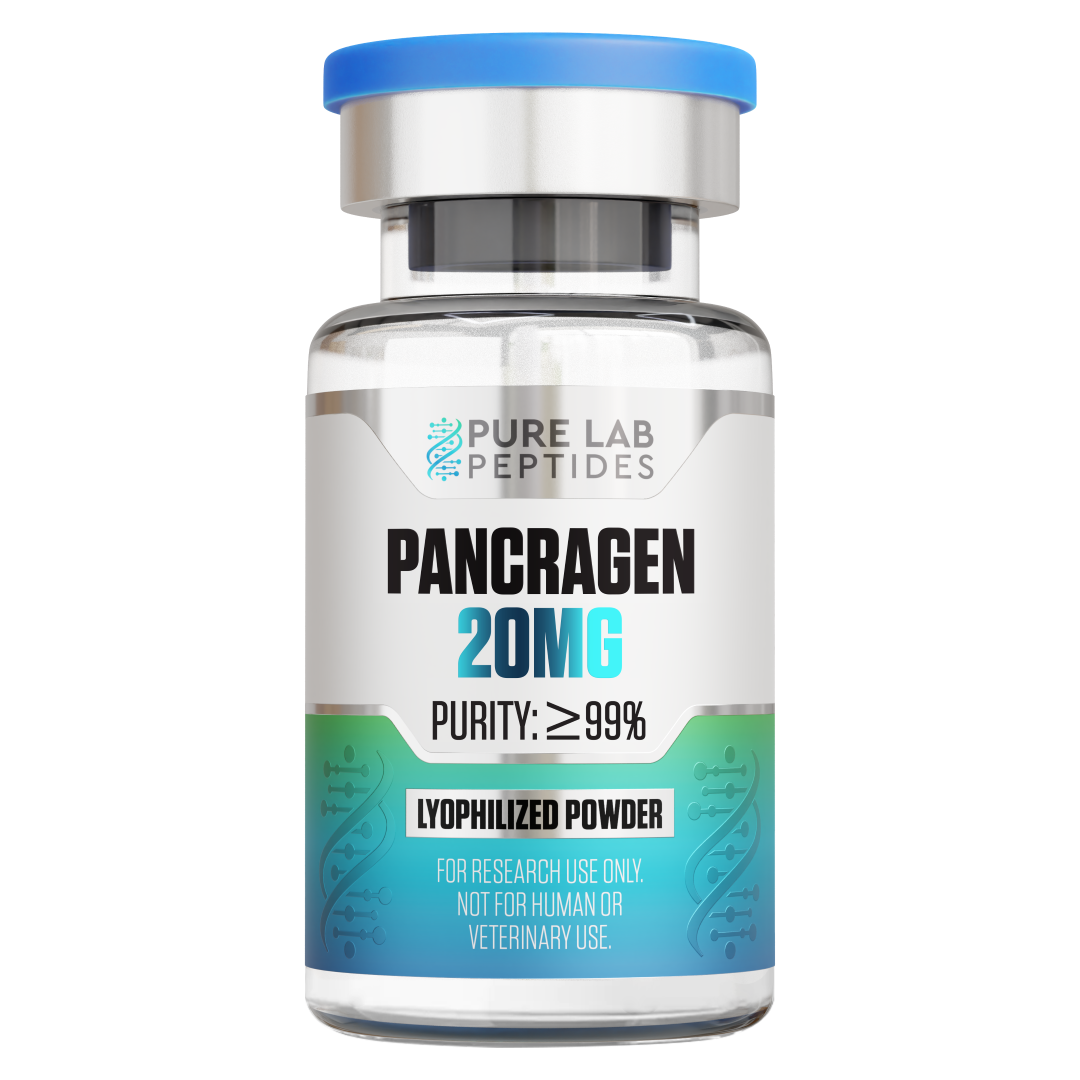
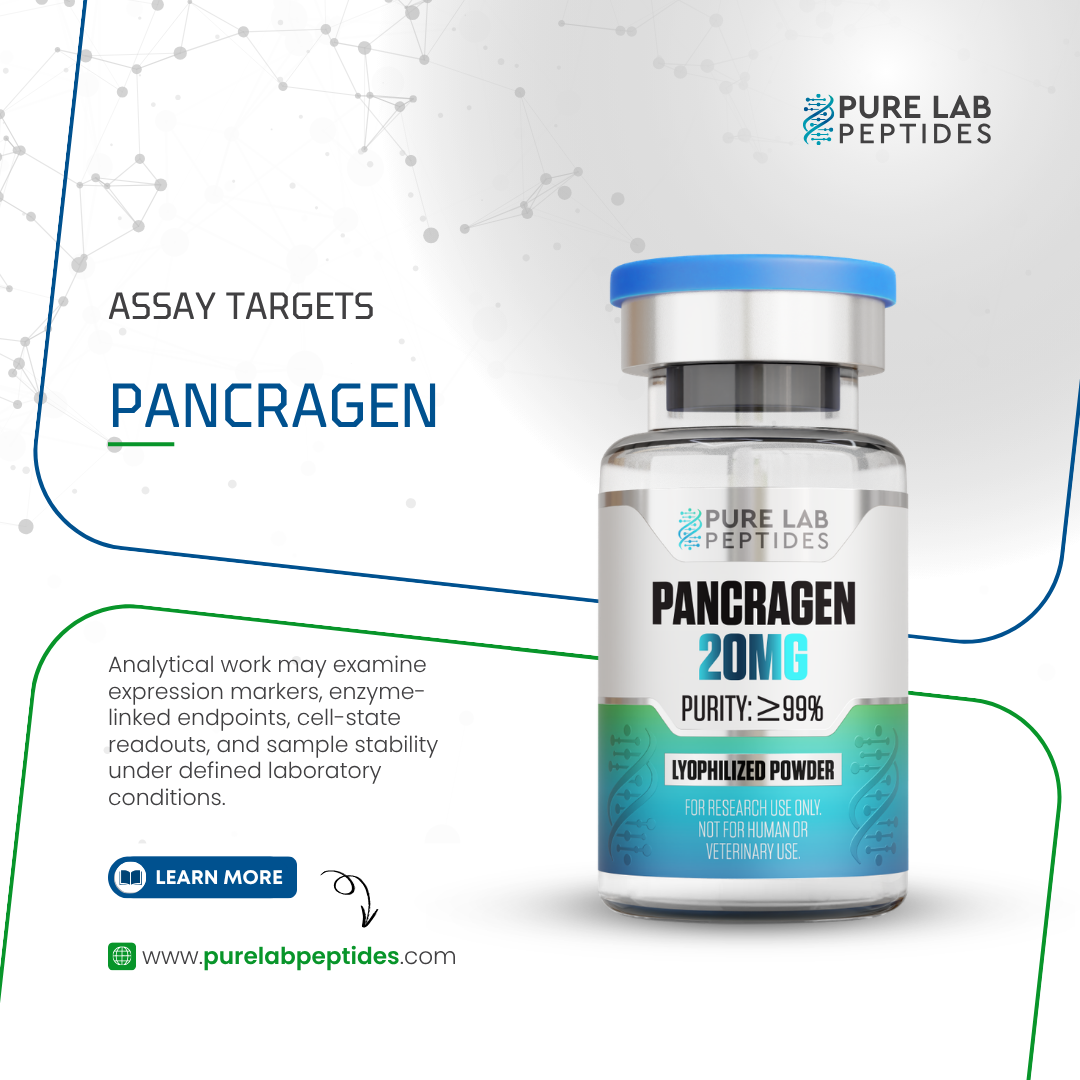
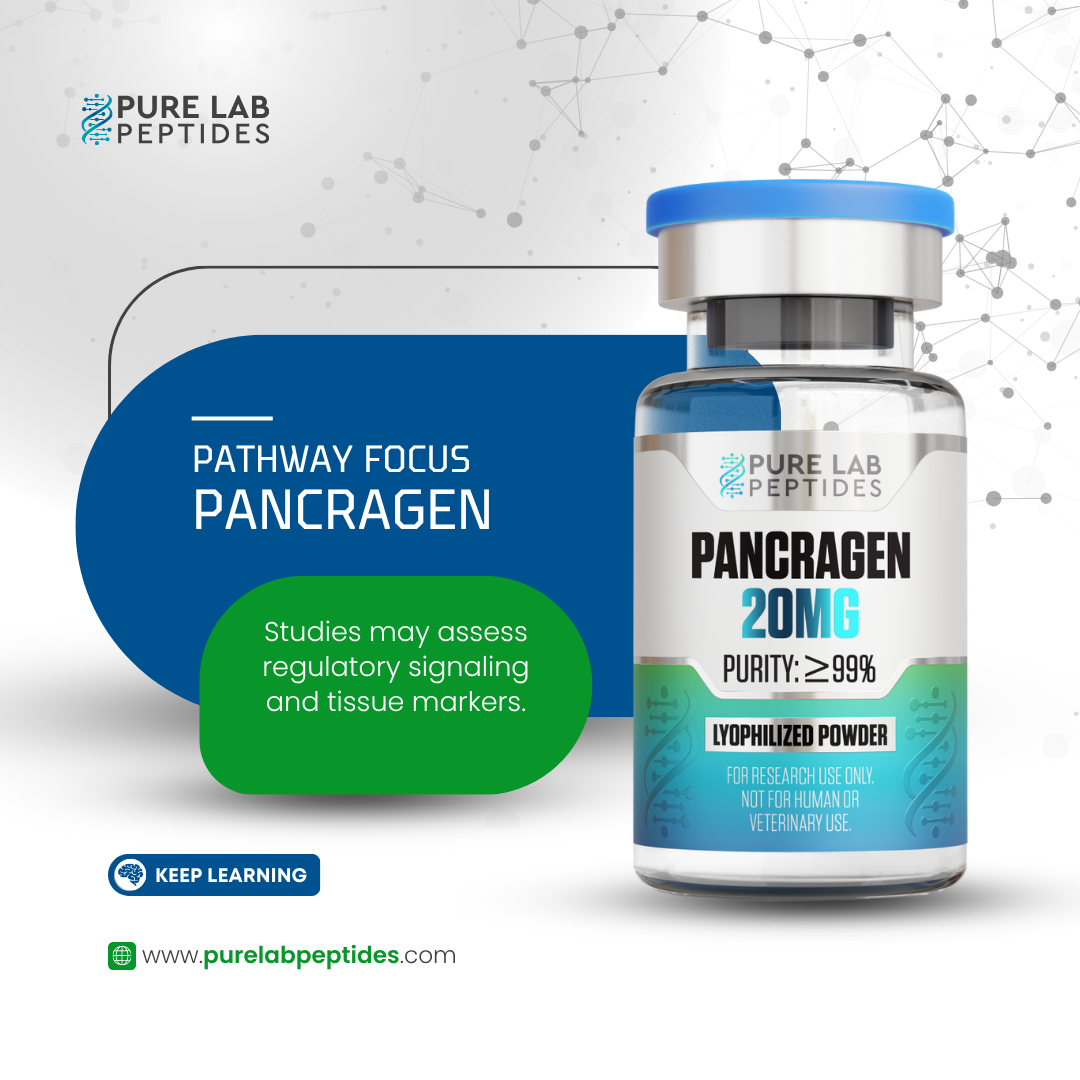
Catalog details should identify the listing without making the article a variant-specific SEO page. If a listing mentions 20mg, the article should treat that amount as a neutral catalog specification.
The canonical topic remains Pancragen. The page should not build separate search intent around product amount, vial size, or experimental quantity.
Pancragen research is often framed around pancreatic cell models and gene-expression markers. The pancreas is a mixed organ, with exocrine acinar and duct tissue and endocrine islet compartments [3].
Pancreatic tissue literature can include acinar cells, ductal cells, islet cells, and cell-culture systems. NCBI Bookshelf describes the pancreas as divided into an exocrine portion and an endocrine portion, which explains why both acinar and islet references appear in research context [3].
A product page should not imply that a research material is intended for biological outcomes. It should describe the model context and then return to documentation.
Acinar references usually point to the exocrine pancreas, while islet references point to endocrine cell clusters. StatPearls describes the endocrine portion as discrete islets of Langerhans containing several endocrine cell types [8].
These terms help readers understand the literature. They should not become product-positioning claims.
Insulin and glucagon are common endocrine-system entities in pancreatic literature. NCBI’s endocrine pancreas chapter describes glucose regulation as primarily linked to pancreatic hormones such as insulin and glucagon [9].
On an RUO page, those entities belong in pathway and literature context only. They should not be framed as product outcomes.
Pancragen research connects to cellular pathway models through published work on pancreatic cell differentiation markers and gene-expression context. The key is to describe what the literature examines, not what a product does.
A Pancragen study in pancreatic cell cultures reported changes in differentiation-factor expression for acinar and islet-associated markers in young and aged cultures [2]. The reported markers included Pdx1, Ptf1a, Pax6, Pax4, Foxa2, and Nkx2.2 in that model-specific context [2].
That evidence belongs in the evidence landscape. It should not be presented as a claim about a research material listing.
Pancreatic differentiation literature often references transcription factors because cell identity is regulated through gene-expression networks. Reviews identify PDX1, NEUROG3, and MAFA as important transcription factors in pancreatic beta-cell development and differentiation research [10].
Other reviews describe pancreatic development as a transcription-factor network involving factors such as Pdx1, Ptf1a, Nkx proteins, and other lineage regulators [11]. This supports semantic coverage for Pancragen research without implying product claims.
Pathway relevance means a compound appears in literature connected to a model, marker, or mechanism. It does not mean the product page can claim an outcome.
A safer framework is simple: cite the model, name the marker, describe the limitation, and return to RUO documentation. That keeps pathway research separate from product effects language.
Pancragen literature may intersect with metabolic research because the pancreas is central to glucose-related physiology. That context must remain academic and model-specific.
Glucose metabolism appears in pancreatic literature because endocrine islets include cell types that secrete insulin and glucagon, which are central to glucose regulation [9]. Some Pancragen-related publications discuss metabolic endpoints outside product-page RUO positioning, and those sources should be treated as literature context only [12].
For Pure Lab Peptides, the safer product-page emphasis is not a metabolic claim. It is research documentation, source quality, and analytical verification.
Insulin and glucagon references can indicate that a paper is discussing endocrine pancreas models. They do not define product purpose.
Researchers should look at model type, assay conditions, marker selection, and study limitations. A keyword such as glucose should be interpreted through literature structure, not marketing language.
Published literature provides context for why Pancragen appears in bioregulator peptide research. It does not replace COA review, supplier documentation, or laboratory evaluation.
| Research Area | What Literature Examines | Evidence Type | RUO Interpretation |
|---|---|---|---|
| Compound identity | KEDW / Lys-Glu-Asp-Trp notation and formula comparison [1] | Database / compound record | Useful for identity review, not sufficient alone |
| Pancreatic cell markers | Differentiation-marker expression in pancreatic cell cultures [2] | In vitro literature | Model-specific context only |
| Short peptide regulation | Short peptide interactions with gene-expression systems [7] | Review literature | Mechanistic context, not product positioning |
| Analytical documentation | Identity, purity, and qualitative or quantitative analytical measurements [4] | Official guideline | Helps structure documentation review |
| Traceability | Competent testing laboratories and traceable measurement systems [13] | Official standard context | Supports confidence in records and lab outputs |
Several Pancragen-related publications are associated with Vladimir Khavinson and collaborators. The most relevant RUO-safe takeaway is that this literature places Pancragen in short peptide and pancreatic cell research contexts [2].
Other short peptide literature from Khavinson-associated research groups discusses peptide interactions with DNA, histones, and gene-expression systems as proposed mechanisms [7]. These concepts should be framed as research hypotheses and literature models.
Research findings can support source discovery, model selection, marker awareness, and vocabulary for laboratory documentation. They cannot support claims about a Pure Lab Peptides material unless the page is describing the exact batch documentation and analytical records available for that material.
A useful evidence ladder is: compound identity record → in vitro literature → preclinical literature → higher-order literature → RUO boundary. The higher the evidence category, the more carefully the page must avoid turning literature into product positioning.
Prioritize peer-reviewed articles, official databases, official guidelines, and recognized standards. Short peptide reviews can help explain the research lane, while PubChem, ICH, FDA, ISO, USP, and NIST sources help with identity and documentation review [1], [4], [13].
Avoid relying on promotional pages for scientific claims. A product page can be commercial and still make the research record the center of the content.

Published research and product-page copy serve different functions. Research literature examines models and observations; product-page copy should describe documentation, RUO status, and procurement considerations.
Some search phrases around product effects or therapeutic language can drift into claims if they are detached from model-specific literature. The safer approach is to state that literature findings belong to the cited study context and do not define the purpose of RUO materials.
This is especially important for Pancragen because some publications discuss metabolic or endocrine endpoints. Those should be treated as academic context, not product claims [12], [14].
Claim boundaries protect the page’s research intent. They tell the reader what the article can do: summarize research context, explain documentation, and support procurement review.
They also define what the article should not do. It should not convert literature into instructions, promises, personal outcomes, or supplier performance claims.

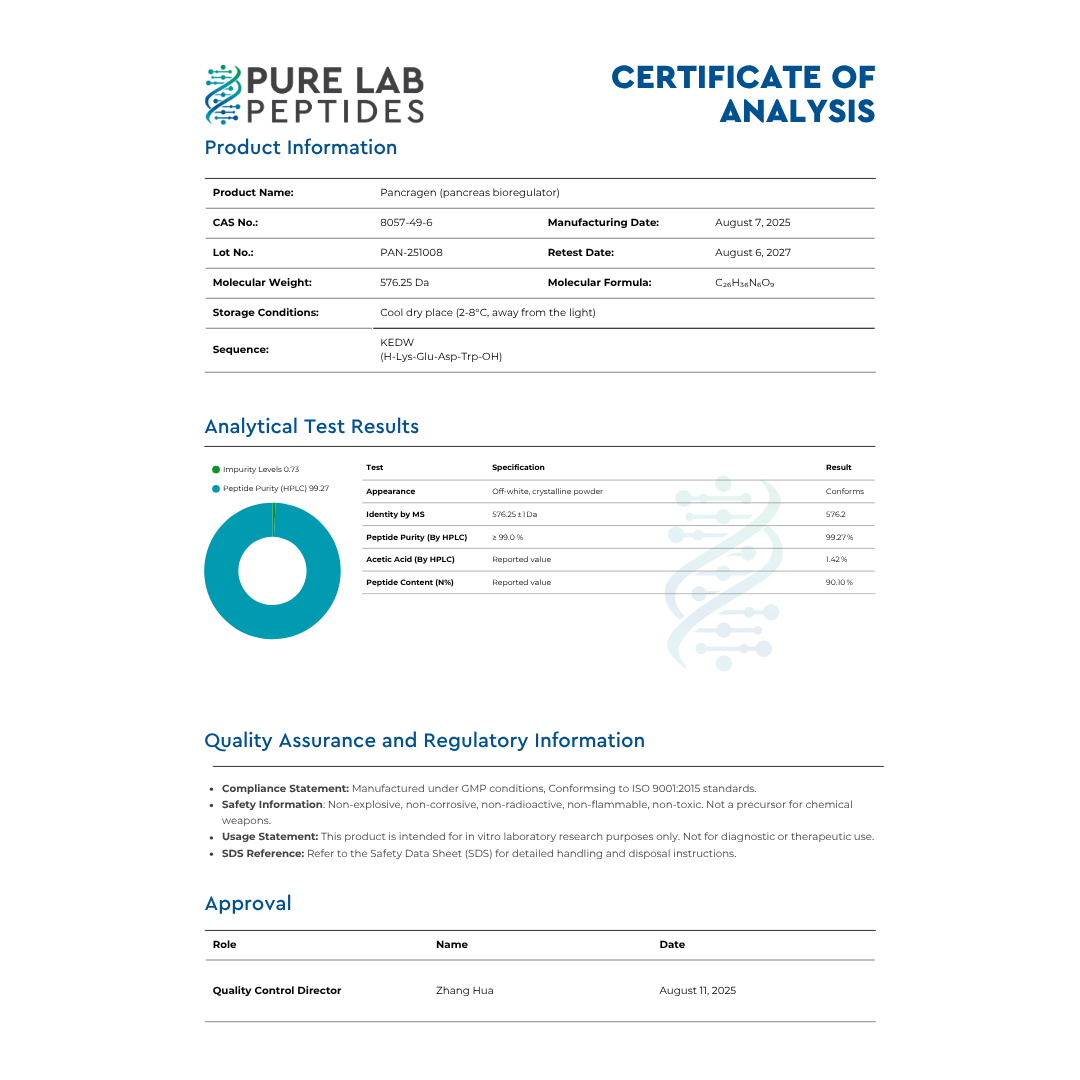
Before researchers buy Pancragen for research, the COA should be reviewed as a batch-specific document. A strong COA helps connect the material listing to the exact lot under evaluation.
A COA should identify the compound name, lot number, testing date, purity result, analytical method, and lab source. Analytical validation guidance treats identity and purity as common analytical-measurement categories, which supports reviewing whether those categories are addressed in the documentation [4].
For Pancragen, the COA should be compared against product-page identity fields. The compound name, KEDW notation, and lot number should tell the same story.
Researchers should compare the COA, label, product listing, and supplier record. ISO/IEC 17025 is widely used as a laboratory competence standard because it helps laboratories demonstrate competent operations and valid results [13].
Batch-specific consistency matters because peptide listings can share a compound name while differing in lot number, test date, analytical record, or documented form. The procurement file should preserve the exact records reviewed.
HPLC is commonly used in peptide purity assessment because chromatographic methods separate components and can report purity-related peaks under defined method conditions. ICH Q2(R2) frames purity, impurities, assay, and identity as analytical-procedure categories, while FDA methods guidance discusses analytical data used to support identity, quality, purity, and related attributes [4], [5].
Purity is not the same as full identity confirmation. A research buyer should look for both purity data and identity-supporting evidence.

Analytical testing turns a product-page claim into reviewable documentation. For peptides, the useful question is whether the method matches the attribute being evaluated.
HPLC can support purity review by showing chromatographic separation and relative peak information under defined method conditions. FDA guidance discusses chromatographic-method validation, integration, standards, controls, samples, and impurity-related calculations as part of analytical-method documentation [5].
For Pancragen, the COA should make clear whether purity is reported by HPLC and whether the record is batch-specific. A chromatogram is more useful when it is tied to the same lot.
LC-MS can support identity verification by pairing liquid chromatography with mass spectrometry data. USP’s discussion of synthetic peptide quality highlights the role of reference standards and analytical methods in supporting peptide identity and quality evaluation [15].
For Pancragen, mass data can be compared with the expected molecular record for the documented form. It should be read alongside the COA, not as a standalone marketing point.
Chromatogram data can show separation behavior, while mass data can support molecular identity review. Peptide quantification literature notes that HPLC and related analytical approaches are used in peptide reference-standard and quantification contexts, with method details shaping interpretation [16].
A documentation-focused lab-test verification workflow can include:
Lot traceability links a research material to its documentation. Without that link, a COA may describe a different batch than the one being evaluated.
Lot numbers help connect the label, COA, inventory record, and procurement file. NIST describes metrological traceability as a way to support measurement results through documented relationships to references and measurement systems [17].
For research buyers, lot traceability is practical. It helps the team know which analytical record belongs to which material.
Labeling consistency means the product name, sequence notation, RUO statement, and lot details align across records. FDA IVD labeling resources state that a product in the laboratory research phase may be labeled “For Research Use Only” in that specific IVD context [18].
A Pancragen peptide page should apply the broader principle cautiously: clear RUO labeling should match the page’s research-only positioning. It should not imply approval or a non-research intended purpose.
Storage and handling documentation is part of the procurement record. It should describe laboratory handling conditions without turning the page into preparation guidance.
Lyophilized peptide means freeze-dried peptide material. Freeze-drying removes water from a formulation to create a solid state that can support stability planning in pharmaceutical and biotherapeutic contexts [19].
For a Pancragen listing, lyophilized status should be documented as a physical-form attribute. It should not be treated as an outcome claim.
Storage records help laboratory teams track conditions, dates, and handling history. Peptide stability reviews describe peptides as vulnerable to degradation pathways influenced by structure and environment, which supports documenting storage conditions carefully [20].
A strong procurement file includes the supplier’s storage statement, receiving date, lot record, COA, and internal laboratory notes. The goal is traceability and consistency.
Pancragen research applications should be described as laboratory research contexts. Common misunderstandings usually happen when literature language is copied into product positioning without boundaries.
A research application is a study context, such as compound characterization, pancreatic cell culture research, or gene-expression marker review. A product claim is language that says or implies what the material does outside that research context.
For Pancragen, the safe route is to discuss research applications as literature categories. Do not convert study findings into commercial promises.
A mechanistic model can describe peptide regulation, transcription-factor markers, cell signaling, or pancreatic cell differentiation. For example, pancreatic transcription-factor literature discusses PDX1, FOXA2, Nkx2.2, and related factors in islet-cell gene regulation [21].
The misunderstanding is assuming pathway relevance equals product performance. It does not. Pathway models guide research interpretation; documentation guides procurement.

For research teams comparing peptide suppliers, the practical question is whether the product page, COA, label, and batch documents are consistent. That review should happen before selecting any research-use-only peptide.
Pure Lab Peptides supplies compounds for laboratory research use only. Products are not intended for human or animal consumption, diagnostic use, therapeutic use, clinical use, veterinary use, or as food, drugs, cosmetics, dietary supplements, or household products. Researchers are responsible for ensuring lawful, appropriate handling and use in accordance with applicable regulations and institutional guidelines.
Ask whether the COA is batch-specific, whether HPLC is used for purity review, whether LC-MS or another suitable method supports identity, whether chromatogram or mass data are available, and whether the lot number matches all records. ICH Q2(R2) notes that analytical procedures may be directed to identity, purity, impurities, assay, and other measurements, which makes method-to-attribute alignment a core review point [4].
Review the product-page documentation, COA details, and RUO labeling before evaluating Pancragen for laboratory research.
Pancragen is described in research literature as a short peptide associated with the amino acid sequence Lys-Glu-Asp-Trp, also represented as KEDW [1]. In RUO product-page context, Pancragen should be discussed through compound identity, peptide documentation, and literature interpretation rather than product-use claims.
Research use only means Pancragen is intended solely for controlled laboratory research contexts. For product-page review, that means the focus should remain on RUO labeling, COA documentation, peptide identity, lot traceability, and supplier records. It should not be framed as a material for human or animal consumption.
Researchers should consider documentation before they buy Pancragen for research. The key review points are batch-specific COA availability, lot number consistency, purity documentation, identity-supporting analytical records, RUO labeling, and whether supplier documentation aligns across the product listing, label, and laboratory record.
A COA matters because it helps connect Pancragen documentation to a specific batch. Researchers should review whether the COA lists the compound name, lot number, testing date, purity method, and identity-supporting records. The COA should be read alongside product documentation, not as a standalone claim.
Published literature about Pancragen should be interpreted as research context, not product positioning. Literature may discuss topics such as regulation of gene expression, pancreatic islets, pancreatic acinar models, or signal transduction, but those topics should stay tied to study conditions, model limitations, and RUO documentation review.
Pancragen product pages should stay research-use-only by separating literature discussion from product claims. A safe page can describe Pancragen bioregulator research, synthetic tetrapeptide bioregulator terminology, and bioregulator peptides as a research category, while keeping the page focused on compound identity, COA review, analytical testing, and lot traceability.
The following authors are recognized for published research that helped shape the scientific context discussed in this article.
Author profile: Institutional Profile
Vladimir Khavinson authored and co-authored published work central to the Pancragen and short peptide literature discussed in this article. His publications are relevant to the bioregulator peptide research lane, especially where Pancragen is framed through KEDW sequence context, pancreatic cell model interpretation, and peptide-linked gene expression. His work also helped shape the broader literature base used to separate model-specific research findings from product-page documentation, COA review, analytical testing, and RUO positioning.
Selected publications:
Author profile: ResearchGate
Boris F. Vanyushin’s published work is relevant to the molecular and epigenetics background that supports the article’s discussion of short peptide research. His publications help provide context for DNA methylation, chromatin-linked regulation, and peptide-associated gene-expression models. This background is useful for interpreting Pancragen as a research topic within bioregulator peptide literature while keeping the product-page discussion focused on compound identity, research documentation, and literature boundaries.
Selected publications:
This research disclaimer clarifies how this page handles published literature and search language around Pancragen. In Bioregulator Peptide Research content, terms such as effects of Pancragen, diabetes mellitus, experimental diabetes, glucose levels, blood glucose, endocrine function, age-related, metabolic disorders, clinical outcomes, human study language, wellness language, and consumer outcomes can drift into consumer-facing, clinical-use, wellness, therapeutic, or product-claim language when framed incorrectly.
Here, those phrases are handled only as research-language examples for published literature interpretation and model-specific context. They are not presented as product claims, intended outcomes, personal-use guidance, or research material recommendations. The focus remains on Pancragen identity, COA review, analytical testing, peptide purity, lot traceability, RUO labeling, product documentation, and clear separation between literature discussion and product positioning.
Discount Applied Successfully!
Your savings have been added to the cart.




There are no reviews yet.