

$49.99
Research Studies:


FREE Shipping on
orders over $200
ALL ARTICLES AND PRODUCT INFORMATION PROVIDED ON THIS WEBSITE ARE FOR INFORMATIONAL AND EDUCATIONAL PURPOSES ONLY. The products offered on this website are intended solely for research and laboratory use. These products are not intended for human or animal consumption. They are not medicines or drugs and have not been evaluated or approved by the FDA to diagnose, treat, cure, or prevent any disease or medical condition. Any form of bodily introduction is strictly prohibited by law.
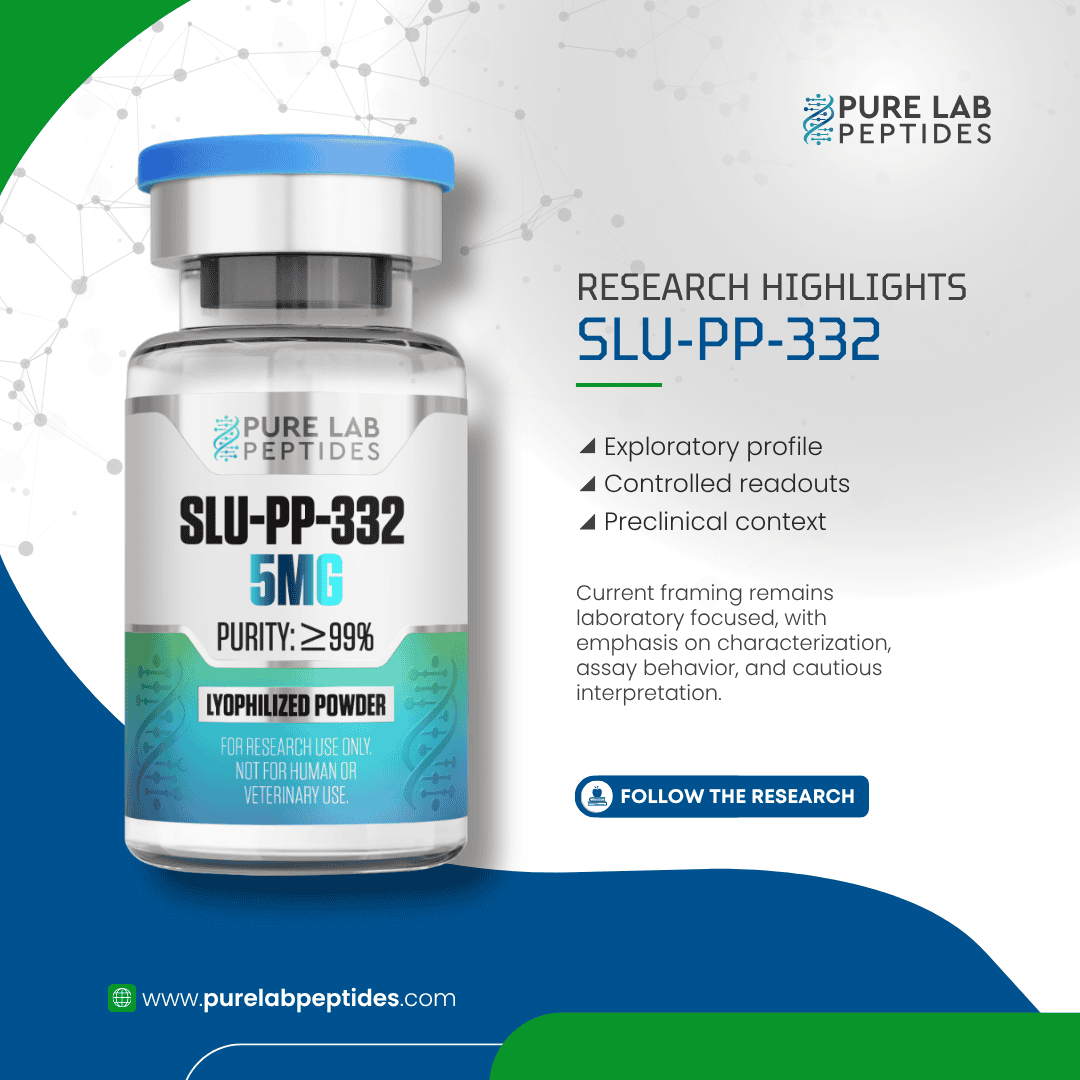
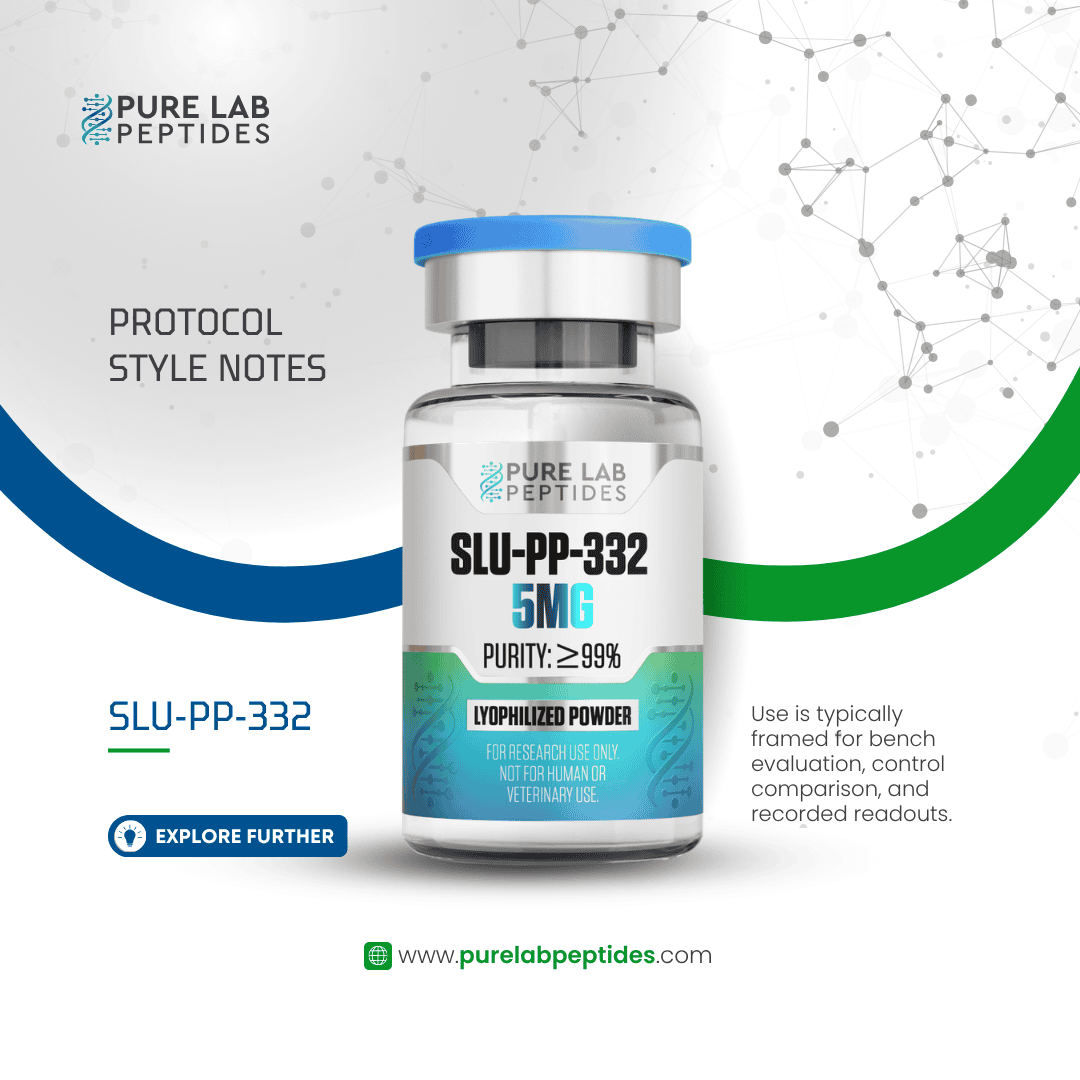
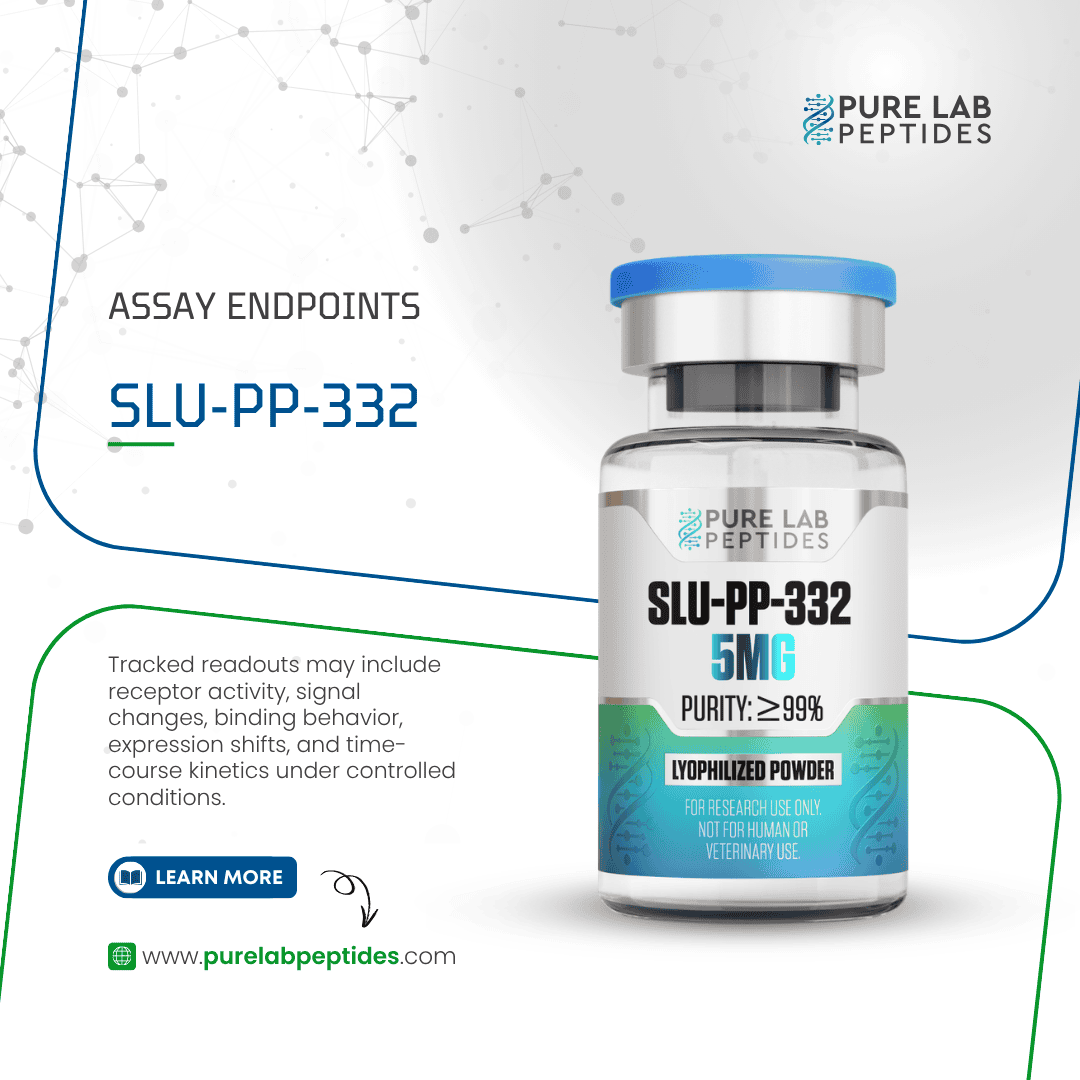
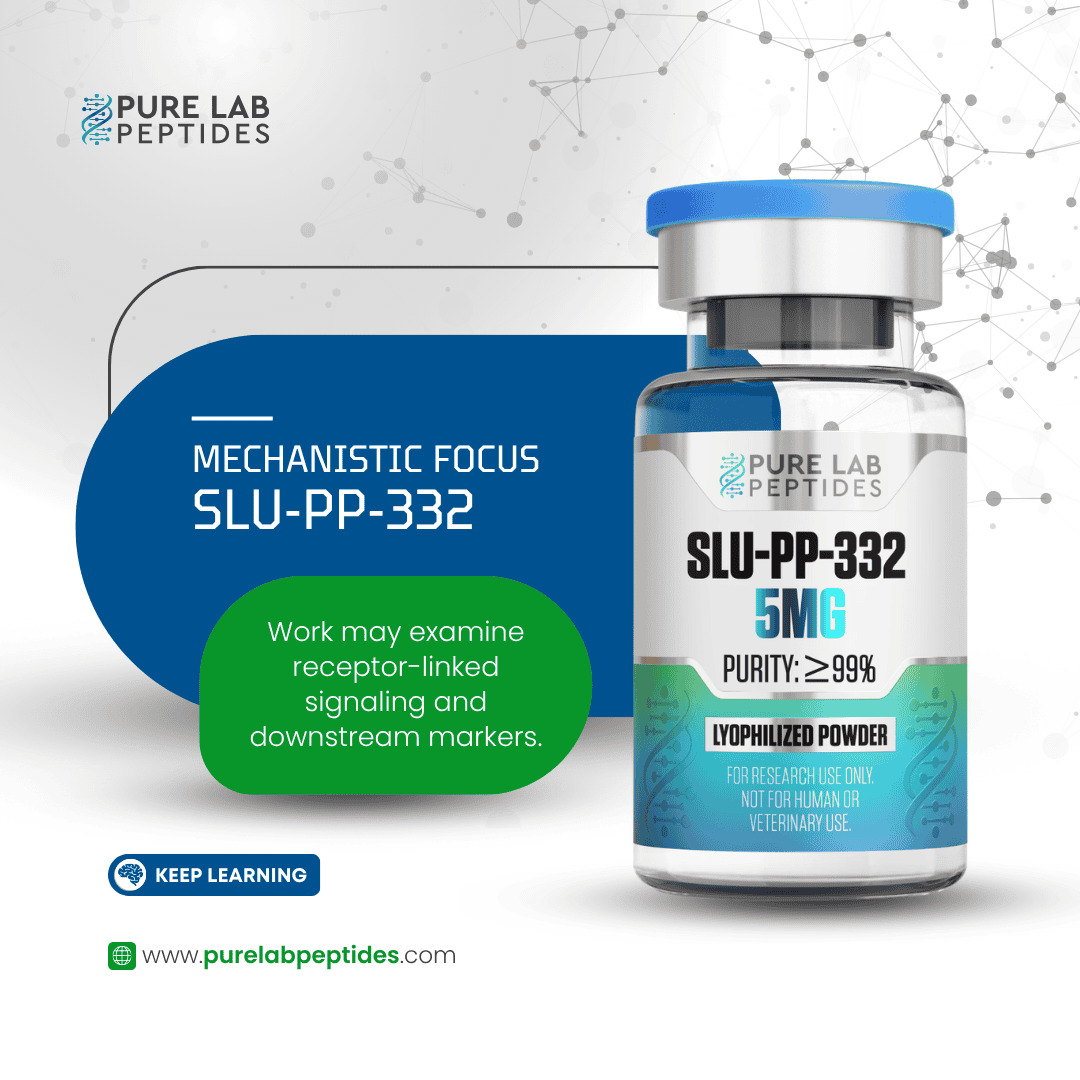
SLU-PP-332 5mg is a research-use-only laboratory material supplied for controlled research workflows, compound characterization, and analytical documentation review. It is manufactured under rigorous quality standards to support consistency, traceability, and batch-specific verification for qualified laboratory settings.
SLU-PP-332 5mg is intended strictly for laboratory research use only. This product is not intended for human or animal consumption, therapeutic use, diagnostic use, clinical use, veterinary use, or as a food, drug, cosmetic, dietary supplement, or household product.
| CAS No. | [To be confirmed] |
|---|---|
| Molecular Formula | [To be confirmed] |
| Molecular Weight | [To be confirmed] |
| Purity | ≥99% |
| Sequence | [Pending disclosure or proprietary] |
| Applications | Appetite suppression, energy regulation, metabolic research, insulin pathway studies |
| Synthesis Method | Solid-phase synthesis |
| Format | Lyophilized powder |
| Solubility | Water/Sterile Diluent |
| Stability & Storage | Up to 24 months at -20°C. Avoid repeated freeze-thaw cycles. |
| Appearance | White to off-white powder |
| Regulatory/Compliance | Not for human consumption. For research use only. |
| Safety Information | MSDS available upon request |
Consider these supplementary peptides for a comprehensive research approach.
For laboratories evaluating where to buy SLU-PP-332 for research, the first question is not hype, but whether compound identity, analytical records, and RUO labeling support a defensible procurement review. SLU-PP-332 is cataloged as a small-molecule compound with formula C18H14N2O2 in PubChem [1]. This Pure Lab Peptides guide keeps the discussion in research-use-only context and separates published ERR literature from product-page claims.
Researchers should buy SLU-PP-332 for research only after reviewing RUO labeling, batch-specific COA availability, lot-number alignment, compound identity, and analytical records. Products discussed in this article are intended for laboratory research use only and are not intended for human or animal consumption. Published literature frames SLU-PP-332 as an ERR receptor research tool, not as product-use guidance [2].
The phrase “buy SLU-PP-332 for research” should be understood as a technical procurement query, not a consumer buying phrase. The research buyer is evaluating whether the listing, COA, label, and supplier documentation create a traceable record suitable for controlled laboratory research.
That shift matters. The commercial intent stays intact, but the page focus moves from claims to verification.
Start with three records: the product label, the batch-specific certificate of analysis, and the lot-level analytical record. FDA analytical-method guidance describes identity, quality, purity, and potency documentation as core functions of analytical procedures in regulated development contexts, which makes identity and purity records useful models for research-material review [16].
For SLU-PP-332, the core question is simple: do the name, lot number, formula, testing method, and COA date tell the same story?
RUO labeling keeps the product page anchored to laboratory research. It also prevents published literature from being misread as a claim about the catalog material.
A well-framed RUO page should clarify the compound, describe documentation, summarize relevant literature cautiously, and avoid product-performance language that could imply a claim outside laboratory research.
A product-page research guide should support procurement without turning into a general wellness article or a clinical explainer. For SLU-PP-332, that means keeping the commercial pathway focused on documentation quality, research literature context, and batch-specific review.
The goal is not to tell readers what to do with the compound. The goal is to help qualified research buyers evaluate whether a research material listing is documented clearly.
Research use means the page should support laboratory evaluation, not personal decision-making. In this context, relevant information includes compound identity, analytical testing, COA documentation, supplier records, storage notation, and literature boundaries.
A controlled laboratory listing should avoid claims that transform a mechanistic paper into a product promise.
Laboratory use stays separate from claims by keeping each information type in its lane. Product documentation describes the material; published literature describes model-specific investigations; procurement review checks whether the supplier record is complete.
Some published literature outside the scope of RUO product use has examined this compound class in human study settings. That literature should not be interpreted as a use claim for research-use-only materials.
SLU-PP-332 appears in the literature as a synthetic small-molecule compound studied in estrogen-related receptor research [1] [2]. PubChem lists its molecular formula as C18H14N2O2, while published work describes it as a synthetic ERR pan-agonist with highest reported activity toward ERRα [1] [2].
That identity matters for product-page accuracy. A listing may appear in a peptide catalog, but SLU-PP-332 should be described by its chemical identity rather than forced into peptide sequence language.
SLU-PP-332 is best handled as a research compound in the metabolic and mitochondrial research lane. The peer-reviewed literature reports it in ERR receptor models, mitochondrial function studies, transcriptional-response work, and structure-activity research [2] [12].
A product page should therefore emphasize compound characterization, not consumer-facing outcomes.
The selected product title uses “peptide,” but the scientific identity record points to a small molecule. PubChem and SLU-PP-332 publications identify a defined small-molecule compound rather than an amino-acid peptide sequence [1] [2].
That clarification helps prevent confusion during documentation review. Researchers should match the product name and formula against the COA and analytical records, not rely on category shorthand alone.
Safe research applications include receptor activity assays, ERR pathway research, transcriptional response models, mitochondrial function models, compound characterization, and analytical verification. Published work has used SLU-PP-332 in cell-line and preclinical model settings to examine ERR-linked signaling and mitochondrial endpoints [2] [9].
These are research applications, not product-positioning statements.
SLU-PP-332 is relevant because ERRα, ERRβ, and ERRγ are nuclear receptor family members involved in transcriptional regulation. The 2023 ACS Chemical Biology study reported SLU-PP-332 as a synthetic ERRα/β/γ agonist with the strongest reported potency toward ERRα [2].
For product-page purposes, the important point is not to overstate pathway relevance. ERR receptor context explains why researchers study the compound; it does not create a claim about a research material.
NCBI Gene identifies ESRRA as the gene encoding estrogen-related receptor alpha, a nuclear receptor related to the estrogen receptor family and linked to PGC-1 cofactor interaction [3]. NCBI also catalogs ESRRB and ESRRG as genes encoding the beta and gamma receptor-family members [4] [5].
This receptor-family context supports same-lane research coverage. It should not be rewritten into claims about the product.
In keyword datasets, ERRA often refers to ERRα or ESRRA-related context. Published ERR literature describes ERRs as transcriptional regulators tied to energy-homeostasis gene networks and mitochondrial biogenesis pathways [6].
In laboratory language, “ERR activation” should be framed as receptor activity observed under model-specific assay conditions. It should not be presented as an outcome claim.
SLU-PP-332 belongs in metabolic and mitochondrial research because ERR pathways are connected to transcriptional programs that regulate mitochondrial function. Reviews describe ERRs and PGC-1 coactivators as linked to mitochondrial biogenesis, oxidative phosphorylation, and cellular energy-production gene networks [6] [7].
For a product page, this supports scientific context. It does not support therapeutic, wellness, or body-composition positioning.
Mitochondrial biogenesis appears in the broader PGC-1 and ERR literature as a transcriptionally regulated process involving nuclear and mitochondrial gene programs [7]. SLU-PP-332 literature has examined mitochondrial function and cellular respiration in laboratory models [2].
That makes mitochondrial biogenesis a relevant research concept, but it should remain tied to model-specific evidence.
ERR and PPAR research literature describes these nuclear receptor pathways as regulators of mitochondrial oxidative metabolism [8]. SLU-PP-332 studies have examined downstream metabolic gene programs in model systems [2] [10].
The safest article frame is pathway research. Avoid turning oxidative metabolism into a product benefit.
SLU-PP-332 evidence is best read as an evidence landscape, not as a product claim. The literature includes receptor assays, cell-line models, murine model studies, cardiac metabolic research models, chemical optimization work, and analytical characterization [2] [9] [10] [12] [13].
| Research Area | What Literature Examines | Evidence Type | RUO Interpretation |
|---|---|---|---|
| ERR receptor activity | SLU-PP-332 activity across ERRα, ERRβ, and ERRγ, with highest reported activity toward ERRα [2] | Receptor and cell-based research | Supports pathway context, not product claims |
| Mitochondrial research | Cellular respiration and mitochondrial function in model systems [2] | In vitro and preclinical literature | Supports mechanistic framing only |
| Metabolic models | Energy expenditure and oxidation endpoints in murine model research [9] | Preclinical literature | Model-specific; not RUO product-use guidance |
| Cardiac metabolic models | ERR-linked fatty acid metabolism and mitochondrial function in a pressure-overload model [10] | Preclinical and in vitro literature | Academic context only |
| Analytical characterization | LC-HRMS/MS characterization of SLU-PP-332 and related ERR agonists [13] | Analytical chemistry literature | Useful for identity and method context |
Preclinical literature can support a limited statement: researchers have investigated SLU-PP-332 in model systems relevant to ERR receptor activity, mitochondrial function, oxidative metabolism, and transcriptional signaling [2] [9].
It cannot support product-use claims for RUO materials. Product pages should keep findings tied to the models in which they were generated.
Mechanistic study design determines what a paper can and cannot show. A receptor assay, cell-line study, preclinical model, SAR paper, or LC-MS characterization study answers a different type of question [11] [12] [13].
For procurement teams, this is where source quality matters. The stronger page is the one that explains evidence limits clearly.
The key research boundary is simple: literature can describe what researchers examined, but the product page should not convert those observations into claims about the material. This is especially important when search language drifts toward product performance or clinical-use language.
Pure Lab Peptides product-page content should keep the focus on RUO labeling, COA review, analytical verification, lot traceability, and research documentation.
Study findings are tied to specific models, materials, methods, and endpoints. A published paper about ERR signaling does not automatically describe a supplier’s batch, purity, identity, or intended research context.
That is why documentation must come first. The product listing should show what the material is; the literature section should show why the compound is discussed in research.
Claim boundaries protect clarity. They prevent pathway context from becoming a benefit statement, and they keep research buyers focused on records they can inspect.
A safer structure is: compound identity, pathway context, literature limits, COA review, analytical testing, lot traceability, and documentation checklist.
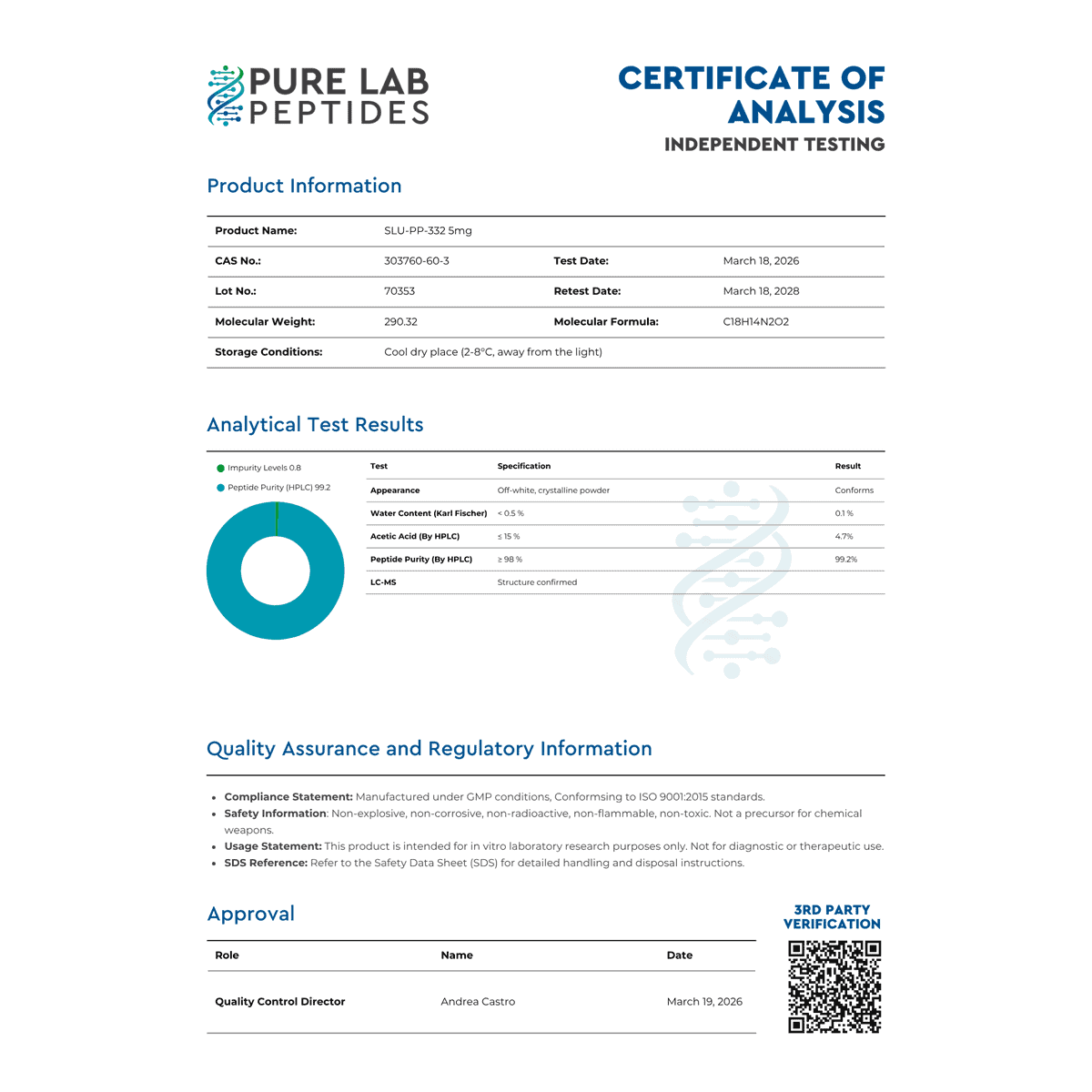
A certificate of analysis is one of the main records researchers review before selecting an RUO compound. It should identify the compound, the batch or lot, the purity result, the test method, the date, and the lab or supplier record source.
ICH Q2(R2) describes analytical validation principles such as specificity, accuracy, precision, range, and robustness for analytical procedures [14]. Those principles are useful reference points when reviewing whether a COA is clear enough for laboratory research procurement.
For SLU-PP-332, the COA should identify the compound name, lot number, purity value, analytical method, and record date. If formula or molecular weight appears, it should align with recognized compound identity records such as PubChem [1].
A COA without batch-specific details is weaker than a COA that can be matched back to the product label and supplier record.
Batch-specific verification helps researchers avoid treating a generic document as proof for a specific material. FDA data-integrity guidance emphasizes complete laboratory records, including notebooks, worksheets, graphs, charts, spectra, and related data where applicable [17].
For RUO procurement, the practical question is whether the COA and supporting files match the actual lot under review.
COA dates help establish when the reported testing was completed. A recent date does not automatically prove better documentation, but a missing date makes the review less complete.
The best record set connects the COA date with the lot number, supplier documentation, testing method, and material label.
Analytical testing should answer two separate questions: is the material consistent with the expected compound identity, and what does the purity method report? ICH Q14 describes science- and risk-based approaches for analytical procedure development, while ICH Q2(R2) focuses on validation principles for analytical procedures [14] [15].
A documentation-first lab-test verification workflow can be organized this way:
HPLC can support purity review by separating components in a sample and reporting chromatographic peaks under defined method conditions. Peak-purity analysis in LC-MS datasets has been described as a way to evaluate chromatographic purity signals, while ICH validation guidance emphasizes that analytical methods should be suitable for their intended analytical purpose [14] [21].
Purity review is not the same as full identity confirmation. That is why HPLC and LC-MS records are often reviewed together.
LC-MS combines chromatographic separation with mass spectrometric detection, which can support small-molecule identity review when interpreted against suitable reference data and method records [18] [19]. MS/MS library-search literature also notes that tandem spectra can support small-molecule annotation when instrument settings, acquisition mode, and scoring are considered [20].
For SLU-PP-332, LC-MS should be read as part of a documentation package, not as a standalone guarantee.
Assay purity can report the result of a defined method under defined conditions. It cannot, by itself, replace compound identity review, lot matching, chromatogram review, or mass data review.
High-resolution mass spectrometry reviews describe HRMS as useful for compound characterization workflows, but the strength of the conclusion still depends on method quality and data interpretation [22]. Mass spectrometry references also emphasize mass-to-charge information as a core feature of MS analysis [25].
Lot traceability connects the physical material, product label, COA, and analytical records. Without that connection, a research buyer cannot confidently determine whether the documentation belongs to the batch being evaluated.
The supplier documentation should support reproducibility. It should also make internal recordkeeping easier for laboratory teams.
Lot numbers allow research teams to connect experimental records to a specific material batch. In scientific data management, the FAIR principles emphasize findability, accessibility, interoperability, and reusability of data assets [23].
For RUO materials, lot traceability supports a similar practical goal: records should be findable, retrievable, and connected to the material under review.
The compound name, lot number, COA, label, purity method, identity method, and storage notation should match. Where an external identity source is used, PubChem can be a useful cross-check because it aggregates chemical data for many compounds and substances [24].
A mismatch does not always mean the material is unusable for research evaluation, but it should trigger closer documentation review.
Labeling and storage records help researchers preserve a clear material history. The label should identify the material and RUO status, while storage documentation should support internal laboratory recordkeeping.
Storage guidance should be treated as supplier documentation, not as personal-use or clinical guidance.
RUO labeling clarifies that the material is supplied for research purposes only. It also helps separate the product page from published literature that may discuss experimental model findings.
For product-page clarity, RUO labeling should appear consistently across the product listing, COA, and supporting documentation.
Storage records help laboratories document how the material is tracked after receipt. FDA data-integrity guidance highlights the value of complete, accurate records in laboratory contexts, including records that support review and retrieval [17].
For SLU-PP-332, storage records should be archived with lot information, COA details, and any analytical documentation supplied.
Researchers should evaluate the product page as a documentation hub. The strongest listing will help a technical buyer confirm identity, RUO status, batch documentation, testing methods, and supplier transparency before procurement.
Use this practical checklist:
A research product listing should state the compound name, RUO status, available documentation, and testing overview. If the listing uses a category term such as peptide, it should still clarify that SLU-PP-332 is documented as a synthetic small-molecule compound [1].
Clear product listings reduce ambiguity. They also make COA review faster.
Research buyers should compare supplier records by asking whether the documents are batch-specific, method-aware, and consistent. FDA analytical-method guidance and ICH analytical-development guidance both reinforce that analytical procedures should be connected to defined quality and method objectives [15] [16].
The supplier with clearer documentation gives laboratory teams a stronger review trail.
Several misunderstandings can weaken RUO product-page accuracy:
Search language often compresses complex literature into short phrases. That can create problems when receptor activity, mitochondrial function, or metabolic model findings are rewritten as claims about a product.
A safer page structure keeps literature interpretation separate from listing claims and brings the discussion back to COA review, analytical testing, and RUO documentation.
Mechanistic findings describe what a study investigated under defined conditions. Commercial positioning describes what a product page says about a material.
For SLU-PP-332, the commercial page should focus on research documentation, not on translating ERR or mitochondrial model findings into promotional language.
Before procurement, researchers should review whether the documentation package supports identity, purity, lot traceability, and RUO positioning. This is the most practical way to satisfy commercial research intent without shifting into consumer-oriented language.
For Pure Lab Peptides, the documentation-first frame is simple: review the product page, inspect available COA details, compare lot-level records, and keep published literature in research context.
Lab teams should review the RUO label, compound name, COA, lot number, purity method, identity method, and storage documentation. They should also compare the compound identity against reliable chemistry databases and peer-reviewed literature [1] [2].
If any record is missing, the purchasing file should note the gap.
Analytical records help technical procurement teams evaluate whether supplier claims are supported by method-level evidence. LC-MS and HRMS literature show why mass data, chromatographic behavior, and spectra can add identity context when interpreted properly [18] [22].
The decision should rest on documentation quality, not on marketing copy.
The next step is to organize the review file. A clean RUO procurement file should include the product-page record, COA, lot number, analytical testing notes, storage records, and cited literature notes.
Pure Lab Peptides supplies compounds for laboratory research use only. Products are not intended for human or animal consumption, diagnostic use, therapeutic use, clinical use, veterinary use, or as food, drugs, cosmetics, dietary supplements, or household products. Researchers are responsible for ensuring lawful, appropriate handling and use in accordance with applicable regulations and institutional guidelines.
Lab teams can organize the record into four groups: identity documents, COA documents, analytical testing documents, and post-receipt laboratory records. This structure aligns with the broader FAIR idea that scientific data should be findable, accessible, interoperable, and reusable where appropriate [23].
A clean archive also helps future literature interpretation.
Researchers should archive the product label, COA, lot number, analytical records, storage notation, receipt date, and supplier documentation. If literature notes are kept, they should identify the source type: database, receptor study, preclinical literature, analytical paper, or review.
Review the product-page documentation, COA details, and RUO labeling before evaluating this compound for laboratory research.
The following authors are recognized for published research that helped shape the scientific context discussed in this article.
Author profile: University of Health Sciences & Pharmacy Scholars Profile
Cyrielle Billon, PhD, is recognized for published work on synthetic ligands for nuclear receptors, including ERR-focused research relevant to SLU-PP-332. Her publications helped shape the article’s discussion of receptor pathway research, compound characterization, and model-specific interpretation in the metabolic and mitochondrial research lane. The RUO framing in this article draws on this type of literature to distinguish what researchers can learn from controlled models from what a product page should document through COA review, lot traceability, and analytical testing. Her SLU-PP-332 publications also provide context for careful discussion of pathway activity, transcriptional context, and mitochondrial model endpoints.
Selected publications:
Author profile: University of Florida Profile
Thomas P. Burris, PhD, is recognized for published research in nuclear receptor chemical biology and pan-ERR ligand development. His work is directly relevant to the article’s discussion of SLU-PP-332, ERR receptor pathway research, and the need to interpret mechanistic studies as literature context rather than product-page guidance. Because the article also emphasizes analytical testing and documentation, Burris’s publications provide useful background for how chemical series, receptor selectivity, parameter selection, and compound characterization connect to a laboratory research page without shifting into outcome-oriented wording.
Selected publications:
SLU-PP-332 is described in research literature as a small-molecule compound studied in ERR receptor models. Published work frames it as a pan-agonist of estrogen-related receptors, with laboratory interest tied to receptor activity, transcriptional signaling, and mitochondrial research models [1] [2]. That literature should be read as research context, not product positioning.
Researchers should consider documentation first before they buy SLU-PP-332 for research. Key review points include RUO labeling, COA availability, lot traceability, analytical testing, peptide identity language, and whether the product listing clearly separates published literature from product claims. Procurement review should focus on records that can be checked and archived.
An ERR agonist is a research term for a molecule studied for receptor activation in estrogen-related receptor models. For SLU-PP-332, published literature discusses ERRα, ERRβ, and ERRγ activity in model-specific contexts [2]. Researchers should interpret those findings as receptor-pathway research, not as statements about catalog material performance.
SLU-PP-332 fits into metabolic pathway research because ERR signaling is linked in the literature to transcriptional programs, mitochondrial function, oxidative metabolism, and bioenergetics [6] [7]. In a product-page context, these topics help explain why laboratory teams evaluate the compound. They do not convert pathway relevance into a product claim.
Analytical testing should support SLU-PP-332 documentation by connecting purity review, identity confirmation, and batch records. HPLC may support peptide purity or compound purity review, while LC-MS can help evaluate identity when paired with suitable reference data and lot-specific documentation [18] [21]. A COA should be reviewed alongside the label and supplier records.
SLU-PP-332 literature language should be separated from product claims by keeping model findings, research documentation, and product listing details in distinct lanes. Published literature can discuss in vitro research, EC50 values, ligand-binding domain context, signal transduction, or gene-expression models. A research-use-only page should return those topics to COA review, analytical testing, and RUO labeling.
This research disclaimer clarifies how this page handles published literature and search language around SLU-PP-332. In metabolic and mitochondrial research content, terms such as exercise-mimetic, thermogenesis, endurance, locomotor activity, absorption, bioavailability, pharmacokinetics, clinical outcomes, consumer outcomes, product effects, and administration-focused language can drift into consumer-facing, wellness, clinical-use, or product-claim territory when framed incorrectly.
Here, those phrases are handled only as research-language examples, not product uses, outcomes, instructions, or recommendations. The focus remains on SLU-PP-332 identity, COA review, analytical testing, peptide purity, lot traceability, RUO labeling, product documentation, and published literature boundaries, with model-specific research context kept separate from product positioning.
Our team is ready to assist you with any inquiries regarding our catalogue of peptides and their applications.
Discount Applied Successfully!
Your savings have been added to the cart.
Pure Lab Peptides
You must be at least 21 years of age to enter this site. By entering, you confirm that you are of legal age and agree to our terms.
For research use only.


There are no reviews yet.