

Pure Lab Peptides frames this page for qualified laboratory teams evaluating where to buy Adamax for research, with emphasis on documentation, analytical review, and research-use-only positioning. Adamax is discussed here as a research compound in the Semax/ACTH-analogue literature lane; a Medsafe classification submission identifies Adamax and Semax as examples of ACTH analogues with similar chemical-structure considerations [1]. This guide keeps product-page review separate from product claims by focusing on compound identity, COA documentation, peptide purity, analytical testing, and lot-level records.

Researchers looking to buy Adamax for research should first review RUO labeling, compound identity, batch-specific COA documentation, peptide purity testing, LC-MS identity support, and lot-level records before technical procurement. Products discussed in this article are intended for laboratory research use only and are not intended for human or animal consumption. Because Adamax sits near Semax/ACTH-analogue literature, the safer review starts with documentation rather than product claims [1].
Commercial research intent needs a narrow frame. The phrase should be understood as research procurement, not consumer purchase intent. For a Pure Lab Peptides product page, the safer search target is “buy Adamax for research,” supported by documentation, COA review, and RUO scope.
This reframing matters because the same keyword can drift into non-research positioning when the article talks about outcomes rather than documentation. A product-page research guide should answer the practical procurement question: does the label, COA, analytical data, and lot record support responsible laboratory evaluation?
The first documents to check are the product listing, RUO label statement, batch-specific COA, lot number, purity report, and identity-supporting analytical record. FDA’s ICH Q7A guidance for active-ingredient quality systems describes documentation categories such as batch production records, laboratory control records, testing records, and labeling records as quality-system elements [15].
For research buyers, the important point is consistency. The compound name, lot number, COA, and analytical files should tell the same story. A high-purity research material listing is more useful when the reported purity can be traced to a specific test method and a specific batch.
RUO labeling defines the research context for the product page. FDA guidance for IVD materials explains that RUO labeling is tied to materials distributed for research-only contexts rather than diagnostic positioning [16]. FDA’s IVD labeling page also describes the RUO statement “For Research Use Only. Not for use in diagnostic procedures” for qualifying laboratory research-phase materials [17].
That IVD framework is not a peptide-specific product approval statement. It is useful here only as a labeling-boundary reference: RUO language should be clear, prominent, and separate from clinical, diagnostic, or consumer-facing claims.
Adamax is discussed on this page as a research peptide in the neuropeptide research category. Public regulatory and literature context places Adamax near Semax/ACTH-analogue discussion, while compound-specific peer-reviewed literature under the name Adamax remains more limited than the broader Semax literature [1].
Adamax product-page review should begin with compound identity rather than assumed class claims. Public database coverage is stronger for N-acetyl Semax amidate than for the commercial name Adamax; PubChem lists N-acetyl Semax amidate as a terminally modified Semax-related peptide with the sequence MEHFPGP, an IUPAC condensed form of Ac-Met-Glu-His-Phe-Pro-Gly-Pro-NH2, molecular formula C39H54N10O10S, and molecular weight of 855.0 g/mol [2].
Because naming conventions can vary across research-material listings, the product page should not rely on name recognition alone. Researchers should verify whether supplier documentation provides the compound name, sequence or structural description where available, molecular weight, and identity-supporting analytical method.
Semax is a heptapeptide described in peer-reviewed literature as Met-Glu-His-Phe-Pro-Gly-Pro and as an analogue of the N-terminal ACTH fragment 4–10 [3]. Adamax is therefore best framed as an Adamax peptide research listing that may use Semax-analog literature as context, not as proof that one compound has the same research profile as another.
Synthetic peptide analogs often differ through terminal modification, residue substitution, salt form, or other structural changes. Literature on Semax acetyl and Semax analog proteolysis shows why small peptide modifications can matter in model-specific stability research [7] [8]. For Adamax procurement review, that reinforces the need for exact identity documentation.
A research peptide product page should define what can be reviewed: compound identity, purity, method, lot traceability, storage documentation, and literature context. It should not convert pathway relevance into a product claim.
Synthetic peptide identity also depends on manufacturing and purification records. Solid-phase peptide synthesis is a foundational method in peptide synthesis, and modern reviews describe how SPPS supports preparation of biologically relevant peptide materials [19] [20].
A safe product page can support the phrase “buy Adamax peptide for research” when the surrounding copy stays focused on RUO procurement. The page should answer documentation questions, not personal-use questions.
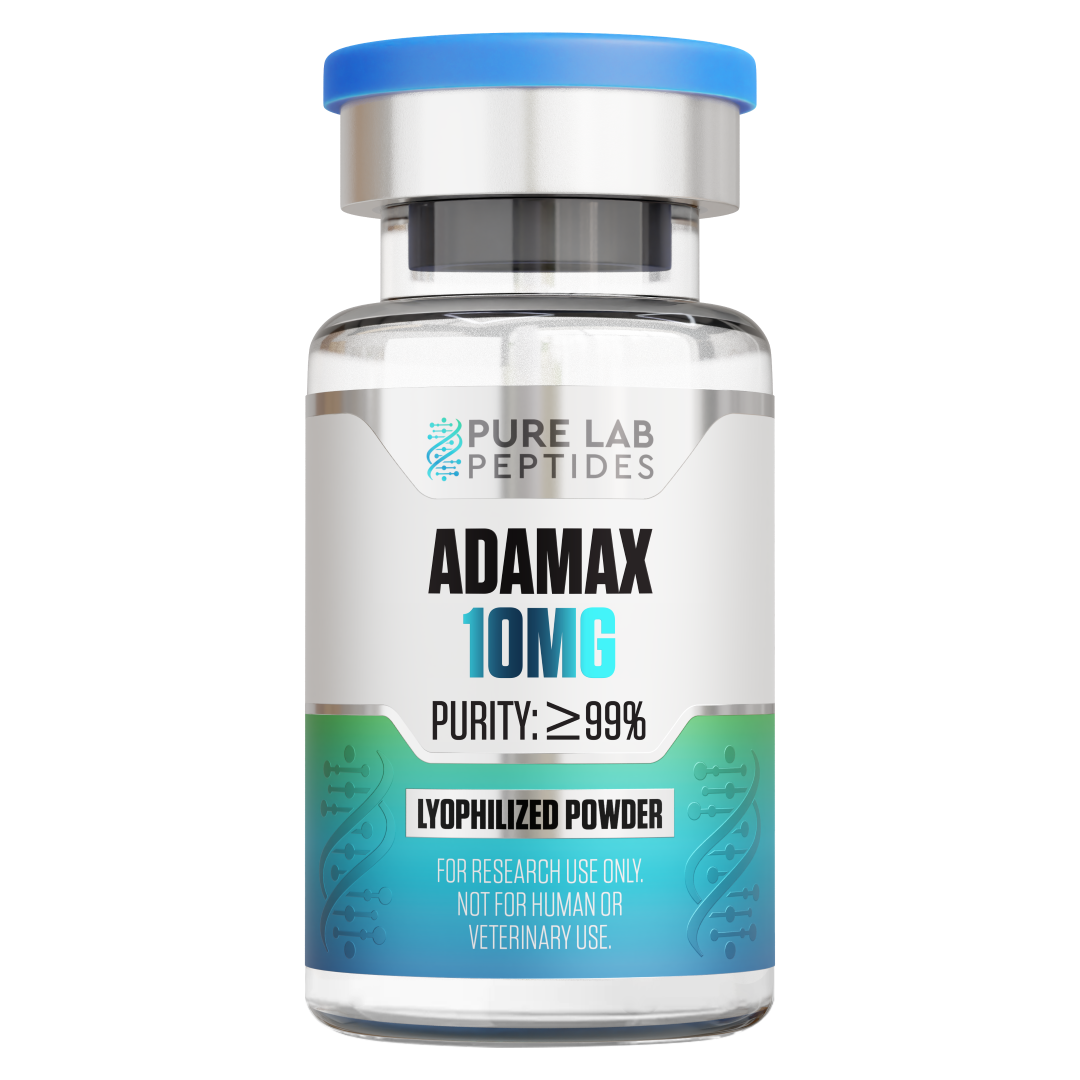
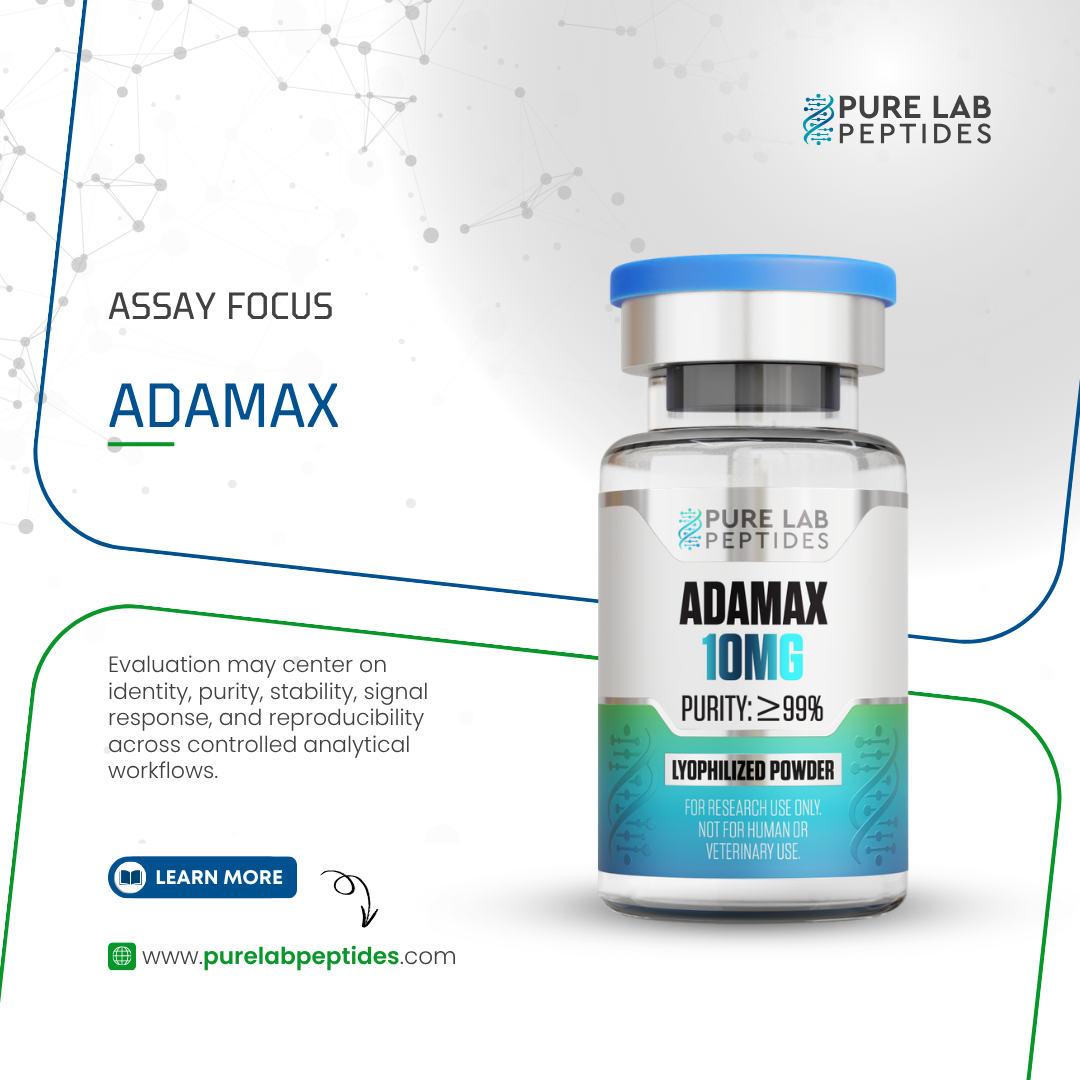
A research material listing should clarify the canonical compound name, research-use-only scope, catalog amount, purity reporting, COA availability, and batch-level documentation. If the page includes a 10mg catalog amount, that amount should be treated as a listing specification only.
The listing should also make clear whether analytical support is batch-specific. A generic document is weaker than a lot-matched COA that includes test date, method, and identity signal.
Catalog amounts and vial sizes should not become separate SEO targets. The product-page article should target Adamax as the canonical research compound.
That approach prevents the article from becoming a variant page. It also keeps the content centered on research documentation instead of quantity-based positioning.
Adamax scientific background should be written with caution because much of the adjacent literature discusses Semax or terminally modified Semax-related compounds. The research page can summarize that literature, but it should not imply equivalence between an Adamax research material and every Semax study.
Published Semax literature has examined ACTH-fragment analogs in model-specific neurobiology research. One study describes Semax as an ACTH(4–10) analogue and reports specific binding and BDNF protein measurements in rat basal forebrain tissue [3]. Other Semax studies have examined gene-expression changes involving neurotrophin-related genes and broader transcriptome patterns in rat model systems [4] [5].
For Adamax, these sources should be treated as same-lane literature context. They can help researchers understand why BDNF, TrkB, synaptic, neuronal, and signal-transduction terms appear in the topic map, but they should not be used as product claims.
Adamax belongs in a neuropeptide research lane because the most relevant adjacent literature centers on Semax, ACTH-fragment analogs, neurotrophic signaling, and neurotransmitter-related models. Semax literature includes work discussing dopaminergic and serotoninergic systems, which is why dopamine and serotonin may appear as same-lane research entities [6].
That does not make Adamax a consumer-facing neurobiology product. It simply helps define the research vocabulary for literature review, source filtering, and pathway mapping.
Preclinical literature can support discussion of model type, assay context, endpoint selection, and mechanistic hypotheses. It cannot support RUO product-positioning claims.
| Research Area | What Literature Examines | Evidence Type | RUO Interpretation |
|---|---|---|---|
| ACTH-analogue context | Medsafe identifies Adamax and Semax as examples of ACTH analogues with similar chemical-structure considerations [1]. | Regulatory classification context | Useful for category framing, not product claims. |
| Semax and BDNF | Semax literature describes binding observations and BDNF protein measurements in rat basal forebrain tissue [3]. | Preclinical literature | Relevant to pathway context only. |
| Neurotrophin and transcriptome work | Semax studies examined neurotrophin gene expression and genome-wide transcriptional patterns in rat models [4] [5]. | Preclinical literature | Model-specific findings should remain literature context. |
| Peptide analytical review | LC-HRMS has been evaluated for peptide quality-control analysis and sequence-change detection in peptide systems [12]. | Analytical literature | Supports identity-review logic, not biological claims. |

Pathway and signal language should help researchers organize literature. It should not imply that an Adamax product page is making claims about product performance.
Relevant pathway models include ACTH-analogue context, Semax-analog literature, BDNF-related signaling, TrkB receptor context, and neurotransmitter-related experimental models. BDNF and related neurotrophin gene-expression work appear in Semax literature, which is why these terms are relevant for Adamax research framing [3] [5].
A pathway model is a map. It helps researchers decide what literature to read and what documentation to verify. It does not establish intended application for a research material.
Signal transduction language should describe what literature examines, not what a product does. UniProt identifies NTRK2/TrkB as a receptor for BDNF and neurotrophin-4, with roles in neuron survival, differentiation, synapse formation, and plasticity as a biological system entry [11].
For an Adamax page, that receptor context belongs in the literature-background layer. It should be tied back to citations, model type, and research limitations.
Neurotrophic signaling is a research concept. It becomes unsafe product-page language when it is written as a direct product outcome.
A safer framing is simple: Semax-related literature has investigated BDNF and neurotrophin-associated markers in specific experimental models [3] [5]. Adamax product documentation should be judged by COA, purity, identity testing, and lot traceability, not by extrapolated claims from adjacent literature.
Receptor and molecular context can improve topical depth when it stays tied to evidence quality. For Adamax, the strongest approach is to separate three layers: the compound listing, the analytical documentation, and the published literature context.
BDNF/TrkB context belongs in the literature interpretation section. Reviews describe BDNF as a key neurotrophin involved in synaptic plasticity research, and UniProt identifies NTRK2/TrkB as a receptor for BDNF [10] [11].
For Adamax, this context helps explain why neuroplasticity research appears in topical mapping. It does not establish a product claim, intended research outcome, or comparative product statement.
Semax literature includes a study on dopaminergic and serotoninergic systems [6]. That makes dopamine and serotonin relevant as same-lane research entities.
The safer article language is “neurotransmitter-related models,” not claims that a research compound changes a biological outcome in a predictable way. Any discussion should stay tied to the specific cited literature and model context.
Synaptic and neuronal language should be treated as scientific vocabulary, not marketing copy. BDNF literature has been reviewed in relation to synaptic plasticity, but that review context does not define Adamax product positioning [10].
For a research-use-only page, synaptic and neuronal terms are useful when they help classify literature, pathway maps, and experimental questions. They should not be used as claims about the material being listed.
The literature interpretation framework should keep the review process structured. A strong framework asks four questions: What compound was studied? What model was used? What endpoint was measured? What can the product page safely say?
Lab teams should prioritize peer-reviewed literature, official databases, official guidance, and method-specific analytical sources. PubChem is useful for database-level molecular identity context when a compound entry is available [2]. PubMed-indexed Semax studies are useful for adjacent literature review [3] [4] [5] [6].
Analytical sources should also be filtered by method. FDA’s Q2(R2) guidance describes validation principles for analytical procedures, including considerations for spectroscopic data [14].
Preclinical findings are model-specific. The fact that Semax literature examines BDNF, transcriptome patterns, or neurotransmitter-related systems does not mean those findings should become product-page claims for Adamax [3] [4] [5] [6].
A safe RUO interpretation is narrower: published literature can inform the research background, but product-page decisions should focus on identity, purity, COA documentation, and batch records.

Claim boundaries protect the page from drifting into consumer, clinical, or therapeutic positioning. They also make the page more useful for technical buyers because the content stays focused on verifiable documentation.
Search terms around Adamax and Semax can drift into product claims if the page repeats unsupported outcome language. The Medsafe submission notes that Adamax and Semax had been marketed as “cognitive enhancers”; on an RUO page, that phrase belongs only as a claim-boundary example, not as product positioning [1].
The safer path is to answer the research procurement question. What is the compound? What documents are available? What analytical methods support identity and purity? What lot-specific records can be reviewed?
Published literature and product documentation have different roles. Literature can describe research findings in a specific model. Product documentation can support review of the material’s identity, purity, lot number, and labeling.
Some published literature outside the scope of RUO product use has examined this compound class in settings that are not product-page positioning. That literature should not be interpreted as a use claim for research-use-only materials.
Research pages should emphasize documentation quality, method transparency, and scope control. Common misunderstandings to keep separate from the product page include:

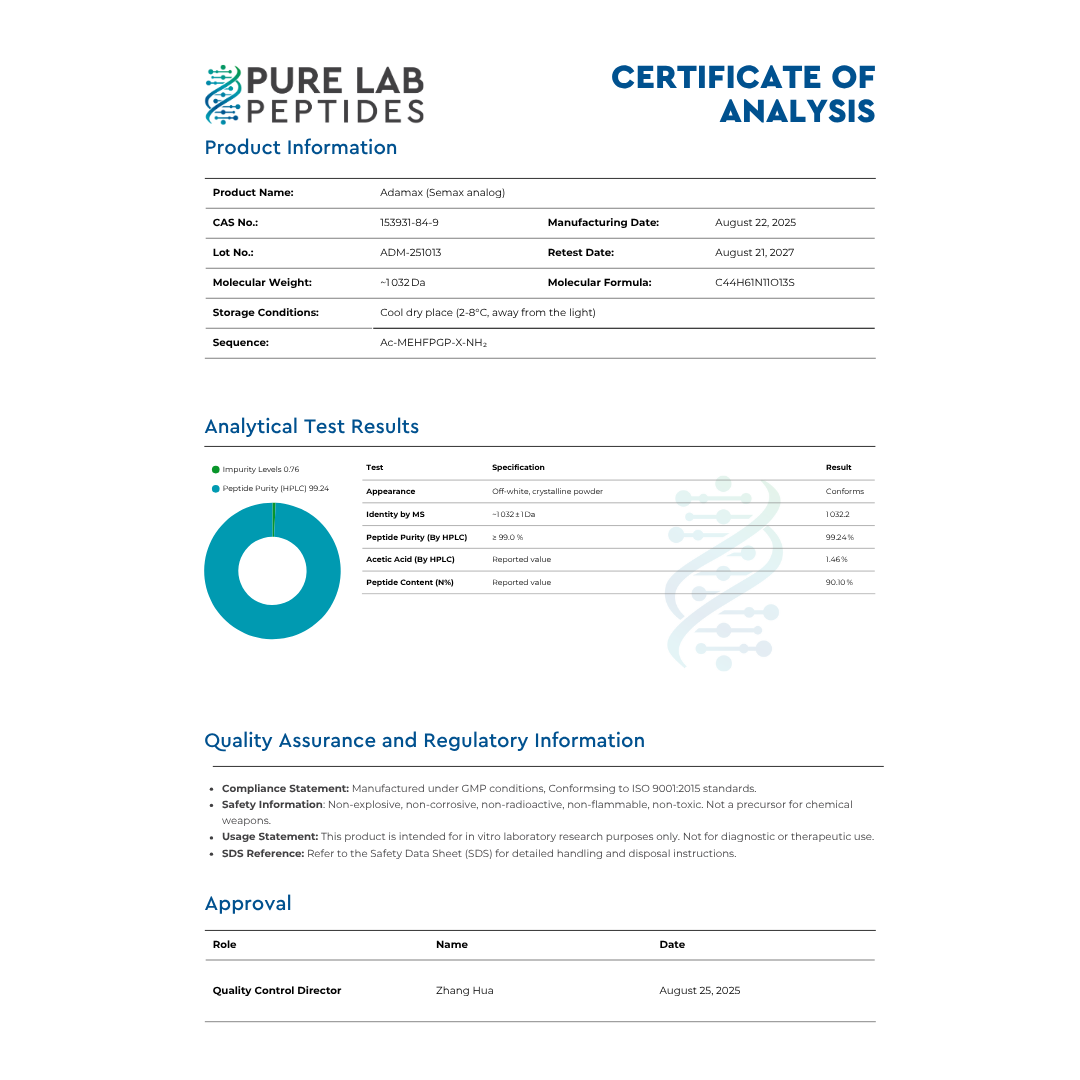
A certificate of analysis is one of the most important documents for Adamax peptide research review. It should not be treated as a decorative file; it should be checked against the listing, label, lot number, and available analytical data.
A useful COA should show the compound name, lot number, test date, purity result, test method, identity method, and responsible laboratory or supplier record. ICH Q7A describes laboratory control records as including sample description, batch number or distinctive code, method reference, raw data, results, and review signatures in quality-system contexts [15].
For Adamax, a COA is strongest when it is batch-specific. A certificate that cannot be tied to a lot number gives the research buyer less evidence for procurement review.
COA dates and lot numbers help research buyers verify that the certificate corresponds to the specific research material being evaluated. ICH Q7A describes batch production records and laboratory control records as tied to unique batch or identification numbers [15].
A dated COA also helps teams understand whether the file reflects the current lot. The date should be reviewed alongside storage documentation and any stated retest or review information.
Batch-specific records support traceability. They help connect the product listing, label, COA, chromatogram, mass data, and supplier documentation.
For laboratory research, that record chain is more useful than broad statements about purity or quality. The strongest review asks whether each document supports the same compound identity and lot.

Purity and identity are related, but they are not the same. A purity percentage describes a measurement under a method; identity review asks whether the material is consistent with the named peptide.
HPLC is widely used for peptide separation, purification, and chromatographic review. A peptide HPLC record can show whether a major peak dominates under the reported method conditions, and it may include retention time, detector conditions, and chromatogram data [12].
Researchers should not treat HPLC purity as the full identity answer. FDA-affiliated LC-HRMS work notes that HPLC-UV methods may be insufficient for distinguishing certain peptide process impurities or degradation products in some peptide systems [12].
Analytical testing can support identity, purity, and documentation reliability when methods are clearly listed. LC-MS or LC-HRMS can connect chromatographic separation with mass-based evidence, and tandem mass spectrometry has long been used for peptide and protein sequence analysis [12] [13].
For Adamax, analytical testing is most useful when the method, lot, mass signal, and reported compound identity align. If the documentation only reports a purity percentage without identity support, the review is incomplete.
LC-MS verification helps bridge the gap between “a major chromatographic peak exists” and “the peak is consistent with the named compound.” That is why LC-MS is useful in a documentation-first procurement workflow.
Mass spectrometry measures mass-to-charge signals that can support molecular identity review. LC-HRMS can detect mass shifts associated with sequence changes, truncations, insertions, substitutions, or degradation in peptide systems [12]. MS/MS methods can also support peptide sequence analysis by generating fragment-ion information [13].
For research procurement, the key question is not whether a method name appears on a COA. The key question is whether the data support the compound identity named on the product listing and batch record.
Molecular weight alignment helps researchers compare database information, supplier documentation, and analytical data. PubChem lists N-acetyl Semax amidate at 855.0 g/mol, with an exact mass of 854.37450913 Da and sequence MEHFPGP [2].
When Adamax documentation provides a molecular weight or formula, that value should be checked against the supplier’s stated identity and any external database or literature references. A mismatch does not automatically answer the identity question, but it does signal a need for review.
A supplier documentation matrix helps technical buyers compare files without relying on marketing language. The matrix should focus on evidence types, not claims.
Research buyers should compare the product listing, RUO label, COA, purity method, identity method, chromatogram, mass data, lot number, COA date, and storage documentation. ICH Q7A describes quality-system documentation concepts such as specifications, laboratory records, batch records, labeling records, storage, and stability testing records [15].
A good supplier file set should be internally consistent. The compound name should not change across documents, the lot number should match, and the analytical report should reflect the same batch.
Reproducible investigation depends on traceable materials. Documentation does not make a research finding; it helps researchers know what material was selected, what record supported it, and what lot was used.
For Adamax, that means a procurement file should include the listing record, COA, lot number, analytical method, and storage notes. The article’s research purpose is to help teams evaluate that file set before selection.
Storage and stability language should remain documentation-focused. It should not become practical guidance outside the supplier’s stated research-material documentation and institutional procedures.
Stability documentation may include supplier-stated storage conditions, retest information, handling cautions, and batch-related records. Peptide and protein materials can still undergo chemical changes in solid-state conditions, so storage records should be treated as part of documentation review rather than ignored [18].
Semax-analog literature also shows that peptide modifications can alter proteolysis behavior in model systems [7] [8]. For Adamax, stability language should stay limited to documentation and literature context.
Handling language should describe recordkeeping, labeling, and storage documentation. It should not provide practical guidance for non-research contexts.
A safe page can say that laboratories should record storage conditions in their internal records and compare those records with supplier documentation. It should not turn that point into research-material instructions beyond documentation review.
Research procurement review is the final step after literature filtering and documentation review. The purpose is to decide whether the available supplier files are clear enough for laboratory evaluation.
Use this numbered laboratory verification workflow before Adamax procurement:
A practical documentation checklist should also be part of procurement review:
The phrase “buy Adamax for research” should appear after documentation review, not before it. For Pure Lab Peptides, the commercial research pathway is documentation-first: RUO labeling, COA review, purity method, identity support, lot traceability, and research-focused product information.
That process keeps the article useful for qualified research buyers while avoiding consumer framing. It also supports a cleaner product-page architecture because every section returns to evidence quality, documentation, and RUO scope.
“Pure Lab Peptides supplies compounds for laboratory research use only. Products are not intended for human or animal consumption, diagnostic use, therapeutic use, clinical use, veterinary use, or as food, drugs, cosmetics, dietary supplements, or household products. Researchers are responsible for ensuring lawful, appropriate handling and use in accordance with applicable regulations and institutional guidelines.”
Review the product-page documentation, COA details, analytical testing information, and RUO labeling before evaluating Adamax for laboratory research.
Researchers should consider documentation first before they buy Adamax for research. A research-focused review should check RUO labeling, COA availability, lot consistency, peptide identity records, and supplier documentation. The goal is to confirm that the product-page file set supports laboratory research purposes without shifting into non-research positioning.
Research applications help organize Adamax literature context, but they should not be framed as product claims. A product-page review should connect research applications to published literature, compound characterization, analytical testing, and documentation quality. This keeps the page focused on laboratory evaluation instead of unsupported claims about the research material.
Researchers should interpret in vitro research as model-specific context. In vitro findings can help define pathway models, receptor signaling questions, or assay design, but they do not replace batch-specific documentation. For Adamax, the safer product-page focus remains COA review, peptide identity, purity testing, and lot traceability.
Compound characterization matters because Adamax documentation should identify the material being evaluated. Researchers may compare compound name, structural analog context, molecular information, COA records, and analytical testing files. This supports a more rigorous research procurement review and helps separate peptide studied in literature from the specific research material listed on a product page.
Receptor signaling language stays research-focused when it describes literature context rather than product positioning. For Adamax, pathway terms such as cell signaling, neuromodulation, neurotransmission, and synapse models should be tied to published research categories. Product-page copy should then return to documentation review, including COA, identity testing, and batch-specific records.
Researchers should compare the product listing, RUO label, COA, lot number, purity method, identity method, and storage documentation. The files should align across the same batch and compound name. If analytical testing includes LC-MS or related mass-based review, that evidence can support peptide identity evaluation when paired with batch records [12].
The following authors are recognized for published research that helped shape the scientific context discussed in this article.
Author profile: ResearchGate
Oleg V. Dolotov is a published author in Semax and ACTH-analogue research, which is relevant to the neuropeptide research context used to frame Adamax literature interpretation. His publications helped inform the article’s discussion of Semax-adjacent research, BDNF-related literature, and model-specific interpretation. This work is useful for understanding why Adamax product-page copy should distinguish published literature context from research-material documentation, including compound identity, lot-level records, and analytical review.
Selected publications:
A Semax/ACTH-analogue study relevant to BDNF protein measurements — Journal of Neurochemistry, 2006. PMID: 16635254
A publication relevant to Semax model research and BDNF expression — Doklady Biological Sciences, 2003. PMID: 14556513
Author profile: CSIC Institute of Catalysis Profile
Jose M. Palomo is a scientific author whose peptide-synthesis publications provide useful background for the documentation-focused portions of this Adamax research page. His work on solid-phase peptide synthesis supports broader understanding of synthetic peptide preparation, sequence design, functional modification, and research-grade material characterization. That context is relevant to product-page evaluation because research buyers often review compound identity, supplier documentation, and analytical testing records alongside the published peptide literature.
Selected publications:
Solid-phase peptide synthesis: an overview focused on the preparation of biologically relevant peptides — RSC Advances, 2014. DOI: 10.1039/C4RA02458C
Solid-phase synthesis of lipidated peptides — Angewandte Chemie International Edition, 2004. PMID: 15523710
This research disclaimer clarifies how this page handles published literature and search language around Adamax. In Neuropeptide Research content, terms such as nootropic, cognitive enhancement, mental clarity, brain health, nasal spray, peptide therapy, neuroprotective effects, and clinical outcomes can drift into consumer-facing, administration-focused language, wellness language, or product-claim language when framed incorrectly. Phrases such as effects of Adamax, efficacy of Adamax, absorption, and bioavailability also require careful separation from product positioning because they can become product-performance claims outside model-specific research context.
Here, those phrases are handled only as research-language examples, not product uses, outcomes, instructions, or recommendations. The focus remains on Adamax identity, COA review, analytical testing, peptide purity, lot traceability, RUO labeling, product documentation, and published literature boundaries. Research discussions may include interaction, modulation, mechanism, or derivative language where it helps explain literature interpretation, but those terms should remain tied to compound characterization and controlled laboratory environments.
Discount Applied Successfully!
Your savings have been added to the cart.




There are no reviews yet.