

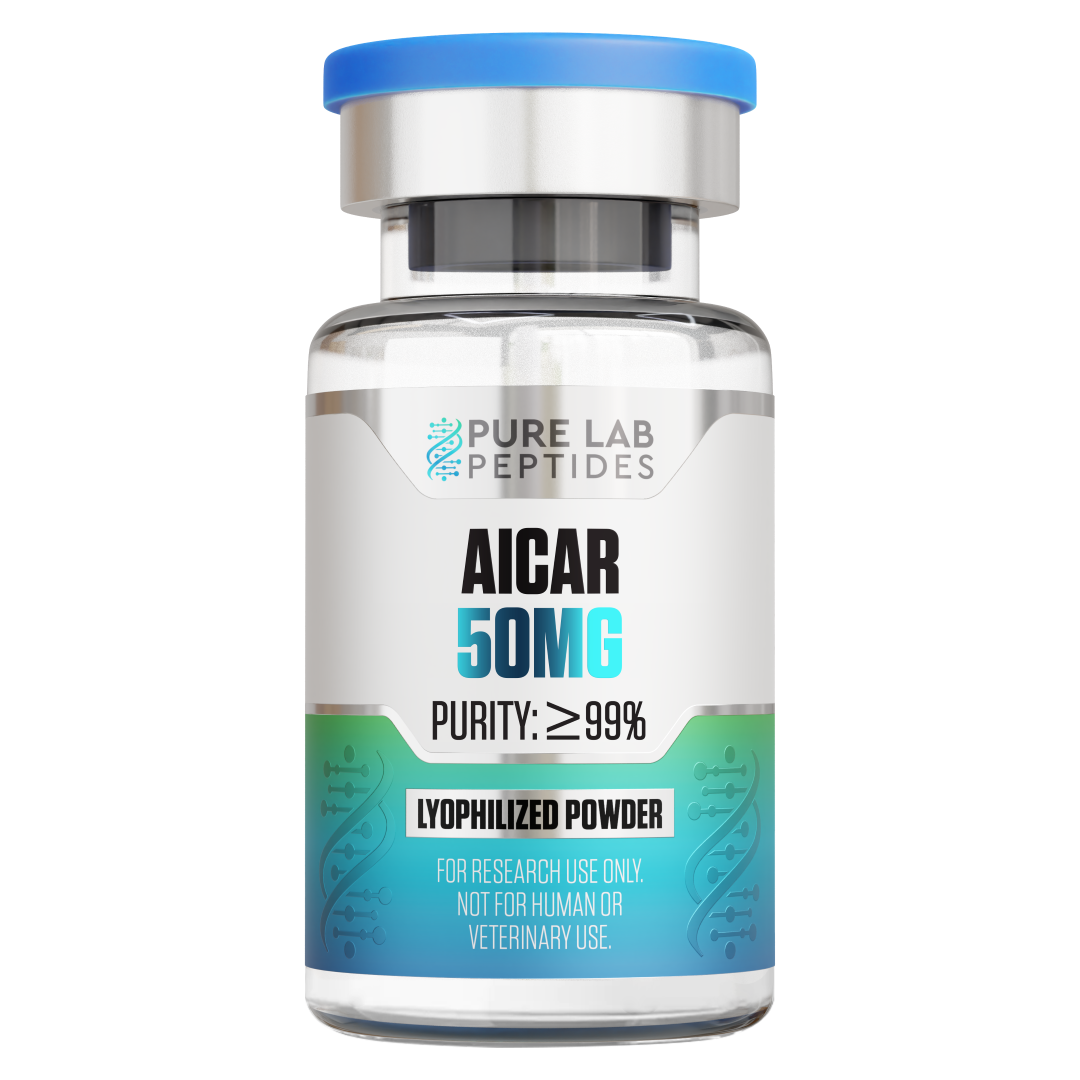
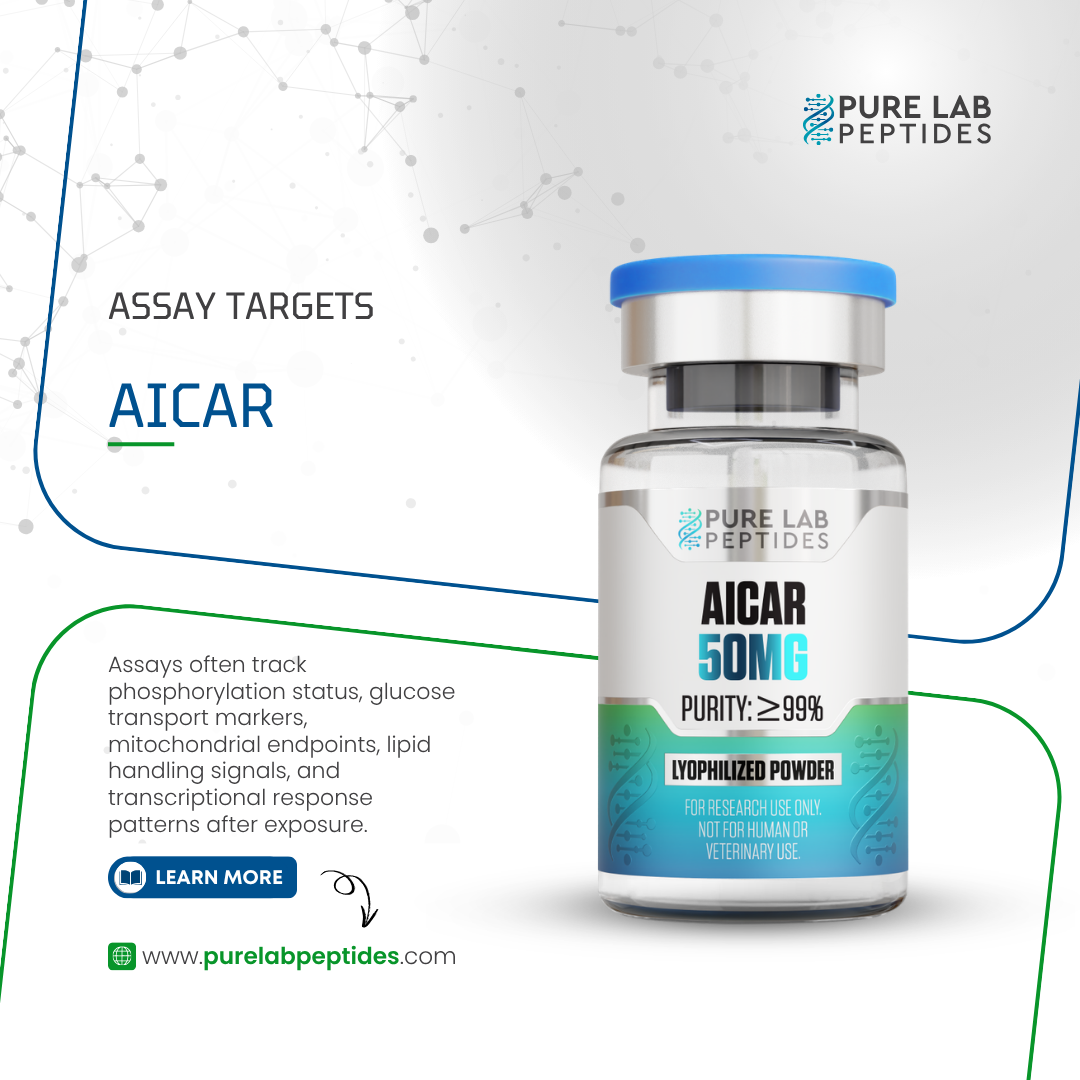
Researchers who buy AICAR for research typically evaluate it as a research-use-only AICAR/Acadesine material for AMPK-pathway, metabolic-pathway, and assay-design studies, not as a consumer product. PubChem lists Acadesine as a compound with molecular formula C9H14N4O5 and molecular weight 258.23 g/mol, while AMPK literature describes AICAR/AICA-riboside as a widely used AMPK research modulator [1], [3]. This Pure Lab Peptides guide explains how qualified research buyers can review identity, COA, analytical testing, literature context, solubility notes, lot traceability, and RUO boundaries before evaluating AICAR for laboratory research.

Researchers evaluating where to buy AICAR for research should first review RUO labeling, compound identity, batch-specific COA documentation, assay purity, HPLC or LC-MS testing, solubility notes, and lot traceability. Products discussed in this article are intended for laboratory research use only and are not intended for human or animal consumption. Published AMPK literature supports research context, not product-use claims [3].
The phrase “buy AICAR for research” reframes commercial intent around qualified laboratory procurement. The product-page task is not to promote outcomes. It is to help technical buyers review whether the research material is identified, documented, traceable, and labeled for RUO work.
For AICAR, this matters because the compound has both identity language and pathway language. The identity side includes Acadesine, AICA-riboside, CAS-linked naming, molecular formula, and molecular weight [1]. The pathway side includes AMPK activity, ZMP formation, AMP-mimetic signaling, and model-specific assay interpretation [3], [4].
Start with the product listing, RUO label, and batch-specific certificate of analysis. These documents should tell the same story: compound name, alias, lot number, purity method, identity method, document date, and supplier record.
A useful source-quality filter is simple: official database for identity, peer-reviewed literature for pathway context, COA for batch data, and analytical-method documentation for test interpretation. No single document replaces the others.
RUO labeling sets the page’s purpose. It keeps the discussion focused on laboratory research, compound characterization, analytical testing, and documentation review.
AICAR appears in research literature across AMPK-dependent and AMPK-independent contexts, which is why product-page language needs restraint [3]. A research page should not turn mechanistic findings into claims about a product.
AICAR product-page content should serve laboratory buyers, procurement teams, and researchers who need to evaluate documentation before selecting an RUO material. The page should explain what the compound is, how literature frames it, and what documentation supports identity and batch review.
RUO positioning requires clear separation between research literature and product positioning. Scientific papers may examine AICAR in cell models, biochemical assays, pathway studies, and preclinical literature, but a product page should present those findings as literature context only [3].
The safest product-page emphasis is documentation. For AICAR, that means identity confirmation, assay purity, test method, lot number, COA date, labeling consistency, and storage or handling documentation.
A product page should anchor claims to documents, not to outcomes. The core documentation set usually includes a product listing, batch-specific COA, purity method, identity method, lot reference, storage notes, and supplier contact records.
For AICAR, documentation is especially important because AICAR, Acadesine, AICA-riboside, and ZMP-related language can appear close together in literature [1], [2], [3]. Procurement teams should confirm which entity the product listing actually identifies.
AICAR is commonly described as 5-aminoimidazole-4-carboxamide ribonucleoside, also known as Acadesine or AICA-riboside [1], [3]. In research settings, it is frequently discussed in relation to AMPK pathway models, purine pathway context, and ZMP-linked interpretation [2], [4].
PubChem identifies Acadesine with molecular formula C9H14N4O5, molecular weight 258.23 g/mol, and synonyms including AICA-riboside [1]. ChEMBL also lists Acadesine as a bioactive-molecule database entry, which can help researchers cross-check naming across cheminformatics resources [19].
This identity review is separate from pathway interpretation. A compound can be correctly named and still require careful review of batch data, assay method, and literature boundaries.
AICAR is not a peptide sequence in the same sense as a chain-defined research peptide. It can appear alongside peptide research materials because many RUO catalog environments group metabolic pathway compounds, AMPK pathway tools, and peptide-category research materials together for procurement convenience.
That category placement should not replace identity precision. AICAR should be evaluated as the canonical compound AICAR/Acadesine, with its own molecular identity and documentation record [1].
Acadesine is an alias used for AICAR/AICA-riboside in scientific and database contexts [1]. A research buyer should expect the product listing, COA, and label to align on the selected name or clearly state the alias relationship.
Name mismatch is a practical documentation risk. If one document says AICAR and another says Acadesine, the COA should make the equivalence clear enough for batch-level recordkeeping.
AICAR identity language can be confusing because literature may distinguish AICA, AICAR/AICA-riboside, and AICA ribotide/ZMP. PubChem lists AICA ribotide as a phosphorylated purine-pathway intermediate, while AMPK literature describes AICAR/AICA-riboside conversion to ZMP in cellular contexts [2], [4].
Identity documentation should clarify the listed compound, synonym set, formula, molecular weight, lot number, and analytical identity method. For AICAR, the product record should not blur AICAR/Acadesine with AICA ribotide unless the document explicitly explains the relationship.
This is where LC-MS, mass spectrometry, and chromatographic records can add value. They help connect the batch record to identity evidence rather than relying only on product naming.
AICAR/Acadesine is often described as a ribonucleoside or adenosine analog in AMPK literature [1], [4]. That phrasing belongs in compound identity and pathway background, not in claims about product outcomes.
A precise page can say that literature discusses AICAR in relation to AMPK and ZMP. It should not imply that a catalog material carries the same claims as any particular study system.
Assay interpretation depends on knowing which entity is being evaluated. AICAR, AICA, and ZMP are related terms, but they are not interchangeable product identities [1], [2].
For procurement, molecular identity is also a quality-control issue. The product listing, COA, and analytical output should support the same compound identity.

AMPK is a conserved protein kinase complex that responds to cellular energy-state signals and coordinates metabolic pathway regulation in research models [5], [14]. AICAR is widely used in AMPK research because its cellular metabolism to ZMP provides an AMP-mimetic context for pathway studies [3], [4].
AMP-activated protein kinase is described as a heterotrimeric kinase complex with catalytic and regulatory subunits [4], [5]. Reviews describe AMPK as a cellular energy sensor that responds to adenine nucleotide balance and regulates downstream metabolic processes through phosphorylation networks [5], [14].
For this page, the key point is context. AMPK language supports pathway research framing, not a claim that an RUO product creates a defined biological outcome.
AICAR is commonly described as an AMPK activator in literature, but the 2021 systematic review emphasizes that AICAR can also show AMPK-independent findings in some study systems [3]. That means “activator” language should be paired with careful discussion of model, assay, and interpretation limits.
A safer product-page phrase is “AICAR is discussed in AMPK activator literature.” That wording keeps the page anchored to published research rather than product claims.
AMPK activation is commonly associated with phosphorylation at Thr172 on the α subunit, and reviews describe this phosphorylation as a major activation-related event [4], [5]. AICAR-linked studies have examined AMPK phosphorylation in specific cell models, including LKB1-independent and ATM-associated contexts [9].
For research buyers, phosphorylation context is not a product specification. It is a literature cue that explains why researchers may evaluate AICAR in kinase-pathway assays.

AICAR literature often describes a mechanism of action involving uptake into cells, phosphorylation to ZMP, and AMPK-related signaling interpretation [3], [4]. The product page should present that as published mechanism context only.
Mechanistic literature can show how researchers design assays, which targets are examined, and which signals are measured. For AICAR, reviews describe AMPK-dependent and AMPK-independent findings, so any mechanistic explanation should remain model-specific [3].
A useful interpretation framework is: compound identity first, pathway context second, assay conditions third, and RUO boundary always. That order prevents pathway relevance from becoming a product claim.
Pathway relevance means AICAR belongs in AMPK and metabolic-pathway research conversations. It does not mean a product listing should promise pathway outcomes.
Some search and literature phrases can drift into clinical-use language or product effects if separated from model-specific evidence. RUO product-page copy should keep those phrases separate from product positioning and focus on compound identity, COA review, analytical testing, lot traceability, and published literature boundaries.
Signal mapping helps organize the AMPK literature without overstating it. Researchers may track AMPK activity, phosphorylation, protein expression, gene expression, glucose-related endpoints, fatty acid pathway markers, autophagy markers, mitophagy markers, or apoptosis markers depending on the model [3], [5].
A signal map separates the compound, the assay, the measured marker, and the interpretation. For AICAR, the measured marker might be AMPK phosphorylation, acetyl-CoA carboxylase phosphorylation, LC3-related autophagy markers, or protein expression readouts in a defined model [5], [9].
The map should also record limitations. The same marker can mean different things across cell models, exposure conditions, and downstream readouts.
AICAR research has examined glucose uptake, fatty acid oxidation, acetyl-CoA carboxylase, and malonyl-CoA in skeletal muscle models [6], [7]. Those findings belong in metabolic pathway literature context and should not be presented as RUO product outcomes.
A product-page interpretation can say that these pathways are part of the AICAR evidence landscape. It should not turn them into commercial promises.
Published AICAR literature spans biochemical assays, cell models, pathway readouts, and preclinical evidence categories [3]. The best product-page approach is to summarize the model types and measurement categories, then reinforce that RUO materials require independent documentation review.
AICAR studies have used skeletal muscle preparations, hepatocyte-related models, adipocyte differentiation models, neural stem cell models, and other cell systems [6], [8], [10], [11]. Each model has its own assay design, readout, and limitation.
This is why an evidence summary should never flatten all AICAR findings into one claim. It should name the model class and explain what was measured.
Western blot analysis appears in many pathway studies because it can track protein abundance or phosphorylation-state changes. AICAR-related literature has examined phosphorylation readouts such as AMPKα phosphorylation in specific model systems [9].
For product-page purposes, Western blot references belong in assay-design discussion. They do not verify a supplier lot unless the lot itself is tested and documented.
Autophagy and mitophagy terms belong in literature context when a cited model actually measures those pathways. AMPK reviews discuss connections among AMPK, mitochondria, and autophagy-related signaling, and AICAR reviews note that interpretations can be AMPK-dependent or AMPK-independent by model [3], [5].
The cautious wording is “published models have examined these markers.” That keeps the page scientific and RUO-safe.
Evidence interpretation should rank the source type, model type, and documentation value. In vitro findings can support pathway hypotheses, while preclinical literature can broaden scientific context, but neither should be presented as product-use guidance for an RUO material.
| Research Area | What Literature Examines | Evidence Type | RUO Interpretation |
|---|---|---|---|
| Compound identity | Acadesine/AICAR naming, formula, molecular weight, and synonyms [1] | Official database | Supports identity review, not batch purity by itself |
| AMPK pathway | AMPK structure, nucleotide sensing, and phosphorylation-related regulation [4], [5] | Review literature | Supports pathway context, not a product claim |
| AICAR mechanism | AICAR/AICA-riboside conversion to ZMP and AMPK-related interpretation [3], [4] | Review literature | Supports mechanism context with model limits |
| Metabolic models | Skeletal muscle and lipid-pathway markers in research systems [6], [7] | Experimental literature | Supports assay awareness, not commercial outcomes |
| Analytical documentation | Analytical validation, chromatography, mass spectral reference data [15], [17], [18] | Official guidance and standards | Supports testing-method review |
In vitro research can support mechanistic hypotheses, assay selection, marker selection, and model-specific interpretation. For AICAR, in vitro literature includes AMPK phosphorylation, mitochondrial oxidative phosphorylation, adipocyte differentiation, neural stem cell differentiation, and apoptosis-related studies in specific systems [8], [9], [10], [11], [12].
What it cannot do is replace batch testing. A published assay does not confirm the identity, purity, or traceability of a specific research material.
Preclinical findings are useful for mapping research questions, but they remain separate from RUO product positioning. Some published literature outside the scope of RUO product use has examined this compound class in human study settings. That literature should not be interpreted as a use claim for research-use-only materials.
For product pages, the safest evidence ladder is: official identity database, peer-reviewed mechanism literature, model-specific assay findings, analytical documentation, and RUO boundary statement. This ladder prevents clinical-use language from entering product positioning.
When teams buy AICAR for research, the COA should be reviewed before the material is selected for laboratory work. The COA should not be treated as decorative paperwork. It is the batch-level document that connects the product listing to test data.
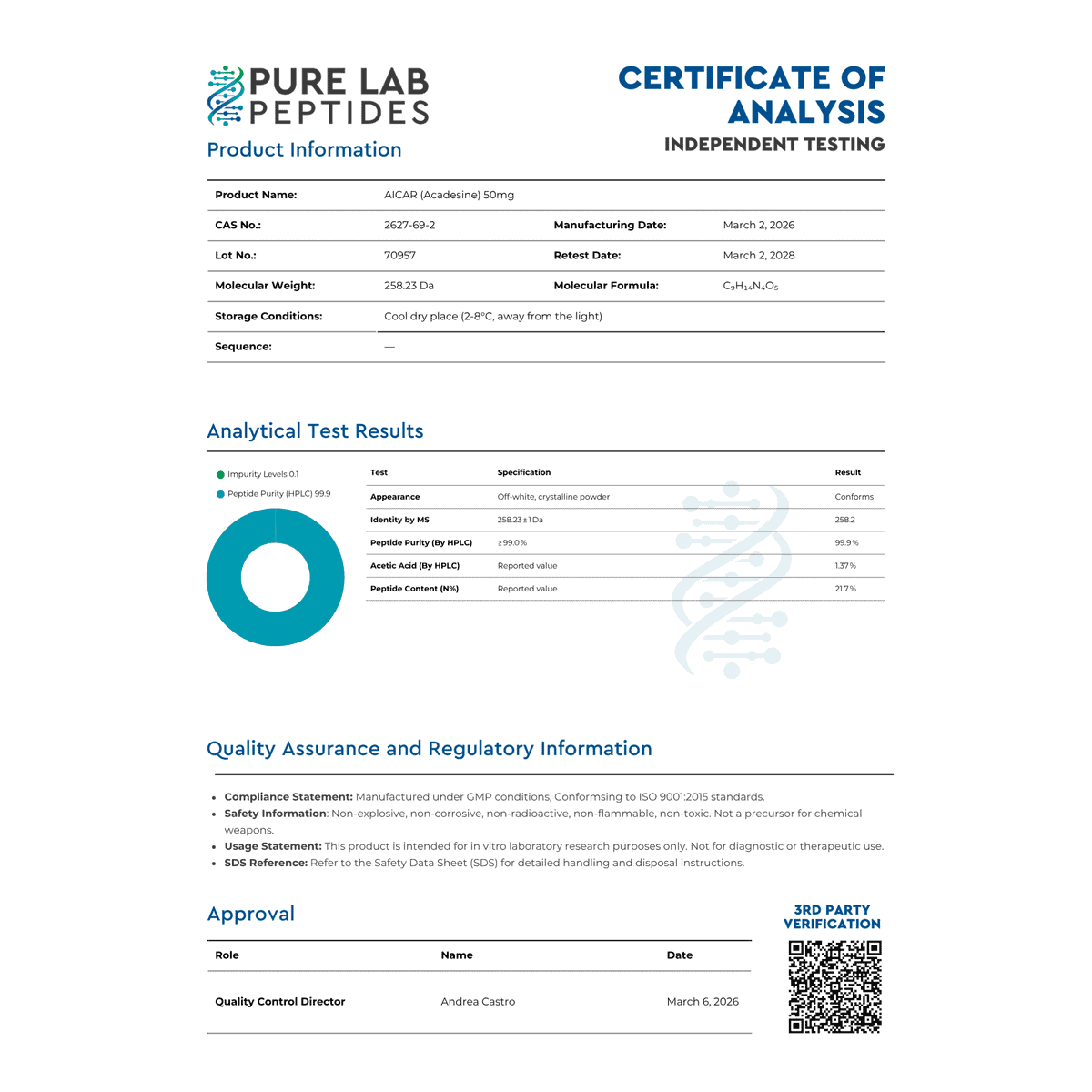
A certificate of analysis should show the compound name, lot number, test date or release date, assay purity, analytical method, supplier or testing-lab information, and any identity confirmation details. FDA analytical guidance describes validation documentation as supporting identity, quality, purity, and related material attributes in regulated analytical contexts [16].
For RUO procurement, the practical question is simpler: does the COA provide enough batch-specific evidence for a qualified lab to document what was received?
COA dates help distinguish current lot documentation from older or generic records. A lot-specific COA should match the lot number on the product label or procurement record.
Date review also helps identify stale documents. A current product listing paired with a mismatched or undated COA should prompt additional supplier documentation review.
Assay purity is meaningful only when paired with the method used to generate it. USP chromatography guidance describes chromatographic separation methods and system suitability concepts that support qualitative and quantitative analyses [17].
A high assay purity value does not automatically establish complete identity. Purity review and identity review are related, but they answer different questions.

Analytical testing helps researchers evaluate whether product documentation is technically coherent. HPLC is commonly used for chromatographic purity review, while LC-MS and mass spectrometry can support molecular identity review when paired with appropriate reference data [17], [18].
A documentation-focused lab-test verification workflow can look like this:
HPLC supports purity evaluation by separating components and allowing chromatographic peaks to be reviewed against a defined method. USP <621> describes chromatography as a separation approach in which sample components distribute between stationary and mobile phases [17].
For AICAR procurement, HPLC documentation should be read as method-specific evidence. It is strongest when linked to the same lot shown on the COA.
LC-MS can support identity review by combining chromatographic separation with mass spectrometric information. NIST describes mass spectral reference data as useful for chemical identification and quality-control applications, including tandem mass spectra for small molecules [18].
For AICAR, LC-MS documentation should align with the listed formula, expected mass-related information, and product identity record [1].
Mass spectrometry review should consider the mass-to-charge ratio, ion information, reference standard context, and whether the documentation ties the data to the lot. IUPAC defines mass-to-charge ratio as the mass number of an ion divided by its charge number in mass spectrometry [20].
For procurement teams, the key is not to overread a single data point. Identity review is strongest when mass data, chromatographic data, COA fields, and product labels all align.
Solubility documentation belongs in laboratory records because assay conditions depend on model design and material handling. Product pages should discuss solubility as documentation context, not as practical product guidance for non-research settings.
Solubility notes should clarify solvent context, temperature assumptions, concentration notation, and whether values are supplier-recorded or literature-derived. For AICAR, teams may encounter water or DMSO references in supplier and laboratory documentation, so records should state the source and context of the solubility note.
The safest procurement approach is to avoid assumptions. If solubility data are important to an assay, the lab record should identify the source of the information and the batch being evaluated.
DMSO stock solution language belongs only in laboratory documentation context. It should not appear as public product-use guidance or practical instruction for non-research readers.
For an RUO product page, a safer statement is that solvent notes, if provided, should be recorded with the COA, lot number, assay plan, and institutional laboratory records.
Lot traceability connects the listed material to the received material and its batch-specific documents. Without that connection, the product page, label, and COA cannot be confidently reconciled.
Research buyers should review lot numbers because the lot is the bridge between the product listing and the COA. If the lot number on the received material does not match the COA, the documentation set is incomplete.
Lot-level review also helps teams keep procurement records consistent. This is especially useful when a compound has multiple aliases, as AICAR does [1].
Labeling consistency means the compound name, alias, catalog description, lot number, and RUO statement should align across documents. Inconsistent labeling does not automatically mean a material is unsuitable, but it does mean the buyer should request clarification before relying on the document set.
This is a documentation issue, not a pathway issue. AMPK literature cannot resolve a mismatch between a label and a COA.

Before teams buy AICAR for research, they should evaluate the supplier documentation with a repeatable checklist. The goal is not to rank suppliers by marketing language. The goal is to identify which documentation package is complete enough for laboratory records.
Lab teams should compare documentation completeness, not promotional language. The strongest supplier file will usually include an RUO label, batch-specific COA, analytical method, identity support, lot traceability, and clear storage or handling documentation.
Common misunderstandings to correct before procurement:
Pure Lab Peptides supplies compounds for laboratory research use only. Products are not intended for human or animal consumption, diagnostic use, therapeutic use, clinical use, veterinary use, or as food, drugs, cosmetics, dietary supplements, or household products. Researchers are responsible for ensuring lawful, appropriate handling and use in accordance with applicable regulations and institutional guidelines.
Final procurement review should confirm that every document is internally consistent. The product listing should match the COA. The COA should match the lot. The lot should match the label. The label should clearly support RUO positioning.
For research teams comparing peptide suppliers, prioritize COA availability, transparent labeling, lot-level documentation, and analytical method clarity before selecting any research-use-only compound.
Researchers should consider documentation first before they buy AICAR for research. A research-focused review should check RUO labeling, compound identity, COA consistency, lot traceability, and whether analytical testing supports the listed material. AICAR should be evaluated as a laboratory material within AMPK and metabolic pathway research, not through consumer-facing expectations.
Research-use-only means AICAR is intended solely for qualified laboratory research contexts. RUO positioning keeps product-page language focused on compound characterization, research documentation, batch-specific records, and published literature boundaries. It also means AICAR product information should not be framed around personal outcomes, clinical decision-making, or non-laboratory purposes.
Researchers review COAs for AICAR because a certificate of analysis helps connect the product listing to batch-specific documentation. A useful COA should support identity, lot number review, purity data, and analytical method transparency. It should also be checked against supplier documentation so the listed material, label, and batch record remain consistent.
HPLC and LC-MS support AICAR documentation review by addressing different parts of analytical evaluation. HPLC is commonly used for purity review, while LC-MS can support identity confirmation when paired with suitable reference information and batch records [17], [18]. These methods should be interpreted as documentation tools, not product claims.
AICAR literature includes model-specific research involving metabolic pathway markers, cellular differentiation, adipogenesis, and enzyme inhibitor context. Some studies discuss markers such as SREBP-1c, FAS, glycogen phosphorylase, or redox-related pathways. These terms should be interpreted as research literature context only, not as claims about an RUO material.
AICAR product pages should stay research-use-only by separating published literature from product claims. The safest focus is compound identity, COA review, analytical testing, lot traceability, and RUO labeling. Research pages may mention model-specific literature, but they should not convert pathway findings into product-positioning statements or non-laboratory claims.
The following authors are recognized for published research that helped shape the scientific context discussed in this article.
Author profile: ORCID
Dora Višnjić’s published work is directly relevant to AICAR research context because it examines AICAr/Acadesine as a research tool in AMPK-dependent and AMPK-independent model interpretation. Her publications help frame why AICAR product pages should separate compound identity, pathway-focused research, and literature interpretation from product claims. This is especially useful for a research-use-only discussion that covers AMPK pathway research, pyrimidine-pathway context, and model-specific differentiation-marker studies without converting the literature into product-positioning language.
Selected publications:
Author profile: Salk Institute Profile
Reuben J. Shaw’s publications are relevant to the AMPK pathway background used throughout this article. His review work helps clarify AMPK as a kinase-centered signaling system, including cellular energy sensing, phosphorylation-linked pathway interpretation, and metabolic pathway coordination in research models. That framework supports the article’s RUO approach by keeping AICAR discussion focused on literature context, AMPK-pathway interpretation, and research documentation rather than outcome-focused product language.
Selected publications:
This research disclaimer clarifies how this page handles published literature and search language around AICAR. In Metabolic and Mitochondrial Research content, phrases such as AICAR administration, administering AICAR, AICAR treatment, effect of AICAR, efficacy of AICAR, absorption, bioavailability, and clinical outcomes can drift into consumer-facing, administration-focused language, therapeutic language, or product-claim language when framed incorrectly. These phrases belong only in published literature interpretation or boundary discussion, not in product positioning.
Here, those terms are handled only as research-language examples, not product uses, outcomes, instructions, or recommendations. The focus remains on AICAR identity, COA review, analytical testing, peptide purity, lot traceability, RUO labeling, product documentation, and published literature boundaries. Product-performance claims, wellness language, consumer outcomes, body-composition language, and performance language should stay separate from research-use-only product pages unless they are clearly presented as examples of language that requires careful boundary control.
Discount Applied Successfully!
Your savings have been added to the cart.




There are no reviews yet.