

Researchers evaluating where to buy Cardiogen for research should start with identity, COA, analytical testing, and RUO labeling rather than consumer-oriented claims. Cardiogen is commonly mapped to H-Ala-Glu-Asp-Arg-OH, a four-residue peptide sequence listed by PubChem as AEDR with molecular formula C18H31N7O9 and molecular weight 489.5 g/mol [1]. This Pure Lab Peptides guide frames Cardiogen research as bioregulator peptide documentation, literature interpretation, and procurement review for qualified laboratory settings.
To buy Cardiogen for research, review RUO labeling, batch-specific COA documentation, HPLC or LC-MS identity data, lot traceability, and storage records before procurement review. Products discussed in this article are intended for laboratory research use only and are not intended for human or animal consumption. Cardiogen maps to the AEDR tetrapeptide entry listed by PubChem [1].
The phrase “buy Cardiogen” becomes RUO-safe only when it is framed as buy Cardiogen for research. That shift changes the search intent from a consumer-facing query into a technical procurement question about peptide identity, supplier documentation, analytical testing, and research-use-only labeling.
A product page should not turn literature findings into product positioning. FDA guidance for RUO-labeled IVDs is not a peptide product rule, but it provides a useful labeling principle: RUO statements should align with research-only intent and should not support diagnostic positioning [20].
The first documents to review are the batch-specific certificate of analysis, the product label, the lot identifier, and any analytical records used to support identity or purity. FDA analytical-method guidance describes identity, quality, purity, and related attributes as central documentation concerns for analytical procedure submissions in regulated quality contexts [17].
For a research peptide page, the practical question is whether the product listing, COA, and batch records tell the same story. If the compound name, sequence, catalog amount, or lot number differs across documents, procurement teams should pause the review.
RUO labeling keeps the page in a laboratory research lane. It also helps separate research materials from diagnostic, therapeutic, veterinary, cosmetic, supplement, or household product positioning.
For Cardiogen research, RUO labeling should appear alongside documentation that supports technical review. The label should not be asked to carry scientific credibility by itself; it should be paired with a COA, test method notes, and lot-level traceability.

Cardiogen is commonly described in research literature and compound databases through the sequence H-Ala-Glu-Asp-Arg-OH, also represented as AEDR [1]. As a bioregulator peptide research topic, it belongs in a short peptide literature lane rather than a consumer wellness lane.
The broader Khavinson-linked literature discusses short peptides as gene-expression and protein-synthesis research subjects, but that literature should be treated as academic context rather than product-use guidance [8].
A Cardiogen peptide listing should identify the canonical sequence, naming format, and molecular data. PubChem lists H-Ala-Glu-Asp-Arg-OH as AEDR, with computed molecular formula C18H31N7O9 and molecular weight 489.5 g/mol [1].
Sequence clarity matters because peptide identity is sequence-dependent. NCBI Bookshelf notes that peptide chains are formed from amino acid residues joined by peptide bonds, while primary structure resources describe peptide and protein sequences as ordered amino acid chains [2] [3].
Cardiogen is a synthetic tetrapeptide, which means the listing should show that the intended four-residue sequence is the one being documented. A short peptide can still require careful identity review because sequence order, molecular mass, and analytical method details all affect interpretation.
Mass spectrometry is widely used for synthetic peptide characterization, including identity and purity evaluation [12]. That makes LC-MS or related mass data especially useful when a lab team is reviewing a Cardiogen research material.
The amino acids and Cardiogen context should be handled as identity review, not as product performance language. A sequence such as Ala-Glu-Asp-Arg tells researchers which residues are expected and gives analytical teams a reference point for mass review.
By convention, peptide sequences are represented from the N-terminus to the C-terminus [3]. For Cardiogen documentation, that supports consistent comparison across a product listing, COA, chromatogram notes, and mass data.
Cardiogen is often placed in cardiovascular bioregulator peptide research because older literature has examined myocardial tissue culture endpoints and cardiac tissue model context [4]. That does not make the product page a cardiovascular outcome page.
A safer product-page frame is simple: Cardiogen belongs in a research model and documentation lane. Literature may discuss cardiac or myocardial endpoints, while the product page should focus on compound identity, analytical testing, and RUO boundaries.
Published myocardial tissue culture research evaluated Cardiogen alongside individual amino acids in explant culture conditions from 3- and 24-month rat sources [4]. The study reported changes in cell proliferation and p53 protein expression under those model-specific conditions [4].
Those findings belong in literature interpretation. They should not be converted into claims about a product, a research buyer, or any non-laboratory outcome.
Myocardial model literature should clarify the model, endpoint, assay conditions, and limits of interpretation. The 2009 myocardial tissue culture paper focused on cell proliferation and apoptosis-related p53 expression in organotypic culture, not on a product-page claim [4].
The word “myocardial” should therefore remain tied to the study model. It should not become language that implies functional outcomes outside controlled research.

Published Cardiogen research should be interpreted as a set of model-specific observations. The strongest product-page role for that literature is to help researchers understand why identity, sequence, and documentation matter.
An evidence landscape helps separate model type from RUO interpretation:
| Research Area | What Literature Examines | Evidence Type | RUO Interpretation |
|---|---|---|---|
| Myocardial tissue culture | Cell proliferation and p53 expression in organotypic explant culture [4] | In vitro / tissue culture | Supports literature context only; not a product claim |
| Cytoskeletal and nuclear matrix proteins | Protein expression patterns after H-Ala-Glu-Asp-Arg-OH exposure in cultured systems [5] | Cell model literature | Useful for mechanistic discussion, not commercial positioning |
| M-1 sarcoma model | Apoptosis-related findings in a preclinical M-1 sarcoma setting [6] | Preclinical rodent-model literature | Boundary-sensitive and should remain strictly academic |
| Prostate fibroblast culture | Signaling factors in aging fibroblast cultures [7] | Cell culture literature | Relevant only as fibroblast and signaling context |
Preclinical literature can establish what researchers examined in a specific model, under defined study conditions. It cannot establish a research-material claim for Pure Lab Peptides Cardiogen.
For Cardiogen, the literature includes a myocardial tissue culture paper, a preclinical M-1 sarcoma model paper by Levdik and Knyazkin, and fibroblast signaling work in prostate-related culture systems [4] [6] [7]. Those are evidence categories, not product positioning categories.
In vitro and tissue culture models can help isolate cell-level or tissue-level research questions. The myocardial tissue culture study is relevant because it compared amino acids and the Cardiogen peptide in a controlled culture setting [4].
The limitation is equally important. A tissue culture finding is not a procurement claim, not a quality claim, and not a substitute for batch-specific analytical documentation.
A Cardiogen product page can discuss mechanism as research context, but it should avoid claim-heavy language. The safer frame is “mechanistic context from published literature,” not “what Cardiogen does.”
Short peptide literature has discussed DNA-peptide interactions, histone interactions, and gene-expression models [8]. Another review reports that short peptides may bind DNA sequences in computational models, while noting that the broader mechanism remains an area of investigation [9].
Peptide regulation and cell signaling language should stay tied to published literature. The 2021 systematic review describes short peptides in relation to gene expression, protein synthesis, histones, and DNA-peptide interactions [8].
For product-page copy, that means pathway context should explain the research lane. It should not imply that a Cardiogen research material produces a defined biological outcome outside the cited model.
Fibroblast findings should be framed as model-specific cellular research. A PubMed-indexed gerontology paper examined short peptides including Cardiogen in relation to signaling factors of fibroblast differentiation in aging prostate-related cultures [7].
This is useful for source discovery and topical coverage. It is not a reason to position Cardiogen for stromal, gland, or tissue outcomes outside laboratory literature.
Apoptosis and cytostasis are legitimate research terms, but they can become product-claim language if detached from the study model. p53 is a transcription factor involved in cell-cycle arrest and apoptosis decisions, and its functions are highly context-dependent [11].
The Cardiogen myocardial tissue culture paper discussed decreased p53 protein expression in that specific culture model [4]. The correct product-page move is to report that literature context carefully and return to RUO documentation.
Khavinson-linked literature is part of the Cardiogen research trail, but it should be treated as a literature cluster rather than as proof of product performance. Reviews by Khavinson and collaborators discuss short peptides, gene-expression regulation, and peptide bioregulation concepts [8] [9] [10].
That literature can help editors build topical context. It should not replace analytical testing, COA review, lot traceability, or supplier documentation.
Historical short peptide studies add context around why AEDR appears in bioregulator peptide literature. Anisimov and Khavinson reviewed peptide bioregulation concepts and described synthesized di-, tri-, and tetrapeptide analogues in the broader research program [10].
For Cardiogen, this supports background. It does not change the research-use-only status of the product-page article.
Author names such as Khavinson, Levdik, and Knyazkin can help researchers locate the relevant literature cluster [6] [8] [10]. They should not be used as authority signals for unsupported product claims.
The best editorial practice is to cite the source, name the model, describe the endpoint, and state the limitation. That keeps the article useful without drifting into product performance language.

The key research boundary is simple. Published literature can describe model-specific findings; a product page should describe research materials, identity documentation, analytical testing, and RUO scope.
Some search phrases can drift into clinical-use language or therapeutic-use language when they are detached from the literature model. RUO copy should redirect those phrases toward compound identity, COA review, HPLC or LC-MS data, and batch-specific documentation.
Study findings depend on model design, assay conditions, endpoints, and source quality. The myocardial tissue culture paper and M-1 sarcoma model paper describe specific experimental settings, not product-page outcomes [4] [6].
A safer way to write about Cardiogen research is to say that published literature has examined AEDR in defined models. Then the page should explain how researchers review the product documentation.
Commercial search intent often starts with a broad phrase. For this page, “buy Cardiogen” is reframed as buy Cardiogen for research so the article answers procurement questions instead of consumer questions.
Boundary-sensitive phrases related to product performance require careful handling. They should be used only to explain what RUO pages do not claim and then redirected to documentation, testing, and literature limitations.
RUO copy should emphasize the compound name, sequence, molecular data, COA, HPLC or LC-MS support, lot number, storage documentation, and supplier records. These are the details a laboratory buyer can review without turning the page into a claims page.
WHO quality-control laboratory guidance emphasizes quality systems, records, and laboratory controls in testing contexts [18]. That supports the editorial focus on documentation rather than marketing claims.
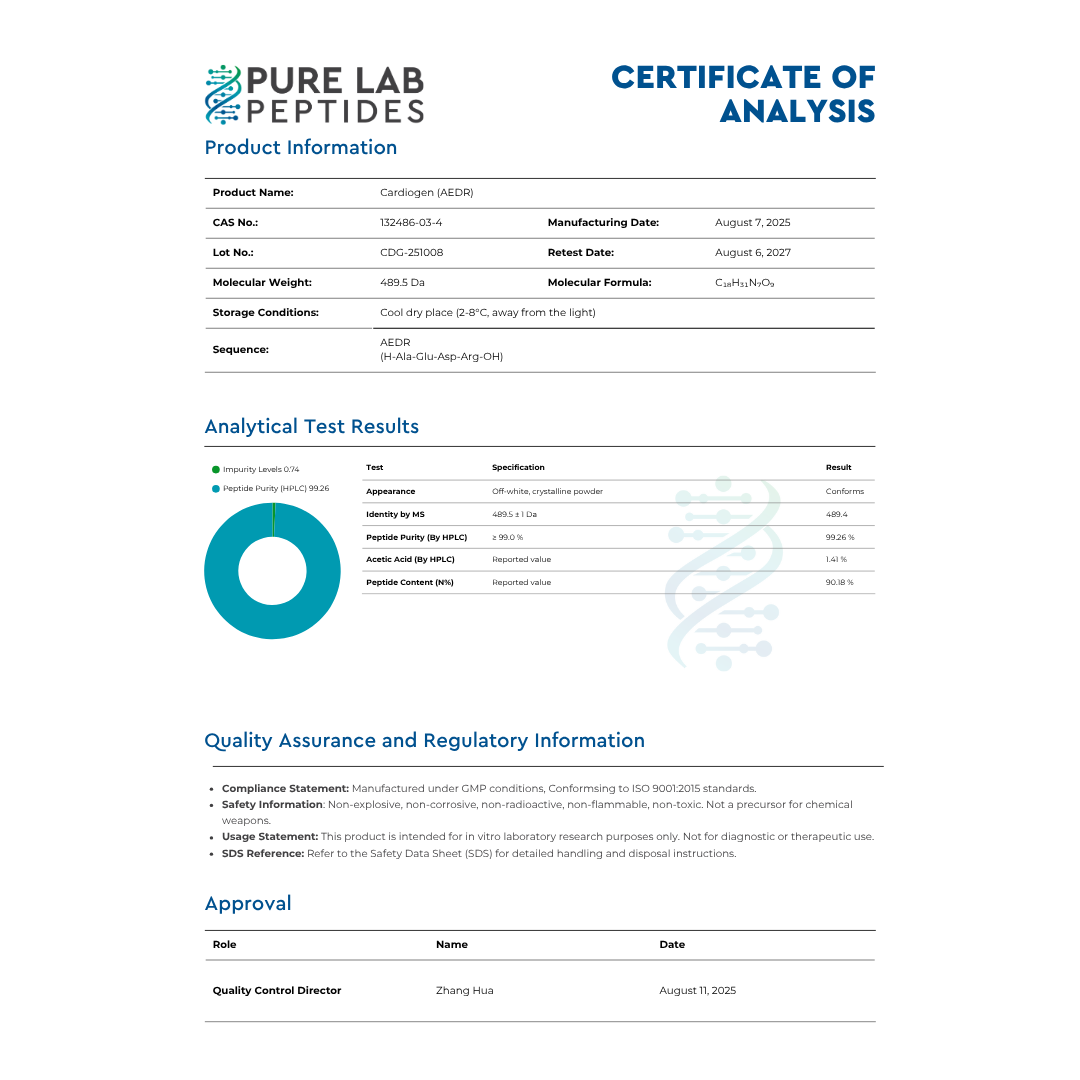
COA documentation matters because it connects a specific lot to test data. For Cardiogen, a useful COA should help confirm that the batch under review matches the peptide identity described on the product page.
A COA does not answer every quality question. It should be read with method details, chromatogram or mass data where available, label consistency, and supplier documentation.
Before labs buy Cardiogen for research, procurement teams should compare the compound name, sequence, molecular weight, lot number, testing date, method notes, and identity data. Analytical validation guidance from FDA and ICH Q2(R2) describes validation as a framework for evaluating analytical procedure performance characteristics [16].
For a research peptide page, the point is not to claim regulatory equivalence. The point is to encourage method-aware review of the documents provided.
Batch-specific records support procurement because they reduce ambiguity. A lot-level COA is more useful than a generic purity statement because it can be compared against the label and product listing.
WHO quality-control laboratory guidance also highlights documentation, laboratory records, and quality-management principles as part of reliable testing operations [18]. That makes batch documentation a practical research procurement issue.
COA dates and lot numbers help connect test records to the material being reviewed. Without that connection, a purity value or identity statement may not clearly apply to the specific listing.
Lot traceability is also important when a laboratory needs to compare records across procurement, receipt, storage, and internal inventory. The stronger the traceability chain, the easier it is to audit the research material record.

Analytical testing supports Cardiogen peptide identity by comparing expected molecular and chromatographic information with measured data. Mass spectrometry is widely described as suitable for synthetic peptide identity and purity characterization [12].
For Cardiogen, testing should support the expected AEDR peptide identity. It should not be presented as a guarantee of biological activity.
HPLC can support peptide purity review by separating sample components under defined chromatographic conditions. For synthetic peptides, purity and identity review often requires method context, not only a single headline number [12] [14].
A Cardiogen COA should make clear whether the purity value comes from HPLC or another method. Editors should avoid writing as though one purity percentage explains the complete quality profile.
LC-MS supports identity review by combining liquid chromatographic separation with mass spectrometric detection. Synthetic peptide literature describes LC-MS and MALDI-TOF-MS as common tools for confirming known peptide identity and purity [12].
For Cardiogen, LC-MS can help compare observed mass-related data against the expected AEDR peptide. Mass spectrometry data are typically represented by mass-to-charge ratio, or m/z, which links measured ions to mass-related interpretation [21].
Chromatogram and mass data can confirm whether the observed signal is consistent with the expected peptide under the stated method. LC-ESI-MS literature has been used to identify known and unknown synthetic peptides based on molecular mass and sequence-related data [15].
These records are strongest when the COA, chromatogram, mass data, and lot number match. They are weaker when a product page gives only a generic purity statement.
Researchers should compare the product listing, COA, label, lot record, test method, and storage documentation before they buy Cardiogen for research. This is a documentation review, not a product ranking exercise.
The most useful comparison is internal consistency. A clean documentation trail should make it easy to identify the compound, match the batch, and understand which analytical methods were used.
A Cardiogen product listing should keep name, sequence, and amount consistent across the page and COA. PubChem’s AEDR record gives a useful reference point for sequence and molecular data [1].
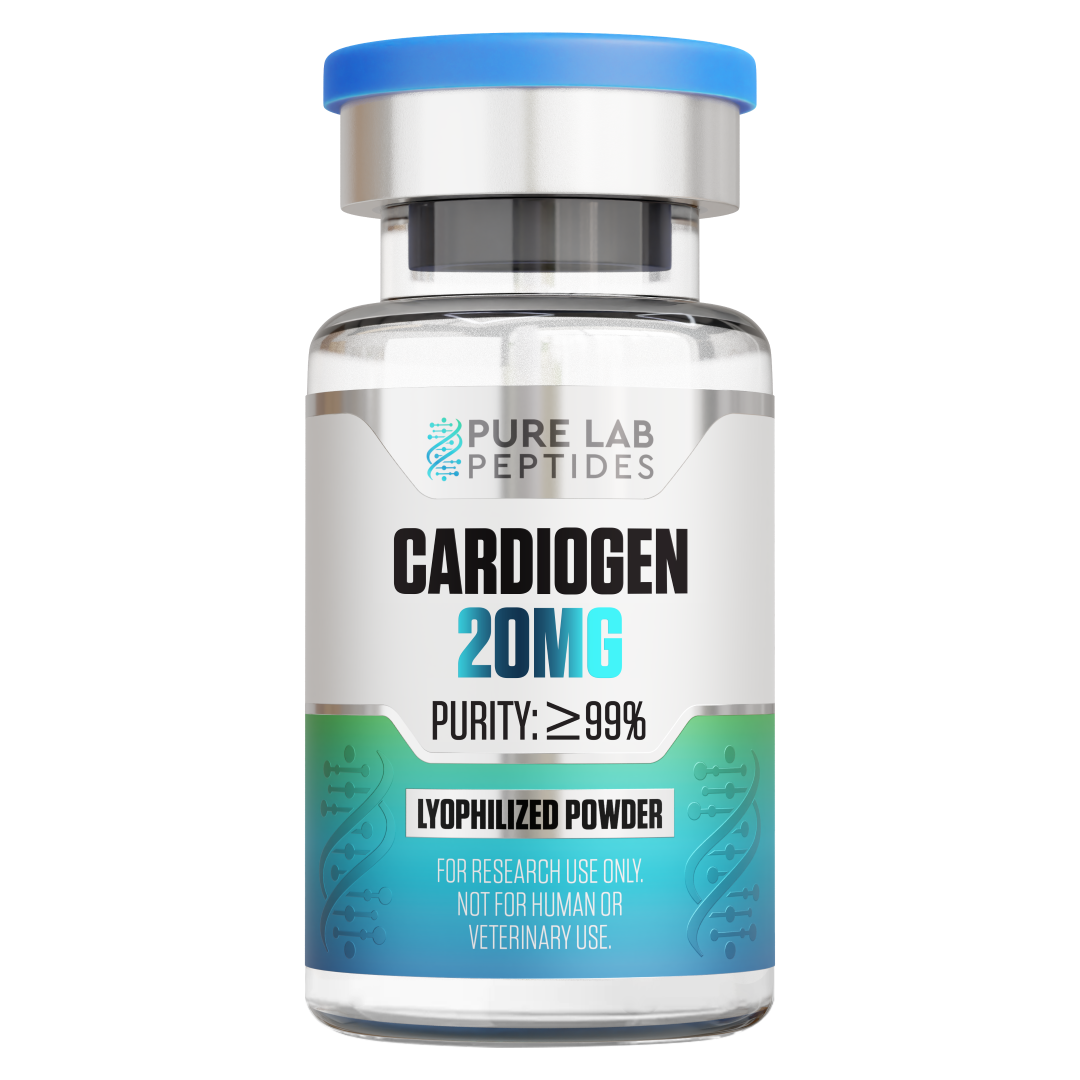
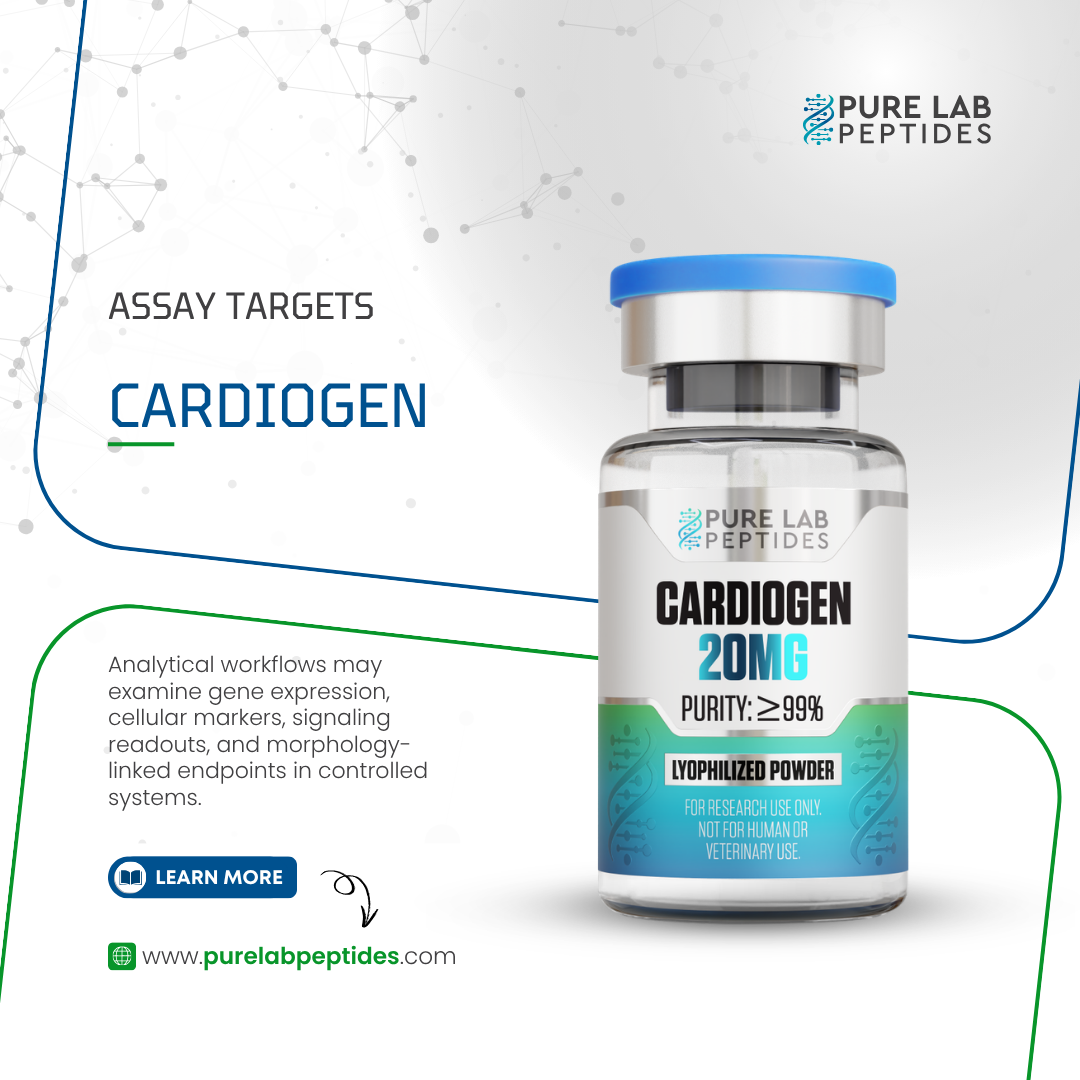
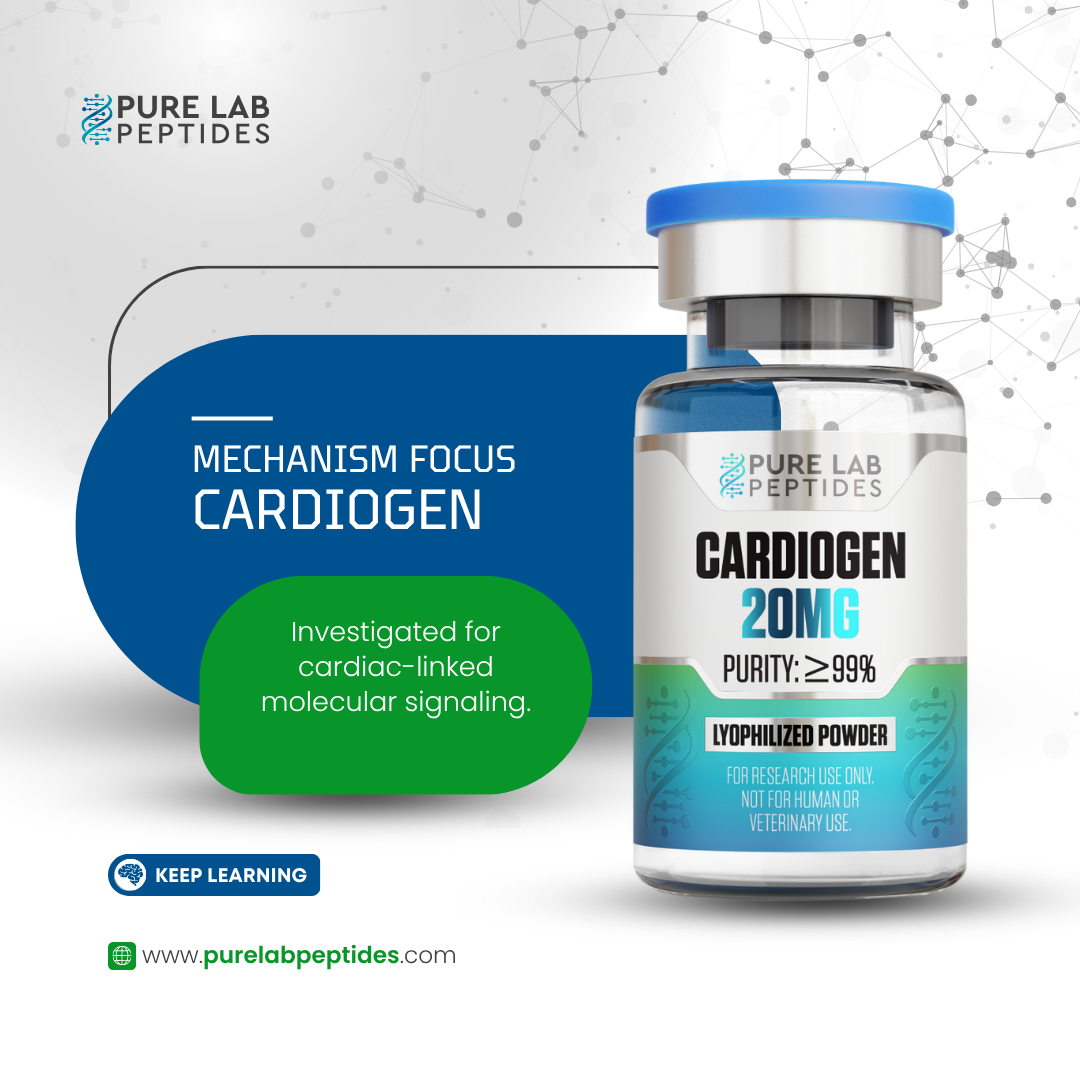
For example, the product page may mention a 20mg catalog amount as a neutral listing specification. That amount should not be expanded into variant-specific SEO targeting or experimental guidance.
Catalog amounts belong in product identification and inventory review. They help procurement teams confirm which listing is being evaluated, but they do not define research design.
For Cardiogen, the canonical entity is the AEDR peptide. The article should target Cardiogen as the compound, not a separate page intent for each listing amount.
Supplier documentation should match the COA because the COA is only useful when it clearly maps to the material being reviewed. The product name, lot identifier, and method notes should align.
If the label, COA, and product page diverge, the uncertainty belongs in the procurement record. Research buyers should prioritize documentation clarity over marketing language.
Storage and handling documentation should describe how the material should be logged, stored, and tracked in a laboratory inventory system. WHO storage and distribution guidance emphasizes storage conditions, documentation, stock control, equipment, and distribution risk management for medical products [19].
For a peptide research material, the safest editorial framing is to tell labs to follow the supplier’s label, institutional requirements, and documented storage records.
The label should identify the material and give storage information in a way that matches the supplier record. Storage notes should be recorded as documentation, not converted into performance claims.
Temperature and stability notes matter because research materials can be sensitive to storage conditions. The article should not infer stability beyond the label, COA, or supplier documentation.
Chain-of-custody records help connect receipt, storage, access, and inventory review. This is useful when multiple research materials are stored in the same facility.
For Cardiogen, chain-of-custody documentation can include supplier record, purchase record, label image, COA, lot identifier, receipt date, and storage location. This helps laboratory teams maintain a clear audit trail.
Research teams evaluate Cardiogen by reviewing identity, documentation, analytical support, and RUO boundaries. The decision should be driven by records, not by unsupported claims.
A practical checklist can keep procurement review consistent:
Procurement teams should confirm identity first: name, sequence, molecular data, and lot match. PubChem’s H-Ala-Glu-Asp-Arg-OH entry provides the AEDR reference point for sequence and computed mass [1].
Next, teams should review COA detail, test method, date, and laboratory source. A well-organized record helps the lab understand what was tested and which batch the record covers.
Third-party testing can add value when the report is batch-specific and method-aware. The value comes from independent analytical documentation, not from a promotional badge.
For synthetic peptides, mass spectrometry and LC-MS have been described as useful for identity and purity characterization [12] [13]. Research teams should still verify whether the report maps to the exact lot under review.
Cardiogen peptide pages can be misunderstood when literature context, product documentation, and commercial language are blended together. A research product page should keep those layers separate.
Common misunderstandings include:
A product page can summarize literature context, but it should not behave like a full literature review. Its primary job is to help research buyers understand identity, documentation, testing, and RUO scope.
For Cardiogen, that means the page can cite myocardial tissue culture and peptide regulation literature [4] [8]. It should still keep the product’s commercial content centered on COA review and analytical verification.
Research findings describe what investigators observed in a defined model. Commercial claims position a product as producing an outcome.
That difference matters for Cardiogen because the literature includes boundary-sensitive topics such as apoptosis, cytostasis, fibroblast signaling, and M-1 sarcoma model findings [4] [6] [7]. The safest product-page approach is to describe these as literature topics and then return to documentation.

Documentation review before labs buy Cardiogen for research should be structured and repeatable. The goal is to confirm that the product listing, COA, analytical records, label, and supplier documentation align.
A numbered lab-test verification workflow can support that review:
The final check should ask whether the Cardiogen listing, COA, label, and lot record all point to the same material. If they do, the documentation package is easier to review, archive, and audit.
Pure Lab Peptides supplies compounds for laboratory research use only. Products are not intended for human or animal consumption, diagnostic use, therapeutic use, clinical use, veterinary use, or as food, drugs, cosmetics, dietary supplements, or household products. Researchers are responsible for ensuring lawful, appropriate handling and use in accordance with applicable regulations and institutional guidelines.
Cardiogen research questions should go next to source review, COA review, analytical data review, and institutional procurement records. Research teams comparing peptide suppliers should prioritize COA availability, transparent labeling, and lot-level documentation.
Review the product-page documentation, COA details, and RUO labeling before evaluating this compound for laboratory research.
Research use only means Cardiogen is intended solely for qualified laboratory research contexts. For a product-page review, that shifts attention toward compound characterization, RUO labeling, batch documentation, peptide COA review, and supplier records. It also means published literature should be interpreted as research context rather than as product positioning or practical guidance.
Researchers should consider documentation first before they buy Cardiogen for research. A safe review should compare the product listing, COA, lot information, peptide identity, analytical testing records, and storage notes. Catalog details may help identify the listing, but the stronger procurement signal is whether the documentation package is batch-specific and internally consistent.
A COA matters for Cardiogen research materials because it connects a specific batch to documented analytical review. Researchers should check whether the COA includes identity, purity method, lot number, testing date, and supplier documentation. A peptide COA is most useful when it matches the product label and supports traceable research documentation.
Published literature about Cardiogen should be interpreted as model-specific research context. In vitro research, pathway research, and development of myocard tissue culture literature can help explain how researchers have studied the compound, but those findings should not become product claims. The safer focus is study model, endpoint, limitation, and documentation relevance.
Cardiogen can be discussed in cardiovascular system research context when the article stays tied to published models and documentation. Terms such as vascular, vascular network, and expression of signaling factors should be handled as literature or model language. They should not be framed as claims about a research material or expected outcomes.
Researchers should review Cardiogen handling records as part of laboratory documentation control. Relevant records may include label information, storage notes, lot traceability, batch documentation, supplier records, chromatogram review, and analytical verification details. Handling of peptides should remain a documentation topic, separate from product-positioning language or non-laboratory interpretation.
The following authors are recognized for published research that helped shape the scientific context discussed in this article.
Author profile: RUDN Journal Profile
Vladimir Khatskelevich Khavinson authored and co-authored published work relevant to short peptide literature, gene-expression research context, and peptide bioregulator discussions. His publications helped shape the broader scientific background used to frame Cardiogen as a research topic within bioregulator peptide research. For this product-page context, his work is most relevant to literature interpretation, short peptide mechanisms, and the need to separate model-specific findings from RUO product positioning.
Selected publications:
Author profile: Molecular Medicine Author Details
Natalia Iosifovna Chalisova authored and co-authored publications that are directly relevant to Cardiogen research context, organotypic tissue-culture models, and peptide bioregulator literature. Her work helped inform the article’s discussion of myocardial model interpretation, documentation-focused research framing, and the distinction between published model findings and product-page claims. In this RUO context, her publications are useful for understanding how Cardiogen appears in controlled research literature while keeping procurement review centered on identity, COA, and documentation.
Selected publications:
This research disclaimer clarifies how Pure Lab Peptides handles published literature and search language around Cardiogen. In bioregulator peptide research content, phrases such as use of Cardiogen, Cardiogen works, effect of Cardiogen peptide, tumor-modifying effect of Cardiogen peptide, Cardiogen peptide on M-1 sarcoma, and how cardiovascular peptides work can drift into consumer-facing, clinical-use, wellness, or product-claim language when separated from model-specific research context.
Here, those phrases are handled only as research-language examples, not as intended-purpose claims, outcomes, instructions, or recommendations. Commercial or literature-adjacent phrases such as Cardiogen peptide for sale, peptide online, buy Cardiogen online, where to buy Cardiogen peptides, order Cardiogen, and intended uses of Cardiogen peptides should remain separate from product positioning and tied back to Cardiogen identity, COA review, analytical testing, peptide purity, lot traceability, RUO labeling, product documentation, and published literature boundaries.
Discount Applied Successfully!
Your savings have been added to the cart.





There are no reviews yet.