


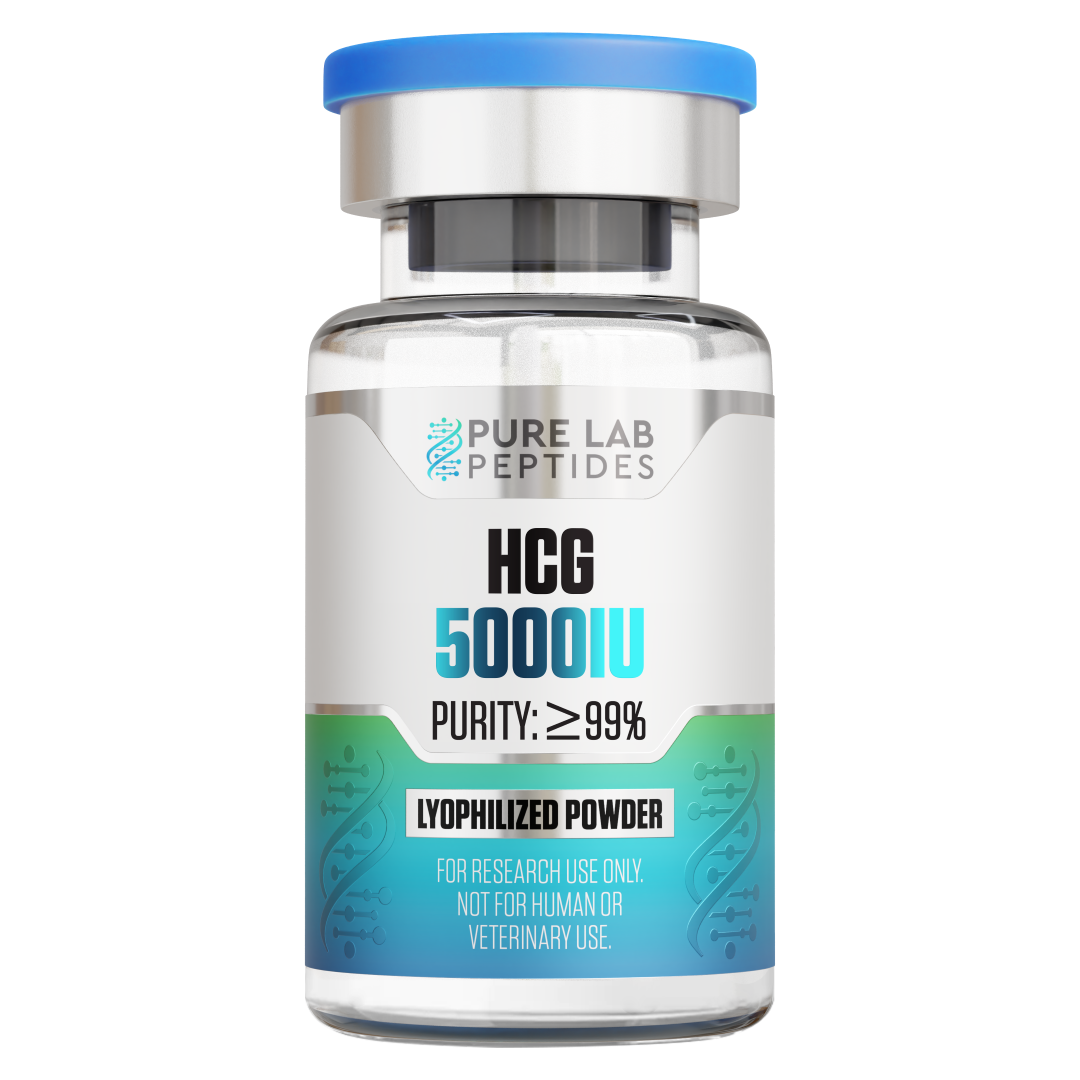
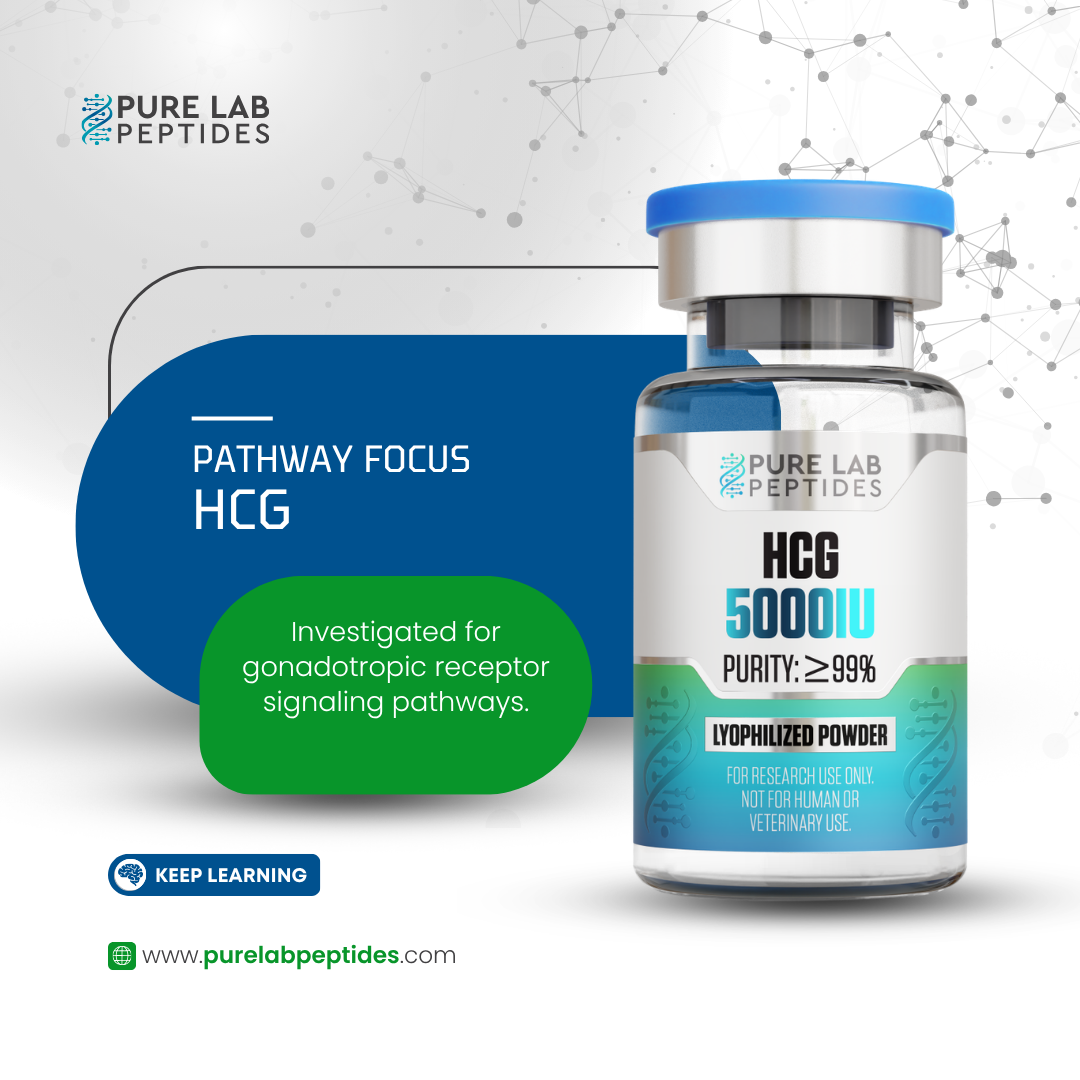
Buy HCG for research should mean reviewing compound identity, RUO labeling, COA data, analytical testing, and lot documentation before any laboratory procurement decision. Human chorionic gonadotropin, often styled hCG in scientific literature, is described in official databases and peer-reviewed sources as a glycoprotein gonadotropin with alpha and beta subunits [1] [2]. This Pure Lab Peptides product-page guide frames HCG strictly as a research-use-only laboratory material, not as a clinical, wellness, or consumer product.
Researchers evaluating where to buy HCG for research should first review RUO labeling, batch-specific COA data, lot traceability, supplier documentation, and analytical testing records rather than standalone commercial phrasing. Products discussed in this article are intended for laboratory research use only and are not intended for human or animal consumption. The practical question is whether the listing, label, COA, and analytical files tell the same research-documentation story.
Commercial research intent needs careful framing. A search phrase such as buy HCG for research should lead to documentation review, not claims about outcomes or non-laboratory contexts.
For an RUO page, the safest commercial path is clear: identify the compound, verify labeling, review batch documentation, and evaluate analytical support. FDA RUO guidance for research-labeled materials emphasizes the importance of keeping research labeling distinct from diagnostic or clinical positioning [15].

Before supplier selection, research buyers should compare the compound name, lot number, COA date, analytical method, and available identity records. FDA analytical-method guidance describes documentation supporting identity, quality, purity, and related analytical attributes for regulated product contexts; the same documentation logic is useful as a research-page review framework [17].
A product page should not ask the reader to trust a name alone. The stronger signal is consistency across the label, COA, chromatogram or mass record, lot number, and storage documentation.
RUO labeling sets the page boundary. Federal labeling language for certain research-labeled laboratory products includes the statement “For Research Use Only. Not for use in diagnostic procedures,” which shows why product-page wording must avoid diagnostic and clinical positioning [16].
For Pure Lab Peptides, RUO positioning means the page should stay anchored in research procurement and laboratory documentation. It should not drift into consumer outcomes, product effects, or clinical-use language.
Buying HCG for research is a documentation-first decision. The article’s role is to help qualified research teams evaluate the compound listing, not to suggest any non-laboratory purpose.
An HCG listing should identify the material, state the RUO context, and make documentation easy to review. Because HCG has a long scientific record across endocrine, placental-biology, and assay literature, product-page copy should separate literature context from supplier claims.
A safe RUO listing does not convert published findings into product positioning. It keeps the focus on compound identity, batch-specific documentation, analytical verification, and labeling consistency.
Pure Lab Peptides should frame HCG procurement around technical review. That means the product page should help laboratory buyers answer practical questions: Is the compound named consistently? Is a COA available? Does the lot number match? Are HPLC or LC-MS records listed where available?
This is commercial, but it is commercial research intent. The page can support supplier evaluation without becoming a general wellness article, medical article, or consumer guide.
HCG is a glycoprotein gonadotropin described as a heterodimer of alpha and beta subunits [1] [3]. Literature and database records describe the beta subunit as biologically specific to chorionic gonadotropin, while the alpha subunit is shared across related glycoprotein hormones [2] [3].
Human chorionic gonadotropin is a research entity with a well-documented identity record. NCBI and UniProt records describe CGB-family genes and beta-subunit proteins associated with chorionic gonadotropin, which helps researchers distinguish HCG identity language from general peptide catalog terminology [2] [3].
For a product page, the key point is not to oversimplify HCG as a short peptide. It is more accurately discussed as a glycoprotein gonadotropin in the HCG peptide catalog context.
Gonadotropin classification shapes which literature belongs on the page. Reviews of LH and HCG describe them as related glycoprotein hormones with overlapping receptor context but distinct biological and signaling features [6] [7].
This matters for SEO and scientific accuracy. A research page should not treat every endocrine or reproductive term as a product claim; it should use classification to organize literature safely.

Peer-reviewed sequence work and recombinant characterization have described HCG as a subunit-based glycoprotein, including alpha and beta chains reported as 92 and 145 amino acids in recombinant-expression characterization [4] [5]. Glycosylation is also central to HCG literature, and reviews describe multiple HCG-related forms and glycoforms [12] [13].
For documentation review, these details clarify why identity support matters. A name alone does not communicate subunit context, glycoform considerations, or analytical fit.
HCG peptide catalog positioning should be precise. The phrase HCG peptide may appear in commercial catalog language, but the product-page body should clarify that HCG is discussed in literature as a glycoprotein gonadotropin rather than a small linear peptide [1] [3].
Precise naming helps prevent confusion among HCG, HCG-related subunits, recombinant forms, and assay-detection terms. UniProt and NCBI records show why beta-subunit naming and gene-family context matter for identity review [2] [3].
A research buyer should see clear naming across the product listing, COA, label, and documentation files. If the naming shifts across files, the page should prompt closer technical review.
Neutral product listing language should describe the material, documentation, and RUO category. It should not imply outcomes, non-laboratory purposes, or clinical equivalence.
A safe listing can say that HCG is provided for laboratory research and that documentation may include COA, purity testing, identity review, lot details, and storage records. It should avoid converting pathway relevance into product performance.
HCG belongs in a gonadotropin and hormonal signaling research lane. This lane supports discussion of receptor literature, signaling models, placental-biology context, and assay history without moving into non-RUO positioning.
The luteinizing hormone/choriogonadotropin receptor, commonly abbreviated LHCGR, is described by NCBI as a G protein-coupled receptor for luteinizing hormone and choriogonadotropin [8]. Reviews of gonadotropin receptors discuss receptor structure, signaling, and regulation as a core framework for interpreting LH/HCG literature [9].
For product-page purposes, receptor context is background. It is not a claim about what a research material does outside a defined research model.
Placental-biology literature helps explain why HCG is historically important in endocrine and developmental research. Reviews describe HCG in relation to trophoblast and placental biology, including multiple forms and broader biological context [11] [13].
This context should stay academic. A product listing should use it to explain why HCG appears in the literature, not to suggest any product purpose beyond laboratory research.
Pathway context describes what researchers have examined. It does not establish a product claim, a procurement promise, or a non-laboratory purpose.
This distinction is especially important for HCG because LH/HCG receptor literature includes mechanistic signaling comparisons. For example, one study reported that LH and HCG can activate different intracellular signaling profiles through the same receptor context [10].
Published HCG literature spans structural characterization, receptor-pathway research, glycoform analysis, detection-assay history, and broader biological review articles. A product page should use that literature to support background accuracy and documentation literacy.
Appropriate study types include official database records, peer-reviewed structural work, receptor-signaling studies, analytical chemistry papers, and method-validation guidance. For HCG, detection-assay literature is also relevant because HCG and its variants have a long history in immunoassay and mass-spectrometry research [14] [24].
A concise evidence landscape helps keep this organized:
| Research Area | What Literature Examines | Evidence Type | RUO Interpretation |
|---|---|---|---|
| Compound identity | HCG subunit structure and database identity [1] [3] | Database and peer-reviewed characterization | Supports naming and documentation review |
| Gonadotropin class | LH/HCG relationship and glycoprotein-hormone classification [6] [7] | Review literature | Supports topical context, not product claims |
| Receptor signaling | LHCGR and model-specific signaling observations [8] [10] | Database and mechanistic study | Supports pathway background only |
| Glycoform analysis | HCG-related forms and glycosylation differences [12] [13] | Review and biochemical literature | Supports identity complexity |
| Analytical review | HPLC, LC-MS, and method-validation concepts [18] [20] [22] | Analytical guidance and methods literature | Supports COA and testing review |
Translational limits matter when literature moves from molecular characterization into broader biological interpretation. Some published literature outside the scope of RUO product use has examined this compound class in human study settings. That literature should not be interpreted as a use claim for research-use-only materials [6].
A product page should not collapse evidence levels. In vitro, preclinical, analytical, database, and broader academic sources each answer different research questions.
A safe HCG page needs an evidence interpretation framework. The goal is to show what a source can support and what it cannot support.
A strong source quality filter starts with official databases and peer-reviewed literature. For HCG, that means PubChem for compound summaries, NCBI and UniProt for gene or protein identity, PubMed-indexed reviews for biological background, and analytical chemistry sources for HPLC or LC-MS discussion [1] [2] [3] [20] [22].
Lower-quality sources should not drive product-page claims. The page should prioritize verifiable literature and documentation rather than unsourced marketing language.
Research findings can support compound background, pathway relevance, terminology, assay context, and documentation priorities. They cannot support promises about product performance.
A practical interpretation rule is simple: cite literature for what it examined, then return the product page to COA review, analytical testing, lot traceability, and RUO labeling.

Research literature and product claims must stay separate. The literature may describe molecular structure, glycoforms, receptor pathways, and assay methods, but a product page should not turn those details into non-laboratory positioning.
Claim boundaries mean the page can discuss HCG as a research entity while avoiding claims about outcomes. They also mean that product effects or consumer outcomes should not be presented as product-page promises.
For HCG, the safest content center is documentation. That includes compound identity, COA data, analytical methods, lot numbers, and RUO labeling.
Search intent can drift when a commercial keyword is separated from research context. The safe phrase is buy HCG for research, not a standalone phrase that implies consumer shopping.
The page should also avoid turning catalog terms into claims. For example, unit strings and listing specifications should be handled as documentation details, not as instructions or outcome signals.
Documentation is what makes the commercial page useful to research buyers. COA files, analytical method names, lot-specific records, and label consistency are concrete review points.
This approach also protects scientific accuracy. A product page can serve commercial research intent without making claims that belong outside RUO positioning.
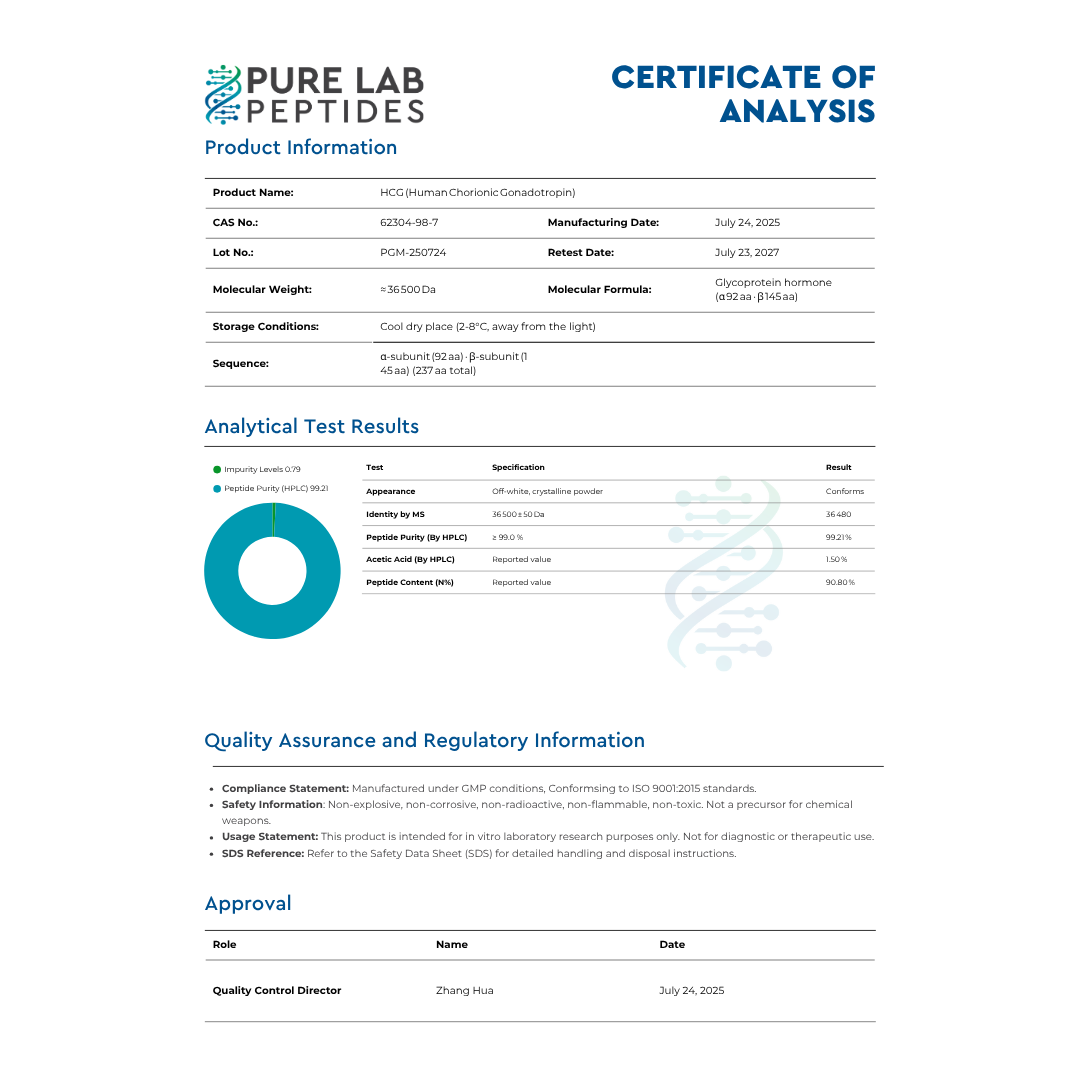
COA documentation should be batch-specific, readable, and consistent with the product listing. For HCG research materials, a COA should help confirm that the listed compound, lot number, and testing records align.

An HCG certificate of analysis should show the compound name, lot number, test date or release date, purity-related data, analytical method, and identity-supporting information where available. FDA method-validation guidance describes analytical documentation as a way to support identity, quality, purity, and related quality attributes in regulated contexts [17].
A COA is not just a decorative file. It is a technical document that should connect the product listing to the batch record.
Batch-specific review reduces ambiguity. FDA cGMP Q&A material describes supplier certificate-of-analysis practices in component-control contexts, including the need to establish reliability rather than relying on paperwork alone [26].
For research procurement, the lesson is practical: the COA should match the actual lot being evaluated. A general sample document is less useful than a lot-level file.
COA dates and lot numbers help connect a product listing to a specific batch record. Without that connection, a purity percentage or identity statement is harder to interpret.
Lot traceability also supports recordkeeping. If a laboratory compares multiple research materials over time, a clear lot trail helps keep procurement files organized.
Analytical testing connects documentation to measurable attributes. For HCG research materials, HPLC and LC-MS can support different parts of the review process, especially when records are batch-specific.
HPLC is widely used in peptide analysis because chromatographic separation can help evaluate components in a sample and support purity review [20]. In an HCG research-page context, HPLC data should be read as part of a documentation package rather than as a standalone identity guarantee.
A useful COA should identify the method and provide enough context for technical review. If a chromatogram is available, it should be associated with the same lot record.

LC-MS combines separation with mass-spectrometry information, making it valuable for peptide and protein analysis workflows [22]. LC-HRMS literature has also described approaches for qualitative and quantitative characterization of peptide drugs and related impurities [23].
For HCG specifically, LC-MS/MS literature has been applied to intact HCG and related HCG forms in analytical research settings [24]. That supports the broader point: identity review is stronger when mass data, method context, and batch documentation are aligned.
Chromatograms can show separation patterns, retention-time information, and relative peak profiles. Mass data can support molecular identity review through mass-to-charge information and related analytical interpretation [22] [23].
Documentation-focused lab-test verification protocol:
ICH Q2(R2) provides a general framework for analytical procedure validation, and ICH Q14 provides a science- and risk-based framework for analytical procedure development [18] [19].
Lot traceability helps research teams connect a product listing to the exact documentation set being reviewed. It also supports repeatable internal recordkeeping.
Research buyers should compare product name, lot number, COA date, purity data, method names, and identity-supporting records. EMA guidance on synthetic peptide development emphasizes characterization, specifications, and analytical control for peptide-related products in regulated development contexts [21].
Even when an RUO product page is not a regulatory submission, the same review logic is useful. The documents should agree with one another.
Storage documentation helps preserve the meaning of the batch record. Reviews of lyophilized protein development discuss freeze drying as a strategy used in protein formulation and stability contexts, which is why storage documentation should be clear when solid-state materials are listed [25].
For HCG research materials, the product page should state storage expectations as documentation. It should not provide non-laboratory handling guidance.
Pure Lab Peptides product pages should make supplier documentation easy to evaluate. The goal is not to overwhelm the reader, but to show the files and facts that matter.
Research buyers can use this checklist:
This checklist keeps the procurement decision tied to evidence rather than promotional language.
Labeling consistency reduces uncertainty. FDA container-closure guidance describes the importance of documentation for packaging materials in regulated product contexts, and that same documentation mindset can help research buyers think about labels, lots, and records [27].
For a product page, the label, COA, and listing should not feel like separate stories. They should identify the same material in the same way.
Misunderstandings often start when commercial keywords, literature terms, and catalog details are blended together. A good RUO page separates them.
The keyword should not control the scientific frame. The safe commercial phrase is buy HCG for research because it keeps procurement tied to laboratory context.
A standalone commercial phrase can be too broad. The page should redirect that intent toward documentation, not claims.
Unit language can create confusion when catalog strings are treated as SEO targets. IU, I.U., 5000 IU, and 5000 I.U. should be treated as listing or catalog language, not as separate article targets.
This page stays canonical to HCG. It does not build a separate product-page strategy around unit strings or variants.
Catalog details identify what is listed. Claims describe what a product is said to do. Those are different categories.
Common misunderstandings to avoid:
Buy HCG for research only after reviewing documentation in a strict RUO frame. The decision should be grounded in compound identity, COA details, analytical support, lot traceability, labeling consistency, and storage documentation.
Pure Lab Peptides supports documentation-first review by keeping the product-page focus on research materials, not non-laboratory positioning. A strong HCG product page should make the COA, analytical methods, lot information, and RUO label easy to find and compare.
Pure Lab Peptides supplies compounds for laboratory research use only. Products are not intended for human or animal consumption, diagnostic use, therapeutic use, clinical use, veterinary use, or as food, drugs, cosmetics, dietary supplements, or household products. Researchers are responsible for ensuring lawful, appropriate handling and use in accordance with applicable regulations and institutional guidelines.
Before evaluating HCG as a laboratory research material, review the product-page documentation, COA details, analytical testing references, and RUO labeling. For research teams comparing peptide suppliers, prioritize COA availability, transparent labeling, lot-level documentation, and method clarity.
Explore Pure Lab Peptides for RUO peptide compounds with research-focused product information and available documentation.
Researchers should consider documentation first before they buy HCG for research. A research-use-only review should focus on RUO labeling, COA availability, lot traceability, analytical testing, and consistency between the product listing and batch-specific records. The goal is supplier documentation review, not non-laboratory positioning or product-use claims.
Recombinant HCG refers to HCG characterized through controlled expression and analytical review in research literature [4]. In product-page documentation, the term should be used only to clarify compound identity, source terminology, or literature context. It should not be used to suggest equivalence to any non-RUO material or any purpose outside laboratory research.
HCG detection literature should be interpreted as assay and measurement context, not product positioning. Researchers may encounter immunoassay, antibody, and analytical testing references when reviewing how studies detect the presence of HCG [14]. On an RUO product page, that information supports literature interpretation and documentation review rather than any diagnostic or clinical claim.
Pituitary gland context may appear because HCG is discussed alongside related glycoprotein hormones in endocrine system literature. Researchers may compare HCG background with follicle-stimulating hormone, thyroid-stimulating hormone, and luteinizing hormone to understand classification and receptor-pathway context [6]. This framing should remain academic and separate from product-page claims.
Molecular weight and peptide sequence can support HCG identity review when they are verified through reliable documentation or scientific databases. For HCG, subunit structure and amino-acid details make identity review more complex than a simple short-peptide listing [3] [4]. Researchers should compare identity information against COA data, supplier documentation, and analytical testing records.
HCG product pages should stay research-use-only by separating literature language from product claims. Phrases about cells of the placenta may belong in published literature context, but they should not become product positioning. A compliant page should return to compound characterization, COA review, analytical testing, lot traceability, RUO labeling, and published literature boundaries.
The following authors are recognized for published research that helped shape the scientific context discussed in this article.
Author profile: ORCID
Livio Casarini’s published work is relevant to the HCG research context because it examines how LH and HCG relate to the same receptor framework while producing model-specific intracellular signaling patterns. His publications helped inform the article’s discussion of LHCGR-centered pathway research, ligand comparison, and the need to keep receptor background separate from product-page claims. This work is especially useful for interpreting HCG as part of a gonadotropin and hormonal signaling research lane.
Selected publications:
Author profile: University of Michigan Medical School Profile
K M Jairam K J Menon’s publications are relevant to this article’s receptor research and documentation-focused interpretation of HCG literature. His work on gonadotropin receptors provides background for understanding LHCGR structure, receptor regulation, and cell signaling models in the broader gonadotropin research category. These publications support the article’s emphasis on separating pathway literature from product claims while using peer-reviewed research to frame scientific context.
Selected publications:
This research disclaimer clarifies how this page handles published literature and search language around HCG. In gonadotropin and hormonal signaling research content, terms such as HCG therapy, testosterone, infertility, ovulation, pregnancy, progesterone, Leydig cells, steroid, pharmacy, FDA-approved, therapeutic language, and administration-focused language can drift into consumer-facing or product-claim territory when framed without research boundaries.
Here, those phrases are handled only as research-language examples, not product uses, outcomes, instructions, or recommendations. The focus remains on HCG identity, COA review, analytical testing, peptide purity, lot traceability, RUO labeling, product documentation, and published literature boundaries, with model-specific research context kept separate from product positioning.
Discount Applied Successfully!
Your savings have been added to the cart.




There are no reviews yet.