

$29.99 Original price was: $29.99.$24.99Current price is: $24.99.
Research Studies:


FREE Shipping on
orders over $200
ALL ARTICLES AND PRODUCT INFORMATION PROVIDED ON THIS WEBSITE ARE FOR INFORMATIONAL AND EDUCATIONAL PURPOSES ONLY. The products offered on this website are intended solely for research and laboratory use. These products are not intended for human or animal consumption. They are not medicines or drugs and have not been evaluated or approved by the FDA to diagnose, treat, cure, or prevent any disease or medical condition. Any form of bodily introduction is strictly prohibited by law.
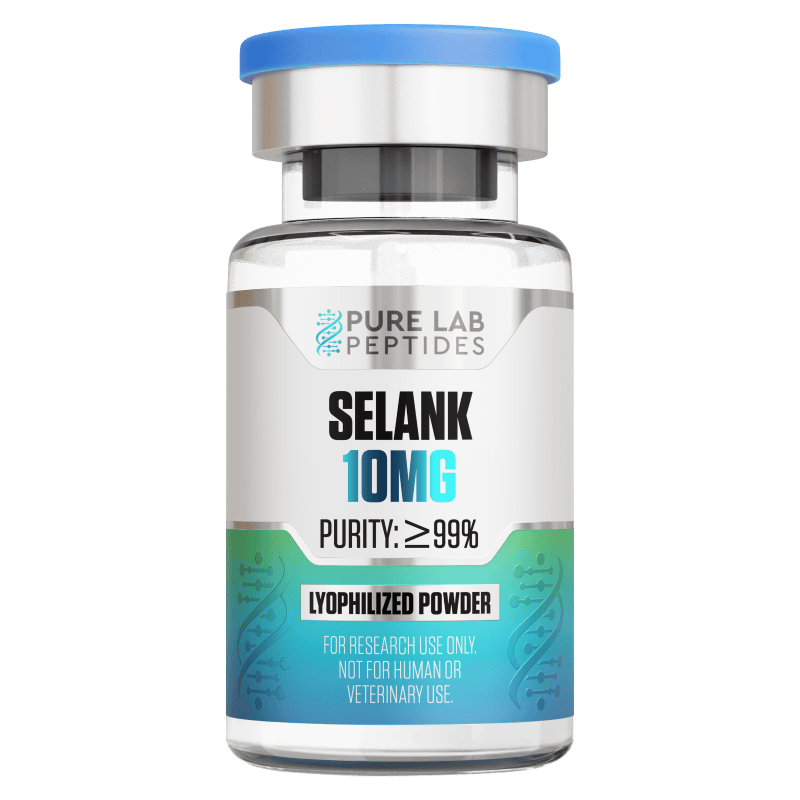
Selank 10mg is a research-use-only laboratory material supplied for controlled research workflows, compound characterization, and analytical documentation review. It is manufactured under rigorous quality standards to support consistency, traceability, and batch-specific verification for qualified laboratory settings.
Selank 10mg is intended strictly for laboratory research use only. This product is not intended for human or animal consumption, therapeutic use, diagnostic use, clinical use, veterinary use, or as a food, drug, cosmetic, dietary supplement, or household product.
| CAS No. | 129954-34-3 |
|---|---|
| Purity | ≥99% |
| Sequence | Thr-Lys-Pro-Arg-Pro-Gly-Pro |
| Molecular Formula | C33H57N11O9 |
| Molecular Weight | 751.9 g/mol |
| Synthesis | Solid-phase synthesis |
| Format | Lyophilized powder |
| Solubility | Soluble in water or 1% acetic acid |
| Stability & Storage | Stable for up to 24 months at -20°C. After reconstitution, may be stored at 4°C for up to 4 weeks or at -20°C for up to 6 months. |
| Applications | Neurological studies, immune system research, cognitive enhancement studies |
| Appearance | White lyophilized powder |
| Shipping Conditions | Shipped at ambient temperature; once received, store at -20°C |
| Regulatory/Compliance | Produced in a facility adhering to cGMP guidelines |
| Safety Information | Refer to provided MSDS |
Consider these supplementary peptides for a comprehensive research approach.
Pure Lab Peptides frames buy Selank for research as a documentation-led procurement question for qualified laboratory teams. Selank is a synthetic heptapeptide listed by PubChem with the sequence TKPRPGP, formula C33H57N11O9, and molecular weight 751.9 g/mol [1]. This product-page research guide keeps the focus on RUO labeling, peptide identity, published literature, COA review, purity testing, and lot-level documentation.
Selank is a research peptide with a PubChem identity record that lists its sequence, formula, synonyms, and molecular weight [1].
Published Selank literature places the compound in neuropeptide and regulatory-peptide research, with specific attention to gene expression, GABA-related signaling models, and peptide analog context [2].
Documentation matters because a product listing should be checked against a batch-specific certificate of analysis, identity information, purity data, and lot records.
Published literature can describe model-specific findings, but those findings should not become product claims.
HPLC and LC-MS are complementary analytical tools: chromatography supports separation review, while mass spectrometry supports molecular-mass and identity review [13] [14].
RUO positioning means the page should stay focused on laboratory research materials, supplier documentation, and responsible procurement review.
Before procurement, research buyers should compare label language, COA fields, lot identifiers, method details, and storage documentation.
Researchers looking to buy Selank for research should first review RUO labeling, batch-specific COA documentation, peptide identity data, purity testing, and lot traceability—not consumer claims. Products discussed in this article are intended for laboratory research use only and are not intended for human or animal consumption. For Selank, identity review should connect the product name with sequence, formula, molecular weight, HPLC purity, and LC-MS support when available [1] [13] [14].
The safest way to frame the commercial query is as a research procurement review. “Buy Selank for research” should lead to questions about compound identity, documentation quality, analytical testing, RUO labeling, and whether the supplier’s records are clear enough for laboratory intake review.
That framing matters because the original phrase “buy selank” is incomplete. On a Pure Lab Peptides product page, the added research context keeps the focus on laboratory materials and prevents the page from drifting into consumer-facing product positioning.
A strong Selank research material listing should make documentation easy to evaluate. The first signals are the compound name, RUO label, lot number, COA availability, purity method, identity method, and storage record.
For analytical review, HPLC is relevant because chromatography separates sample components between stationary and mobile phases, producing chromatographic data that can support qualitative and quantitative review [13]. Mass spectrometry is relevant because it measures mass-to-charge ratios and can support molecular-mass and structural review of an analyte [14].
RUO labeling defines the intended research context of the material. FDA guidance for IVD products, while written for a different regulated category, illustrates a core editorial principle: research-use-only wording should be consistent with the product’s research positioning and not mixed with non-research claims [11].
For a Selank research page, RUO labeling should be visible, consistent, and supported by the rest of the copy. The page should guide qualified researchers toward documentation review, not personal-use interpretation.
Selank is indexed by PubChem as an oligopeptide with the sequence TKPRPGP and the condensed notation H-Thr-Lys-Pro-Arg-Pro-Gly-Pro-OH [1]. Published research describes Selank as a synthetic regulatory peptide related to tuftsin, a tetrapeptide sequence commonly written as Thr-Lys-Pro-Arg [2].
The key research point is identity. A Selank peptide page should not rely on a product name alone; it should connect the name with sequence-level documentation and batch-specific analytical support.
Selank belongs in a neuropeptide research lane because the literature discusses regulatory-peptide models, gene expression, and neurotransmitter-related signaling. PubChem lists Selank as C33H57N11O9 with molecular weight 751.9 g/mol, and those identity fields give researchers a baseline for documentation comparison [1].
A product page should keep that identity discussion narrow. The role of the article is to help researchers evaluate documentation, not to translate literature into product-use language.
Tuftsin literature identifies Thr-Lys-Pro-Arg as an immunoglobulin-associated tetrapeptide [9]. A review by Najjar describes tuftsin as a small oligopeptide isolated and sequenced as Thr-Lys-Pro-Arg, giving context for why Selank is often discussed as a tuftsin analog in peptide literature [10].
Selank extends that tuftsin-related sequence context with Pro-Gly-Pro at the C-terminal side, as described in the Frontiers gene-expression paper’s introduction [2]. That analog context is useful for classification, not for product claims.
Semax appears beside Selank in some same-lane regulatory-peptide literature. One PubMed-indexed paper examined Semax and Selank in relation to enkephalin-degrading enzyme models, making Semax relevant as a nearby literature entity rather than a substitute product target [8].
For SEO architecture, that means Semax can be mentioned briefly where it clarifies the research lane. It should not become a comparison page, a recommendation, or a product-performance claim.
A Selank peptide product page should answer commercial research intent with documentation-first content. The page can help procurement teams decide what records to review before selecting an RUO research material.
That is different from a blog article. The purpose is not broad wellness education; it is product-page clarity around identity, COA fields, analytical methods, literature context, and supplier documentation.
Documentation-led copy gives research buyers a concrete way to evaluate a material. A product listing should make the technical review path visible: compound identity, COA, purity method, identity method, batch match, and label consistency.
Customer reviews may inform service expectations, but they should not be treated as scientific evidence. For an RUO peptide page, documentation should carry more weight than anecdotal or marketing language.
Commercial intent stays RUO-focused when the page answers procurement questions without promising product outcomes. The page can explain what a COA is, why lot traceability matters, and how analytical methods support documentation review.
It should not answer consumer-intent questions. A safe product-page structure redirects buying intent into research procurement standards.
RUO context should shape every section of a Selank product-page article. Scientific literature may discuss model systems, pathways, and gene-expression findings, but product copy should remain anchored to documentation and research material review.
The simplest rule is this: literature context can explain why a compound is studied, while product-page copy should explain how the material is documented.
Research-use-only language should be direct and plain. It should identify the material as intended for laboratory research, avoid consumer-facing claims, and point readers toward documentation.
The FDA’s RUO/IUO guidance for IVD products reinforces the broader compliance idea that RUO language is connected to intended research context and should not be undermined by other messaging [11]. For this Selank page, that means every scientific phrase should be framed as literature context, not a product promise.
Product documentation should emphasize the record set that supports research procurement: product name, peptide identity, batch-specific COA, purity method, identity method, lot number, COA date, and storage documentation.
This approach also improves SEO quality. It gives the page commercial relevance without drifting into non-research intent.
Non-research framing can change the meaning of a product page. Terms tied to cognitive positioning or product performance can become claims if they are separated from model-specific literature and used as product copy.
A Selank page should therefore keep the research boundary visible. When sensitive language appears in search data or literature abstracts, it should be handled as a boundary issue, not as a product message.
Scientific background should begin with the compound’s identity, not with outcomes. PubChem provides the sequence TKPRPGP, formula C33H57N11O9, molecular weight 751.9 g/mol, and synonym fields that help confirm the intended molecule [1].
The published literature describes Selank in relation to regulatory-peptide research, GABA-related signaling models, cytokine literature, and same-lane peptide analog studies [2] [4]. Those topics are useful for research context when they are kept separate from product claims.
Selank is a heptapeptide because its listed sequence contains seven amino acid residues: Thr-Lys-Pro-Arg-Pro-Gly-Pro [1]. Sequence documentation should be checked against the product name and COA because a research material listing is only meaningful when the named compound and analytical record align.
Sequence notation also helps distinguish canonical Selank from modified or salt-form entries. PubChem separately indexes related records, which is why the canonical product page should avoid variant-specific SEO unless the page is explicitly built for that separate material [1].
Molecular weight and formula are basic identity fields. For Selank, PubChem lists C33H57N11O9 and molecular weight 751.9 g/mol [1].
In procurement review, those fields are not enough by themselves. They should be compared against COA identity data, analytical method notes, and any mass-spectrometry record available for the lot.
Synthetic peptide materials can contain closely related impurities, sequence variants, or process-related species. A 2021 review on LC-MS characterization of synthetic peptides notes that synthetic peptides can show complex structural modifications linked to starting materials, manufacturing processes, and storage conditions [16].
That is why identity review should not stop at the product name. A documentation-first page should connect peptide synthesis context with COA review, HPLC data, LC-MS data, and batch records.
Pathway context belongs on a Selank research page only when it is clearly framed as literature context. Published work has examined Selank alongside GABA-related gene-expression patterns, receptor-related terms, and neurotransmission models [2] [3].
That context can support topical depth, but it should not be written as a product outcome. The page should make clear that pathway relevance is a research concept.
Central signaling models appear in Selank literature because researchers have examined gene expression and neurotransmission-related pathways in nonclinical systems [2] [3]. These papers can inform a literature overview, but they do not define the intended purpose of an RUO research material.
A safe product-page sentence might say that published literature has examined Selank in neurobiology-related model systems. It should not say the product changes a biological outcome in a reader, consumer, or subject.
GABA and serotonin belong as literature entities because one Frontiers study evaluated genes tied to GABA receptor subunits, transporters, ion channels, dopamine receptors, and serotonin receptors in a gene-expression model [2]. A separate cell-model paper examined GABA, Selank, and olanzapine in relation to GABAergic neurotransmission gene-expression patterns [3].
That makes GABA and serotonin useful semantic terms for research interpretation. They should remain pathway and receptor-context terms, not claims.
Published Selank literature includes gene-expression work, peptide analog research, cytokine-related studies, and nonclinical neurobiology models [2] [3] [5] [6]. A product page can summarize that evidence landscape without turning it into a product-positioning statement.
The research boundary is simple. Literature can explain why a compound is studied; product documentation explains what is being supplied for laboratory research.
Research findings can show what a specific paper examined, what model was used, and what the authors reported within that model. For example, the Frontiers gene-expression paper analyzed 84 neurotransmission-related genes in a model focused on GABA-related signaling [2].
Research findings cannot show that an RUO product is intended for any non-research purpose. They also cannot replace batch-specific identity and purity documentation.
Preclinical literature is useful because it can define model systems, pathways, and mechanistic hypotheses. The 2019 Selank paper involving BDNF and brain-region markers is one example of nonclinical literature that belongs in the evidence landscape rather than in product claims [5].
Translational limits should be stated plainly. Model-specific findings do not establish what an RUO material is for; the intended context remains laboratory research.
Study context and product positioning answer different questions. A paper might examine gene expression, receptor binding, cytokine levels, or peptide metabolism, while a product page should describe documentation, COA review, lot traceability, and RUO labeling.
Some published literature outside the scope of RUO product use has examined this compound class in human study settings [7]. That literature should not be interpreted as a use claim for research-use-only materials.
An evidence interpretation framework helps editors and procurement teams avoid overreading the literature. The goal is to identify source type, model context, analytical relevance, and RUO interpretation.
| Research Area | What Literature Examines | Evidence Type | RUO Interpretation |
|---|---|---|---|
| Compound identity | Sequence, formula, molecular weight, and synonyms for Selank [1] | Official database | Supports identity comparison, not product claims |
| Tuftsin analog context | Tuftsin sequence and Selank analog framing [2] [9] [10] | Peer-reviewed literature | Supports classification and same-lane research context |
| Gene expression | GABA-related and neurotransmission-related gene panels [2] [3] | Nonclinical and cell-model literature | Supports pathway discussion with clear limits |
| BDNF and cortex markers | BDNF content and brain-region markers in a model-specific paper [5] | Nonclinical literature | Supports evidence mapping, not product positioning |
| Cytokine literature | Cytokine-level research involving Selank [6] [7] | Model-specific and human-study literature | Requires strong separation from RUO product copy |
| Analytical documentation | Chromatography, mass spectrometry, synthetic peptide MS, and LC-MS impurity review [13] [14] [15] [16] | Official standards and analytical literature | Supports COA and testing review |
A source quality filter keeps the article from relying on marketing claims. Stronger sources include official databases, PubMed-indexed papers, peer-reviewed analytical chemistry, USP chapters, and official regulatory resources.
For Selank, source quality begins with PubChem for identity fields [1], Frontiers and PubMed-indexed papers for literature context [2] [3] [4], and USP or analytical chemistry sources for testing-method discussion [13] [14] [15] [16].
Literature gaps should be stated near the evidence discussion, not hidden at the end. If a paper is model-specific, limited in scope, or outside RUO product positioning, the article should say so.
This helps prevent overinterpretation. It also supports trust because the article explains what documentation can confirm and what literature cannot confirm.
Claim boundaries protect both scientific accuracy and RUO positioning. A Selank product page can discuss published literature, but it should not translate that literature into product claims.
Boundary-sensitive phrases should be reviewed carefully. If a term creates consumer, wellness, or product-performance meaning, it belongs in a claim-boundary discussion rather than in product positioning.
Pathway relevance means a compound appears in literature tied to a research model, receptor family, or signaling pathway. It does not mean the product is intended to create that pathway outcome.
For example, Selank literature can discuss GABA-related gene expression [2] [3]. The product page should interpret that as research context, not as a promise about the material.
Search intent can drift when readers bring consumer language into a research material page. A term such as cognitive can become unsafe if it is written as a product outcome rather than a literature-boundary example.
Common misunderstandings to correct are simple: published literature does not equal product-use guidance; a purity percentage does not prove complete identity; a COA should be batch-specific; RUO labeling does not support personal interpretation; and pathway relevance does not equal a product claim.
Documentation keeps the page grounded because it gives research buyers verifiable review points. A COA, lot number, HPLC record, LC-MS record, and storage note are concrete documents.
That is why the article should return to documentation after any literature discussion. The product page is strongest when the reader can see how each scientific point connects back to identity, purity, and traceability.
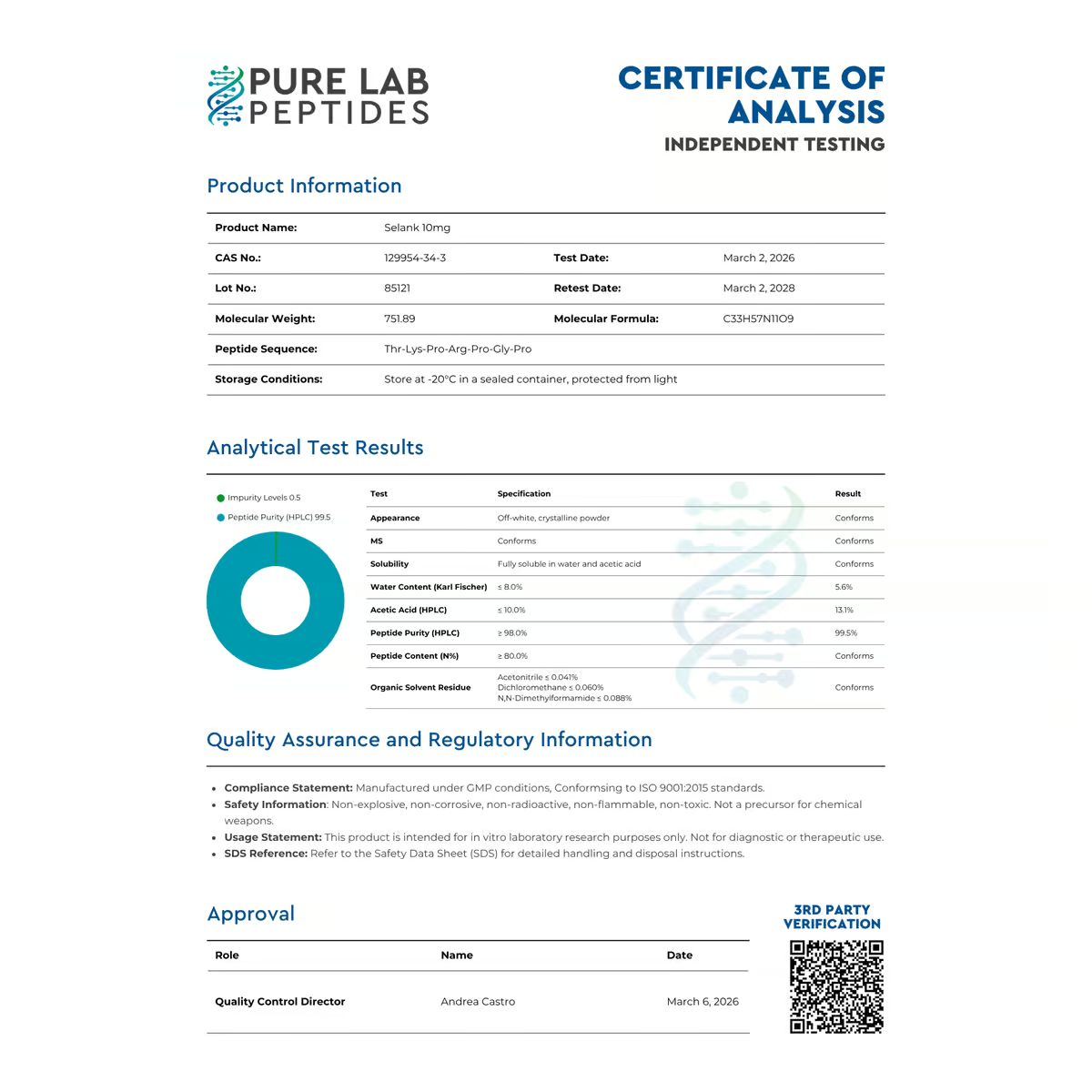
A COA matters because it gives procurement teams a structured record to compare against the product listing. At minimum, researchers should look for compound name, lot number, testing date, method names, purity data, identity support, and lab source.
The analytical literature supports the importance of pairing purity review with identity review. Mass spectrometry is well suited for synthetic peptide identity and purity analysis, and LC-MS can help characterize peptide-related impurities [15] [16].
A batch-specific COA is stronger than a generic document because it can be matched to the lot under review. The lot number on the product documentation should match the COA and any supporting analytical record.
FDA labeling resources for IVD products identify lot or control numbers as traceability fields in that regulated context [12]. For research peptide procurement, the same documentation principle is useful: the record set should let reviewers connect the material to its batch.
Researchers should compare the compound name, lot number, COA date, purity method, identity method, expected molecular weight, observed mass data if provided, and supplier labeling. They should also check whether the analytical record belongs to the same lot.
A COA should not be read as a marketing badge. It is a document for cross-checking identity, method, and traceability.
Purity and identity testing answer related but different questions. HPLC can support a chromatographic purity profile, while MS-based methods can support molecular-mass and identity review [13] [14] [15].
For Selank, the expected identity fields come from the sequence and molecular formula [1]. Analytical review should ask whether the COA and testing record match those fields.
HPLC supports purity review by separating components under defined chromatographic conditions. USP <621> describes chromatography as a separation process based on distribution between stationary and mobile phases, with separations based on physicochemical properties such as size, mass, or volume [13].
For peptide COA review, the practical output is a chromatogram and integrated peak information. That information supports a purity review, but it should not be treated as complete identity proof by itself.
LC-MS adds molecular-mass information to chromatographic separation. USP <736> describes MS as measuring mass-to-charge ratios of ionic species and supporting molecular mass, elemental composition, and structural elucidation [14].
Synthetic peptide literature also supports the role of MS and LC-MS in confirming identity and characterizing related impurities [15] [16]. For Selank, LC-MS support is most useful when it can be compared with the expected molecular weight from identity documentation [1].
Chromatogram details add context. A headline purity number is more useful when the reviewer can see the method, detection notes, main peak, retention time, secondary peaks, and integration record.
A documentation-only lab-test verification sequence can follow these steps:
Verify that the compound name, lot number, and label match across documents.
Review the batch-specific COA.
Check whether the purity method is listed.
Confirm whether identity testing is supported by LC-MS or another suitable analytical method.
Review chromatogram or mass data when available.
Check the COA date and lab source.
Record storage and handling requirements in a laboratory file.
Lot traceability connects a product listing to a specific batch record. It helps reviewers determine whether the COA, label, and analytical record are describing the same material.
This is especially important for synthetic peptides because related impurities and structural variants can be relevant in analytical review [16] [17]. Traceability does not replace testing, but it makes the testing record meaningful.
Lot numbers matter because they connect the product label, supplier documentation, and analytical record. If those fields do not match, the research buyer cannot confidently connect the COA to the material under review.
Lot records also support repeatable procurement review. They make it easier to compare documentation from one batch to another without relying on generic statements.
Batch records support repeatable review by making the evaluation process consistent. A technical procurement team can compare the same fields each time: compound name, lot number, COA date, HPLC method, LC-MS method, purity value, identity support, and storage language.
Repeatability matters because documentation quality is not a one-time impression. It is a structured review process.
When researchers buy Selank for research, supplier documentation should be reviewed before the material is selected. The strongest pages make the research context clear and provide documentation that can be checked without guesswork.
A supplier page should not make the reader hunt for basic review fields. The COA, RUO label, batch details, and analytical method notes should be easy to locate.
Listing consistency means the product page, label, COA, and analytical record use the same compound name and batch identifiers. It also means the research category and RUO positioning remain consistent across the page.
For Selank, identity consistency should connect the product name to the canonical sequence and formula fields [1]. If a listing references a modified form or salt form, that should be documented clearly rather than blended into the canonical page.
Lab teams should compare documentation quality across a short, practical checklist. A good review asks whether the page is RUO-labeled, whether the COA is batch-specific, whether HPLC and LC-MS are stated, whether the lot number matches, and whether storage documentation is available.
They should also look for independent third-party testing language only when it is supported by a clear lab source and batch match. Unverified testing claims should not substitute for actual documentation.
Product handling documentation should describe storage and recordkeeping expectations for laboratory materials. It should not become practical guidance for non-research handling.
For Selank research materials, storage language should be treated as a supplier documentation field. The reviewer should record the stated conditions, check label consistency, and keep those records with the batch file.
Storage documentation and labeling consistency work together. If the product listing, label, and COA provide conflicting information, the discrepancy should be resolved before the material is accepted into a laboratory record.
FDA IVD labeling resources list storage instructions and lot/control information as labeling fields in that regulated context [12]. For RUO peptide procurement, those same types of fields are useful as documentation checkpoints, even though the page remains focused on research materials.
A final review should be simple and documentation-led:
Verify that the compound is labeled for research use only.
Review the batch-specific certificate of analysis.
Confirm that purity data are supported by analytical testing.
Check that the lot number on the COA matches the product documentation.
Compare compound name, molecular weight, and sequence across documentation.
Assess whether the product page avoids non-research claims.
Document storage and handling conditions in a laboratory record.
Pure Lab Peptides supplies compounds for laboratory research use only. Products are not intended for human or animal consumption, diagnostic use, therapeutic use, clinical use, veterinary use, or as food, drugs, cosmetics, dietary supplements, or household products. Researchers are responsible for ensuring lawful, appropriate handling and use in accordance with applicable regulations and institutional guidelines.
Review the product-page documentation, COA details, and RUO labeling before evaluating this compound for laboratory research.
NCBI PubChem. Selank compound record. PubChem Compound. CID 11765600.
Volkova A, Shadrina M, Kolomin T, Andreeva L, Limborska S, Myasoedov N, Slominsky P. Gene-expression study of Selank and GABA-related neurotransmission. Frontiers in Pharmacology. 2016. DOI: 10.3389/fphar.2016.00031. PMID: 26924987.
Filatova E, Kasian A, Kolomin T, Rybalkina E, Alieva A, Andreeva L, Limborska S, Myasoedov N, Pavlova G, Slominsky P, Shadrina M. Cell-model gene-expression study of Selank and GABA-related pathways. Frontiers in Pharmacology. 2017. DOI: 10.3389/fphar.2017.00089. PMID: 28293190.
Vyunova TV, Andreeva L, Shevchenko K, Myasoedov N. Molecular-aspects review of heptapeptide Selank research. Protein & Peptide Letters. 2018. DOI: 10.2174/0929866525666180925144642. PMID: 30255741.
Kolik LG, Nadorova AV, Antipova TA, Kruglov SV, Kudrin VS, Durnev AD. Nonclinical Selank study involving BDNF and cortical-region markers. Bulletin of Experimental Biology and Medicine. 2019. DOI: 10.1007/s10517-019-04588-9. PMID: 31625062.
Yasenyavskaya AL, Samotrueva MA, Tsibizova AA, Bashkina OA, Myasoedov NF, Andreeva LA. Nonclinical cytokine-level study involving Selank. Current Reviews in Clinical and Experimental Pharmacology. 2021. DOI: 10.2174/1574884715666200704152810. PMID: 32621722.
Uchakina ON, Uchakin PN, Miasoedov NF, Andreeva LA, Shcherbenko VE, Mezentseva MV, Gabaeva MV, Sokolov OI, Zozulia AA, Ershov FI. Human-study cytokine literature involving Selank. Zhurnal Nevrologii i Psikhiatrii Imeni S.S. Korsakova. 2008. PMID: 18577961.
Kost NV, Sokolov OIu, Gabaeva MV, Grivennikov IA, Andreeva LA, Miasoedov NF, Zozulia AA. Semax and Selank enzyme literature. Bioorganicheskaia Khimiia. 2001. DOI: 10.1023/a:1011373002885. PMID: 11443939.
Tzehoval E, Segal S, Stabinsky Y, Fridkin M, Spirer Z, Feldman M. Tuftsin tetrapeptide and macrophage-function literature. Proceedings of the National Academy of Sciences. 1978. DOI: 10.1073/pnas.75.7.3400. PMID: 277940.
Najjar VA. Tuftsin overview. Annals of the New York Academy of Sciences. 1983. DOI: 10.1111/j.1749-6632.1983.tb37086.x. PMID: 6370072.
U.S. Food and Drug Administration. RUO/IUO labeling guidance for IVD products. Guidance for Industry and FDA Staff. 2013.
U.S. Food and Drug Administration. IVD labeling requirements reference page. FDA Medical Devices.
United States Pharmacopeia. General Chapter <621> Chromatography. USP-NF. 2023. DOI: 10.31003/USPNF_M99380_07_01.
United States Pharmacopeia. General Chapter <736> Mass Spectrometry. USP-NF. 2017. DOI: 10.31003/USPNF_M99525_02_01.
Prabhala BK, Mirza O, Højrup P, Hansen PR. Synthetic peptide characterization by mass spectrometry. Methods in Molecular Biology. 2015. DOI: 10.1007/978-1-4939-2999-3_9. PMID: 26424265.
Lian Z, Wang N, Tian Y, Huang L. LC-MS characterization of synthetic peptide impurities. Journal of the American Society for Mass Spectrometry. 2021. DOI: 10.1021/jasms.0c00479. PMID: 34110145.
Li M, Josephs RD, Daireaux A, Choteau T, Westwood S, Wielgosz RI, Li H. LC-HRMS quantification of structurally related peptide impurities. Analytical and Bioanalytical Chemistry. 2018. DOI: 10.1007/s00216-018-1155-y. PMID: 29862433.
Selank is described in research literature as a synthetic peptide with a documented sequence, formula, and molecular weight in PubChem [1]. For product-page review, that identity record supports compound characterization, supplier documentation checks, and comparison against COA details. It should be interpreted as research context, not as a product claim.
Researchers should consider documentation first before they buy Selank for research. Key review points include RUO labeling, batch-specific documentation, COA availability, peptide identity, purity data, lot traceability, and analytical testing support. The procurement question should stay focused on whether product records are consistent, complete, and suitable for laboratory documentation review.
Researchers review COAs for Selank because a certificate of analysis helps connect the listed compound to batch-level testing records. A useful COA should support peptide identity, purity review, lot matching, and supplier documentation consistency. The COA should be read alongside the product label and batch records rather than treated as a standalone assurance.
HPLC and LC-MS support Selank documentation by addressing different parts of analytical review. HPLC can support peptide purity review through chromatographic separation data, while LC-MS can support identity review through mass-analysis information [13] [14]. Together, these methods help researchers compare expected identity fields with batch-specific analytical records.
Neuropeptide research provides the scientific lane for interpreting literature on Selank. Published work has examined receptor signaling, GABAA receptor context, cell signaling, and genes involved in neurotransmission in model-specific research settings [2] [3]. Those topics can support literature interpretation, but they should remain separate from product-page claims.
Published Selank literature should be interpreted as research context for RUO materials. “Selank has been studied” does not mean a product page should convert papers into claims. A safer reading separates literature on Selank from product positioning and returns to compound identity, COA review, analytical testing, lot traceability, and research documentation.
The following authors are recognized for published research that helped shape the scientific context discussed in this article.
Author profile: ORCID
Anastasiya Kasian, also indexed in earlier literature as Anastasiya Volkova, is a research author whose publications are closely connected to Selank gene-expression literature and neuropeptide research context. Her work is relevant to the article’s discussion of Selank as a documented research peptide, especially where published literature examines GABA-linked models, in vitro research, and neurotransmission-related gene panels. These publications provide useful background for interpreting Selank literature without converting model-specific findings into product claims.
Selected publications:
A Frontiers study relevant to Selank and GABA-linked gene-expression models — Frontiers in Pharmacology, 2016. DOI: 10.3389/fphar.2016.00031. PMID: [26924987]
A cell-model study relevant to Selank and GABA-related gene-expression research — Frontiers in Pharmacology, 2017. DOI: 10.3389/fphar.2017.00089. PMID: [28293190]
Author profile: ResearchGate
Timur A. Kolomin is a research author whose publications are relevant to Selank, tuftsin-related structural analog literature, and gene-expression research models. His work appears in the published literature connected to Selank’s broader neuropeptide research category and helps support the article’s focus on pathway research, literature interpretation, and compound characterization. These studies are useful for understanding how Selank has been examined in model-specific research settings while keeping product-page language centered on documentation and RUO context.
Selected publications:
A peptide analog study of Selank and inflammation-related gene-expression models — Regulatory Peptides, 2011. DOI: 10.1016/j.regpep.2011.05.001. PMID: [21609736]
A publication on temporal gene-expression dynamics in tuftsin analog Selank research models — Molecular Immunology, 2014. DOI: 10.1016/j.molimm.2013.11.002. PMID: [24291245]
This research disclaimer clarifies how Pure Lab Peptides handles published literature and search-language context around Selank. In neuropeptide research content, terms such as Selank nasal spray, injectable Selank, nootropic, cognitive function, mental clarity, peptide therapy, and clinical studies can drift into consumer-facing, administration-focused, wellness, or product-claim language when framed incorrectly. Phrases such as effect of Selank, absorption, bioavailability, and immunomodulatory effects also require careful separation from product positioning because they can be misread outside model-specific research context.
Here, those phrases are handled only as research-language examples, not product uses, outcomes, instructions, or recommendations. The focus remains on Selank identity, COA review, analytical testing, peptide purity, lot traceability, RUO labeling, product documentation, and published literature boundaries. This approach helps keep the page aligned with research procurement, compound characterization, receptor research, and documentation review rather than consumer interpretation or product-performance claims.
Our team is ready to assist you with any inquiries regarding our catalogue of peptides and their applications.
Discount Applied Successfully!
Your savings have been added to the cart.
Pure Lab Peptides
You must be at least 21 years of age to enter this site. By entering, you confirm that you are of legal age and agree to our terms.
For research use only.


There are no reviews yet.