

$54.99
Research Studies:


FREE Shipping on
orders over $200
ALL ARTICLES AND PRODUCT INFORMATION PROVIDED ON THIS WEBSITE ARE FOR INFORMATIONAL AND EDUCATIONAL PURPOSES ONLY. The products offered on this website are intended solely for research and laboratory use. These products are not intended for human or animal consumption. They are not medicines or drugs and have not been evaluated or approved by the FDA to diagnose, treat, cure, or prevent any disease or medical condition. Any form of bodily introduction is strictly prohibited by law.
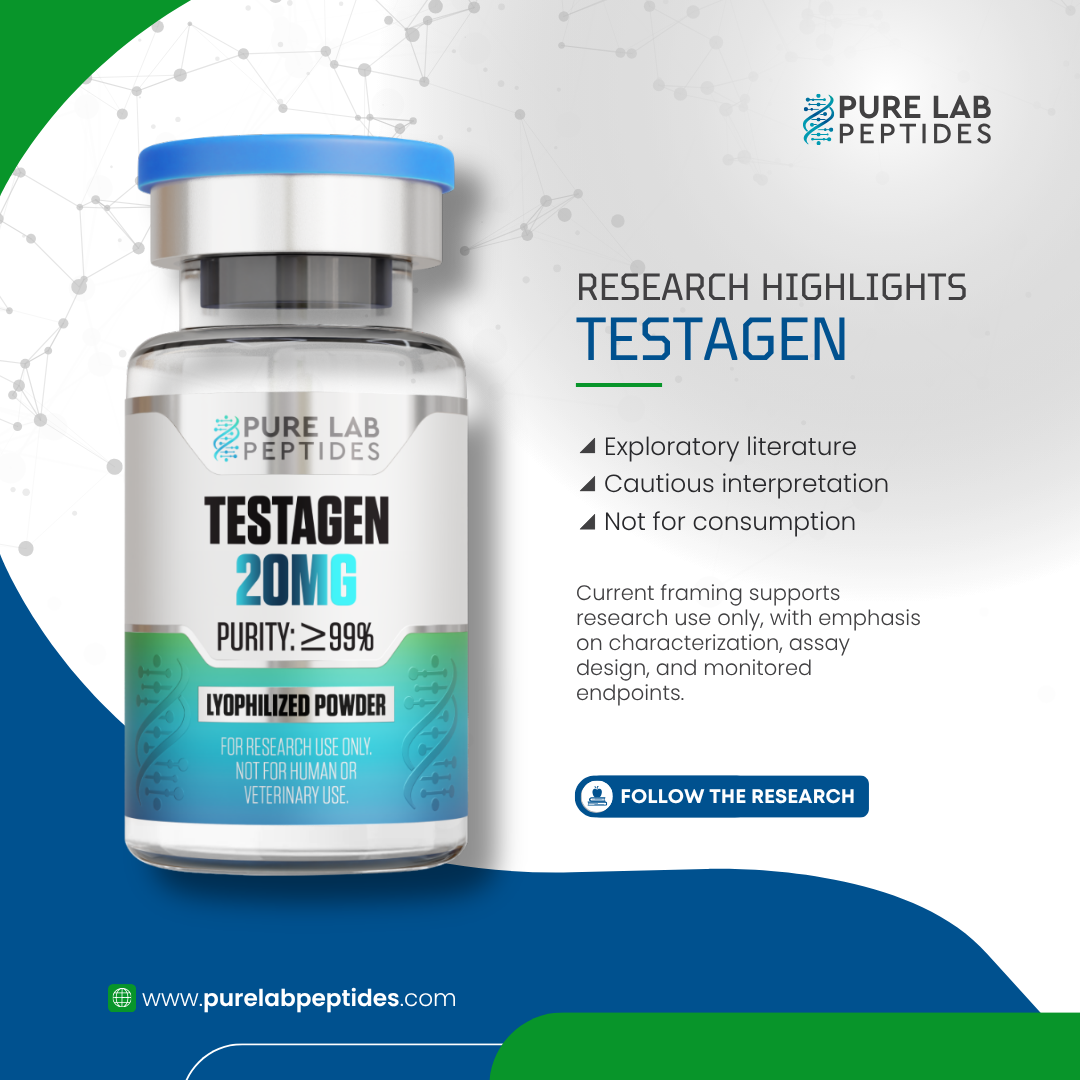
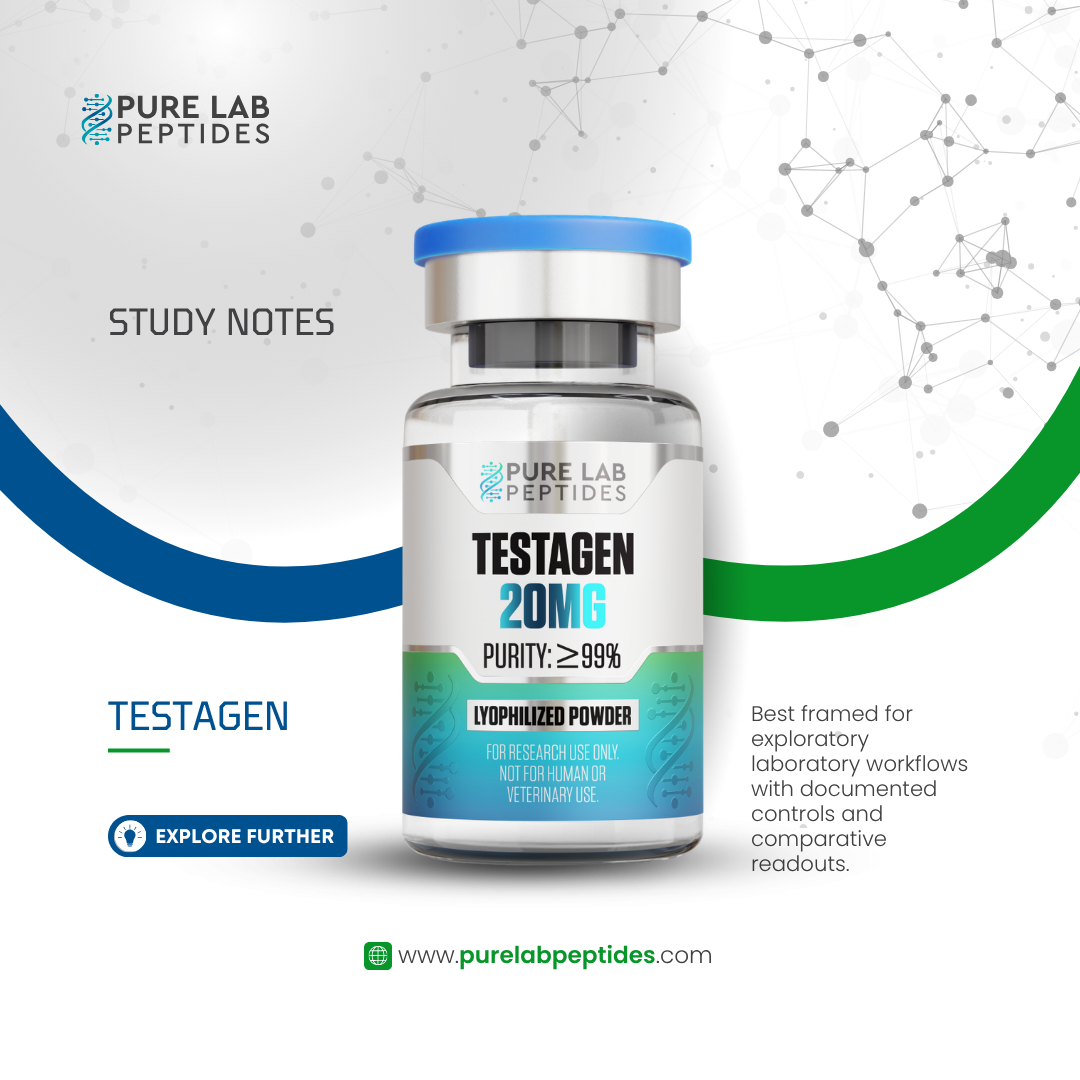
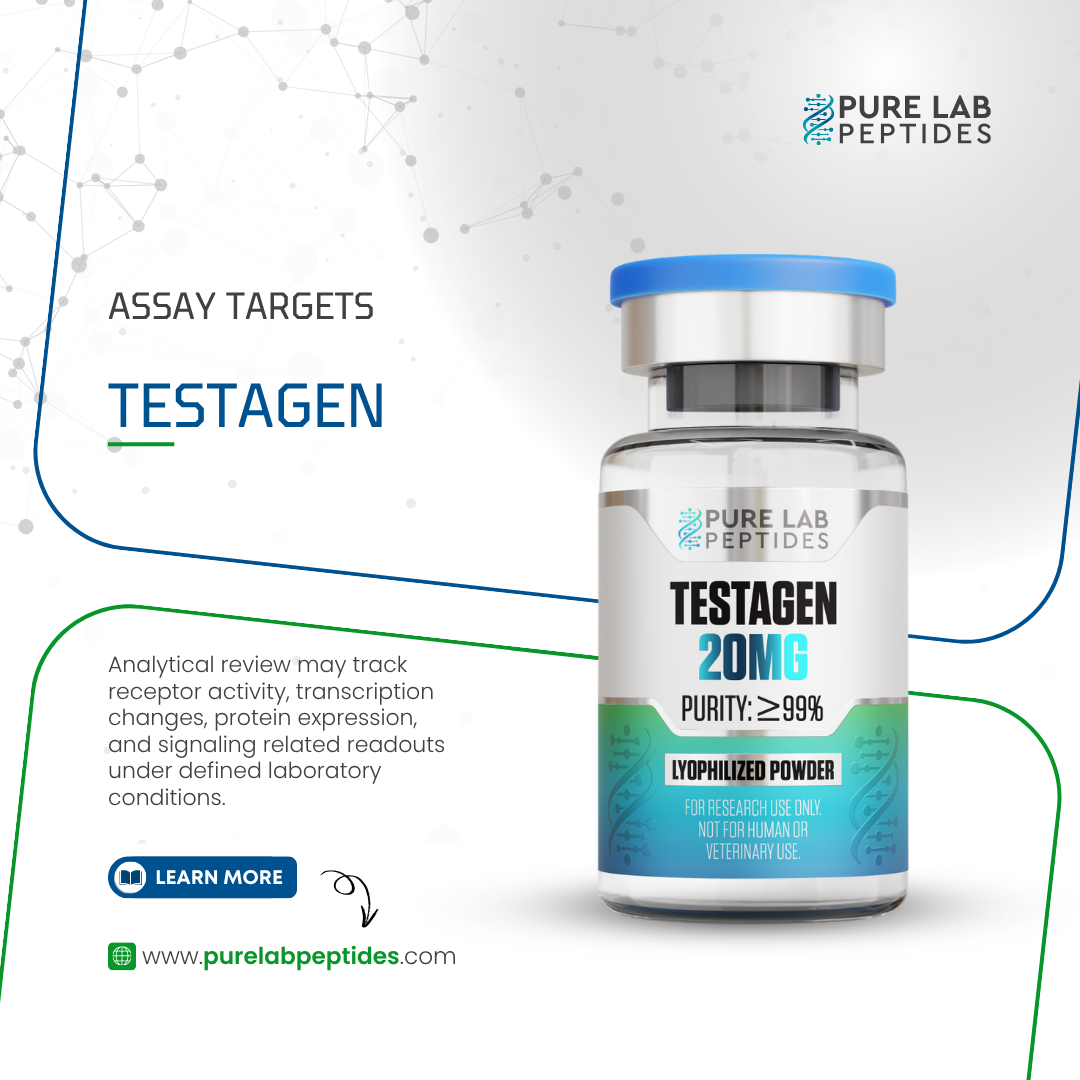
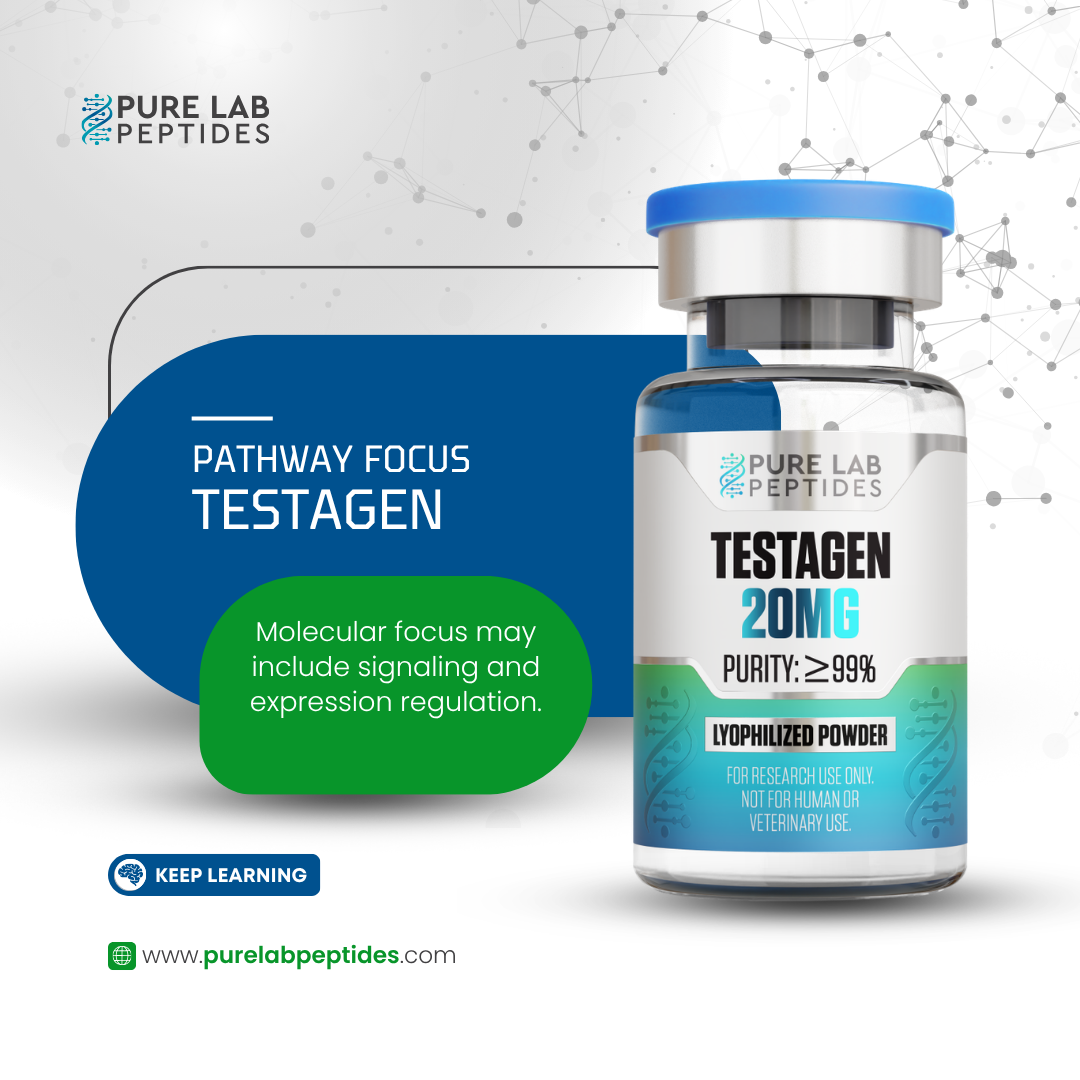
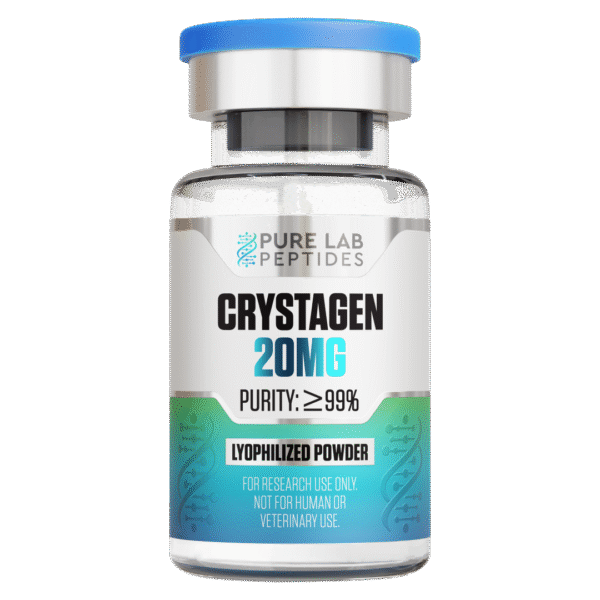
Testagen 20mg is a research-use-only laboratory material supplied for controlled research workflows, compound characterization, and analytical documentation review. It is manufactured under rigorous quality standards to support consistency, traceability, and batch-specific verification for qualified laboratory settings.
Testagen 20mg is intended strictly for laboratory research use only. This product is not intended for human or animal consumption, therapeutic use, diagnostic use, clinical use, veterinary use, or as a food, drug, cosmetic, dietary supplement, or household product.
| CAS No. | 33515-09-2 |
|---|---|
| Molecular Formula | C51H75N13O21 |
| Molecular Weight | 1206.22 g/mol |
| Purity | ≥99% |
| Sequence | Ala-Glu-Asp-Gly-Pro-Lys-Glu-Gly-Ser-Ser-Gly-Glu |
| Synthesis Method | Solid-phase synthesis |
| Format | Lyophilized powder |
| Solubility | Water/Sterile Diluent |
| Stability & Storage | Up to 24 months at -20°C. Avoid repeated freeze-thaw cycles. |
| Applications | Hormonal regulation, testosterone restoration research, endocrine function studies |
| Appearance | White to off-white powder |
| Regulatory/Compliance | Not for human consumption. For research use only. |
| Safety Information | MSDS available upon request |
Consider these supplementary peptides for a comprehensive research approach.
For research buyers evaluating where to buy Testagen for research, the priority is compound identity, batch-specific documentation, and clear research-use-only positioning. Testagen is discussed in chemical databases and literature as KEDG, a tetrapeptide sequence written as Lys-Glu-Asp-Gly or H-Lys-Glu-Asp-Gly-OH, with PubChem listing the molecular formula C17H29N5O9 and molecular weight of 447.4 g/mol [1]. This Pure Lab Peptides guide frames Testagen peptide procurement around literature interpretation, certificates of analysis, analytical testing, and lot-level records.
Researchers who want to buy Testagen for research should first compare Testagen peptide identity, KEDG sequence records, certificates of analysis, purity testing, LC-MS identity support, lot traceability, and RUO labeling. Products discussed in this article are intended for laboratory research use only and are not intended for human or animal consumption. Documentation should come before catalog selection.
Commercial search language can be useful for finding product pages, but research buyers still need a documentation-first filter. A safer interpretation of the search is not “what is the product for?” but “does the listing provide enough technical information for controlled laboratory research?”
That shift matters because Testagen is a compound name, not a product claim. The product-page task is to connect the compound to identity records, literature context, and batch-specific documentation without turning research findings into consumer-facing promises.
The first documents to review are the product label, certificate of analysis, lot number, compound name, sequence record, and analytical testing details. FDA analytical-method guidance describes validation as a way to show that an analytical procedure is fit for its intended purpose, which is why method details matter when assessing identity, purity, and quality records [21], [23].
For a research-grade Testagen peptide, a COA should not stand alone. It should align with the catalog listing, lot identifier, label text, molecular record, and available storage documentation.
The phrase buy Testagen peptide for research is safest when it means technical procurement for controlled laboratory environments. It should not be read as a personal-use buying guide, a clinical guide, or a wellness article.
RUO procurement is about documentation quality. A research buyer should ask whether the product page clearly identifies the peptide, provides lot-specific records, and avoids product claims that go beyond research documentation.
Testagen is commonly described as KEDG, a four-residue peptide with the sequence Lys-Glu-Asp-Gly [1], [2]. In the literature, it appears in the same general lane as short peptides and Khavinson peptides, a category often discussed in relation to sequence-specific research models, DNA interaction hypotheses, and gene-expression literature [4], [5].
That literature is not a product-use statement. It is a research context for how the compound has been described, characterized, and interpreted.
The most stable way to classify Testagen is by sequence and molecular identity. PubChem lists H-Lys-Glu-Asp-Gly-OH with formula C17H29N5O9 and molecular weight 447.4 g/mol [1].
In product-page documentation, this identity layer helps researchers compare the catalog listing against the COA and analytical report. Name consistency is useful, but sequence and mass records are stronger anchors than marketing language.
KEDG is the one-letter sequence shorthand for lysine, glutamic acid, aspartic acid, and glycine. A 2025 peer-reviewed study also describes Testagen known as KEDG as a tetrapeptide consisting of Lys, Glu, Asp, and Gly [2].
For procurement review, this means “Testagen,” “KEDG,” and “Lys-Glu-Asp-Gly” should point to the same research material. If those identifiers do not align across documents, the record should be reviewed before selection.
Molecular weight gives researchers a check against the expected compound identity. In mass spectrometry, accurate mass measurement helps determine the mass-to-charge ratio of biomolecules and supports identity assessment when paired with appropriate reference information [20].
A molecular weight value alone does not prove the full identity of a peptide. It is one part of a larger documentation package that should include sequence, purity method, identity method, lot number, and COA details.
A Testagen peptide listing should make the identity trail easy to follow. The expected sequence, synonym KEDG, molecular weight, and batch-specific documentation should be internally consistent [1], [2].
Structural documentation is not cosmetic. It is the basis for comparing a product-page listing with analytical data.
Lys-Glu-Asp-Gly gives the three-letter amino acid sequence for Testagen. PubChem lists the compound as H-Lys-Glu-Asp-Gly-OH, and the sequence appears in literature descriptions of KEDG [1], [2].
Sequence review should ask a simple question: do the label, catalog listing, COA, and identity testing refer to the same peptide? If the answer is unclear, the page needs stronger documentation before procurement.
A four amino acid peptide record should clarify the residue order, terminal form, formula, and expected molecular weight. The difference between a correct sequence and a similar-looking sequence can matter in peptide identity review, especially for short peptides where a small change affects the entire compound description.
Researchers should also check whether the listing uses KEDG consistently. Sequence shorthand is useful only when it is tied to the full written sequence and supporting molecular record.
Synthetic peptide synthesis commonly relies on solid-phase peptide synthesis, a field developed from Merrifield’s original solid-phase concept and refined across later peptide chemistry methods [14], [15]. Purification and characterization are central because synthetic peptides may require separation from related byproducts or incomplete sequences [18], [19].
For a product page, the key issue is not the synthesis process itself. The key issue is whether the final research material is supported by traceable purity, identity, and lot documentation.
Research applications for Testagen should be described as literature context, not as product-positioning claims. Published studies and reviews discuss short peptide models, gene-expression hypotheses, and endocrine-axis research themes, but RUO copy should keep those categories separate from product promises [4], [8].
A safe product page should explain what researchers evaluate: identity, documentation, literature boundaries, and analytical verification.
Pituitary and thyroid research context appears because the hypothalamic-pituitary-thyroid axis is a recognized endocrine framework, and Endotext describes thyroid gland activity as predominantly regulated by pituitary thyroid-stimulating hormone [28]. Some Testagen-related literature has examined KEDG in preclinical endocrine-axis models, but that evidence remains model-specific [8], [9].
For RUO positioning, the page should not translate those models into claims. It should simply explain why the compound appears in that research lane.
Short peptide literature often discusses signal molecules, cellular localization, and possible interaction with nuclear or nucleic-acid structures [3], [5]. Cell-penetrating peptide reviews also describe broader mechanisms by which certain peptides can cross cell membranes in experimental systems [12], [13].
These concepts belong in literature interpretation. They do not establish product performance for a research material.
Short peptides are often studied because small sequence changes can affect molecular interaction models. Reviews of peptide regulation describe short peptides of 2–7 residues as a category examined for interactions with nucleosomes, DNA, and gene-expression processes [4].
For Testagen, the scientific background should remain modest. The safest framing is “published literature has examined,” not “this peptide does.”
A bioregulatory peptide is generally discussed as a short peptide in research models that examine signaling, gene expression, or cellular processes. Reviews of peptide regulation describe proposed epigenetic mechanisms, including DNA methylation and histone-related models, as research hypotheses that require careful interpretation [4], [7].
This background can help researchers understand why sequence documentation matters. It should not become a claim about a product’s intended application beyond laboratory research.
Khavinson peptides are frequently discussed in the short-peptide literature around gene expression, protein synthesis, and differentiation models [4], [6]. Several papers propose that short peptides may interact with DNA or histone-related structures, but the literature also remains mechanism-focused and model-specific [5], [11].
That makes Testagen a documentation-sensitive product page. The compound should be presented through identity, analytical testing, and literature boundaries rather than outcome language.
Pathway context can help researchers locate Testagen within the right literature lane. It becomes unsafe when pathway discussion is written as a product claim.
The clean boundary is simple: describe what literature examines, then return to what the product page can document.
Gene expression appears in short-peptide research as a model-specific topic. A systematic review reports that short peptides have been studied in relation to gene expression and protein synthesis across several systems [4].
For product-page copy, that should be treated as background. It should not imply that a specific research material produces a defined biological outcome.
Molecular level discussion can cover the compound name, sequence, formula, molecular weight, and analytical identity checks. It can also describe literature categories, such as DNA-peptide interaction models and histone-related hypotheses, when they are clearly framed as research context [4], [7].
The safest wording stays close to documentation. It should not move from “studied in models” to “intended to affect a system.”
A pathway can be relevant to a research paper without becoming the purpose of a product page. That distinction protects the RUO frame.
When a product page mentions pituitary, thyroid, endocrine, cellular, or gene-expression context, the article should immediately anchor the discussion to literature interpretation. The product record itself should focus on COA review, analytical testing, and lot traceability.
Published literature gives researchers context, but it does not replace product documentation. The strongest product-page content separates compound literature from supplier evidence.
This section uses an evidence landscape to keep those layers distinct.
Published research can support neutral statements about what has been examined, reported, or characterized. It cannot support a product-use claim for a research material.
| Research Area | What Literature Examines | Evidence Type | RUO Interpretation |
|---|---|---|---|
| Compound identity | KEDG as Lys-Glu-Asp-Gly with molecular formula and molecular weight records [1], [2] | Official database and peer-reviewed literature | Supports identity review, not product claims |
| Short peptide localization | Fluorescence-labeled short peptides, including KEDG, in cell and nuclear research models [3] | In vitro literature | Supports literature context only |
| Gene expression | Short peptide literature examining gene-expression and protein-synthesis models [4], [5] | Review and mechanistic literature | Supports cautious topic coverage |
| Differentiation processes | Short peptides in differentiation-related research models [6] | Review literature | Does not create product-purpose language |
| Endocrine-axis models | KEDG in preclinical pituitary and thyroid research context [8], [9] | Preclinical literature | Model-specific, not a product claim |
| Analytical documentation | HPLC, LC-MS, and accurate mass measurement as identity and purity tools [16], [17], [20] | Analytical chemistry literature | Supports documentation review |
In vitro literature can show what a model examines, such as cellular localization or interaction with nucleic-acid structures [3]. It cannot be converted into claims for a product listing.
The correct product-page response is to keep model language narrow. Use it to explain why sequence, purity, and identity matter for laboratory research.
Claim boundaries keep a commercial research page from drifting into consumer-facing or clinical-use language. That is especially important for search phrases that can mix commercial intent with product claims.
Some search phrases, such as testagen for sale, and endpoint phrases such as testosterone, can pull copy toward outcome language when framed incorrectly. On a RUO product page, those phrases should remain separate from product positioning.
Study findings describe what researchers observed under defined model conditions. Product claims tell readers what a product is intended to do.
Those are different categories. For Testagen, the page should discuss literature as context and then return to supplier documentation, COA review, analytical verification, and RUO labeling.
Search intent can drift when a commercial phrase is paired with product-performance language. A phrase like buy Testagen for research is safer because it ties procurement to research context rather than consumer outcomes.
The page should not answer consumer-intent questions. It should answer documentation questions: what is the compound, what do the records show, and how can a lab team evaluate the listing?
Product-page copy should keep literature context separate from product positioning. It should also keep research applications separate from outcome claims.
A safer product page emphasizes the COA, purity method, identity method, lot number, catalog description, and RUO label. That is where commercial research intent belongs.
Certificates of analysis help connect a product listing to batch-specific testing records. For peptide procurement, a COA should support the same compound identity that appears on the label and product page.
The COA is not a guarantee of every possible quality attribute. It is one documented piece of the review process.
Researchers should compare these COA fields before catalog selection:
ICH Q2(R2) frames analytical validation around the intended purpose of a procedure, while FDA analytical-procedure guidance emphasizes documentation for identity, quality, purity, and potency in regulated contexts [21], [23].
Batch-specific documentation helps prevent a generic COA from being mistaken for the record of a specific lot. ISO/IEC 17025 describes testing and calibration competence as a basis for confidence in laboratory results, which is relevant when research buyers evaluate third-party or laboratory-generated data [26].
For Testagen, batch specificity means the lot number, COA, label, and catalog record should agree. If a product amount such as 20mg appears on a listing, treat it as a catalog specification rather than a research claim.
Assay purity belongs in supplier review because peptide synthesis and purification can leave related species that require analytical separation and characterization [18], [19]. HPLC is widely used for peptide analysis and purification because it can separate peptide components under defined chromatographic conditions [16].
A purity number should be read with method context. Researchers should look for the method, chromatogram support, lot match, and identity confirmation.
Analytical testing gives research buyers a way to compare the stated compound identity with supporting laboratory data. HPLC and LC-MS are complementary tools, not interchangeable proof points.
HPLC is commonly used to review peptide purity, while LC-MS can add molecular identity information through mass-based analysis [16], [17].
HPLC supports peptide purity review by separating components in a sample and generating chromatographic information. Peptide HPLC literature describes multiple modes, including reversed-phase, size-exclusion, and ion-exchange approaches [16].
For a COA, the practical question is whether the purity result is tied to the correct lot and method. A reported percentage is stronger when paired with a clear chromatogram and batch identifier.
LC-MS supports molecular identity confirmation by pairing liquid chromatography with mass spectrometry. Short homologous peptide research shows why retention-time information and mass data can matter when small peptides have similar compositions [17].
A useful documentation workflow is:
Chromatogram details can show retention behavior, peak patterns, and whether the purity claim is supported by a visible analytical trace. HPLC peptide literature places chromatographic separation at the center of peptide analysis and purification [16].
Mass data add a different layer. Accurate mass measurement supports molecular identity review when compared with the expected mass and interpreted with proper method context [20].
Lot traceability connects the product listing to the actual research material record. Without that connection, a COA can become generic rather than batch-specific.
For research procurement, traceability is a practical quality filter. It helps lab teams preserve a clear chain between catalog selection, documentation review, and laboratory recordkeeping.
Lot numbers matter because they tie a material to a batch record. USP reference-standard resources show how lot-level information is central to reference standard identification and status review [27].
For Testagen research procurement, the same logic applies at the documentation level. The product page, label, COA, and analytical report should all point to the same lot.
The COA, purity record, identity method, chromatogram, mass data, label image, and storage documentation should stay batch specific whenever possible. ISO/IEC 17025 also supports the broader idea that valid laboratory results depend on competent processes and documentation [26].
Batch-specific records help research teams compare documentation without relying on broad claims. They also make the procurement file easier to audit internally.
Storage and handling documentation should be treated as part of the product record. If Testagen is supplied as a lyophilized research material, the page should preserve storage notes in a laboratory documentation context.
Freeze-drying is widely used in pharmaceutical and bioproduct settings to improve stability of sensitive materials by removing water under controlled process conditions [30].
Freeze drying, also called lyophilization, is a solid-state preservation process that can support stability documentation when paired with appropriate storage conditions [30]. For a product page, the point is not to provide preparation guidance.
The point is documentation. Researchers should preserve the supplier’s storage record, lot details, and COA in the same procurement file.
Researchers should preserve the storage condition, date received, lot number, label text, COA date, and any supplier documentation tied to the catalog listing. Those records help maintain consistency across procurement, inventory, and later laboratory review.
Storage notes should stay neutral. They should not become practical product-use instructions.
A research procurement checklist helps translate commercial intent into documentation review. It also gives product-page readers a clear way to evaluate whether a listing is research-ready.
For Testagen, the checklist should focus on identity, purity, lot traceability, RUO language, and supplier documentation.
Research buyers should compare:
This checklist is practical, but it is not a substitute for institutional review, regulatory review, or laboratory quality processes.
Quality peptides are evaluated by the strength and consistency of their documentation. In a research procurement context, quality evidence is stronger when the same lot number appears across the label, COA, analytical records, and supplier documentation.
For Testagen, the highest-value documents are identity records, sequence documentation, purity testing, LC-MS support, storage notes, and RUO labeling. This documentation matrix is more useful than general marketing language.
Before catalog selection, research teams should run a final documentation review. The review should ask whether the product listing, label, COA, and analytical data tell the same story.
This is also the right place to resolve common misunderstandings.
A peptide catalog listing should include the compound name, synonym if relevant, sequence, molecular weight, catalog specification, RUO positioning, COA availability, lot-specific documentation, and storage notes. For Testagen, the listing should connect Testagen, KEDG, and Lys-Glu-Asp-Gly clearly [1], [2].
Common misunderstandings to resolve before selection:
Pure Lab Peptides product documentation should help research teams evaluate Testagen as a research material through label clarity, COA availability, analytical testing context, and lot-level records. The purpose is to support laboratory research procurement, not consumer positioning.
“Pure Lab Peptides supplies compounds for laboratory research use only. Products are not intended for human or animal consumption, diagnostic use, therapeutic use, clinical use, veterinary use, or as food, drugs, cosmetics, dietary supplements, or household products. Researchers are responsible for ensuring lawful, appropriate handling and use in accordance with applicable regulations and institutional guidelines.”
Review the product-page documentation, COA details, and RUO labeling before evaluating this compound for laboratory research.
Researchers should consider buy Testagen for research intent through documentation, not product-purpose language. A research-focused review should compare RUO labeling, COA availability, lot traceability, peptide identity, analytical testing, and supplier documentation. The strongest product-page review keeps commercial procurement tied to laboratory records, not consumer claims or clinical-use positioning.
Compound characterization helps confirm that Testagen is being evaluated as the correct research material. Researchers can compare the compound name, KEDG identifier, sequence record, molecular weight, and analytical documentation before catalog selection. This review supports research documentation by keeping identity, purity, and lot-level records aligned across product-page materials.
Researchers should interpret receptor signaling or cell signaling language as literature context, not product positioning. For Testagen, signaling-related terms may help organize research questions, receptor research themes, or pathway models. They should remain separate from claims about what a research material is intended to accomplish outside controlled laboratory research.
Preclinical literature requires careful framing because it describes model-specific research findings rather than product-page claims. Testagen-related literature may help researchers understand study categories, pathway context, or experimental design questions. RUO product pages should keep those findings separate from procurement language and focus on COA review, analytical testing, and lot traceability.
Receptor pathway research fits into Testagen product-page review as scientific background only. It can help research teams understand how a compound appears in pathway-focused literature, but it should not define product purpose. Product-page review should return to peptide identity, batch-specific documentation, analytical testing, and RUO labeling.
Verification and validation mean research teams check whether documentation is consistent and fit for review. For Testagen, that includes matching the catalog listing, COA, lot number, sequence record, assay purity data, and identity testing. These checks support research documentation and help keep supplier evaluation focused on evidence quality.
The following authors are recognized for published research that helped shape the scientific context discussed in this article.
Author profile: ORCID
Vladimir Khatskelevich Khavinson is a published research author whose work on short peptides helped inform the broader scientific background for Testagen and Bioregulator Peptide Research. His publications are relevant to the article’s discussion of sequence-specific peptide research, gene expression, cell differentiation, and literature interpretation for short peptide compounds. This body of work provides context for how small peptide sequences are discussed in published literature while keeping product-page language focused on research documentation and compound identity.
Selected publications:
Author profile: University of Colorado Anschutz Medical Campus Profile
Robert S. Hodges is a research author whose publications are relevant to peptide analytical characterization, HPLC method context, and laboratory evaluation of peptide materials. His work helps support the article’s documentation-focused discussion of analytical testing, peptide identity, chromatographic review, and mass spectrometry as part of research-material assessment. These publications are especially useful for understanding how laboratories approach peptide separation, identity review, and method-based documentation in research settings.
Selected publications:
This research disclaimer clarifies how this page handles published literature and search language around Testagen. In Bioregulator Peptide Research content, phrases such as peptide for sale, hormonal, influence testosterone levels, efficacy, immune system, inflammation, and clinical outcomes can drift into consumer-facing or product-claim language when separated from model-specific research context.
Here, those phrases are handled only as research-language examples, not product uses, outcomes, instructions, or recommendations. Terms such as wellness language, consumer outcomes, product effects, absorption, and bioavailability also require careful separation from product positioning. The focus remains on Testagen identity, COA review, analytical testing, peptide purity, lot traceability, RUO labeling, product documentation, and published literature boundaries.
Our team is ready to assist you with any inquiries regarding our catalogue of peptides and their applications.
Discount Applied Successfully!
Your savings have been added to the cart.
Pure Lab Peptides
You must be at least 21 years of age to enter this site. By entering, you confirm that you are of legal age and agree to our terms.
For research use only.



There are no reviews yet.